








Your first electric guitar should suit the music you want to play, feel comfortable in your hands and work with the equipment you will actually use. An electric guitar set can bring several essentials together, but the guitar is only one part of the purchase. You also need a way to hear it.
This electric guitar buying guide explains how pickups, body construction, neck feel and bridge design affect that choice. It also separates conventional electrics from acoustic-electric instruments, then walks through the listening equipment and playing checks that belong in your budget.
Choose by Sound, Feel and Setup
- Start with Your Music and Listening Setup
- Separate Body Construction from Pickup Type
- Choose the Pickup Sounds You Want
- Compare Neck Feel, Scale and Playing Position
- Choose a Bridge You Can Maintain
- Check the Complete Setup Before Paying
- Price the Complete Playing Setup
- Try These Checks Before You Commit
Start with Your Music and Listening Setup
Pick two songs you would like to learn. Listen for the guitar part rather than the whole recording: is it a clear, ringing chord pattern, a thick distorted riff or an amplified acoustic sound? These examples give you something useful to compare when you try different guitars. You do not need to identify every effect on the recording.
Next, decide where you will practice. Playing through a speaker in a room calls for a suitable amplifier. Quiet practice needs a wired headphone path, either built into the instrument or provided by another device. A computer setup needs an appropriate interface and monitoring arrangement, not just a cable that fits the computer.
Set the budget for that complete arrangement. Keep room for the cable, tuning, a strap or other support, and protection for the instrument. Spending the entire amount on the guitar leaves the most practical question unanswered: how will you hear it tonight?
Separate Body Construction from Pickup Type
Body construction describes how the instrument is built. Pickup type describes how its sound becomes an electrical signal. Treating them as separate choices makes the options easier to understand.
| Design | What to compare as a beginner |
|---|---|
| Solid-body electric | A magnetic-pickup instrument without a large hollow sound chamber. Compare its pickups, playing position and amplified sound. |
| Semi-hollow or hollow-body electric | A magnetic-pickup electric with hollow space in the body. Try the body size and listen through the intended amplifier rather than choosing by appearance alone. |
| Acoustic-electric | An acoustic-oriented instrument with a pickup and, where specified, a preamp. Match its output to a suitable listening system. |
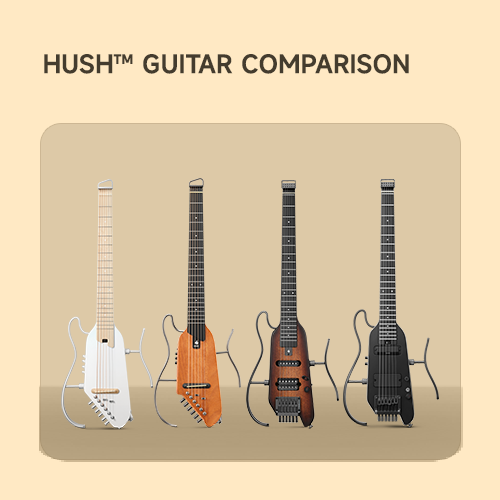
| Minimal-body electroacoustic travel guitar | An acoustic-oriented amplified design with a reduced body. Do not expect the unplugged volume of a full acoustic body. |
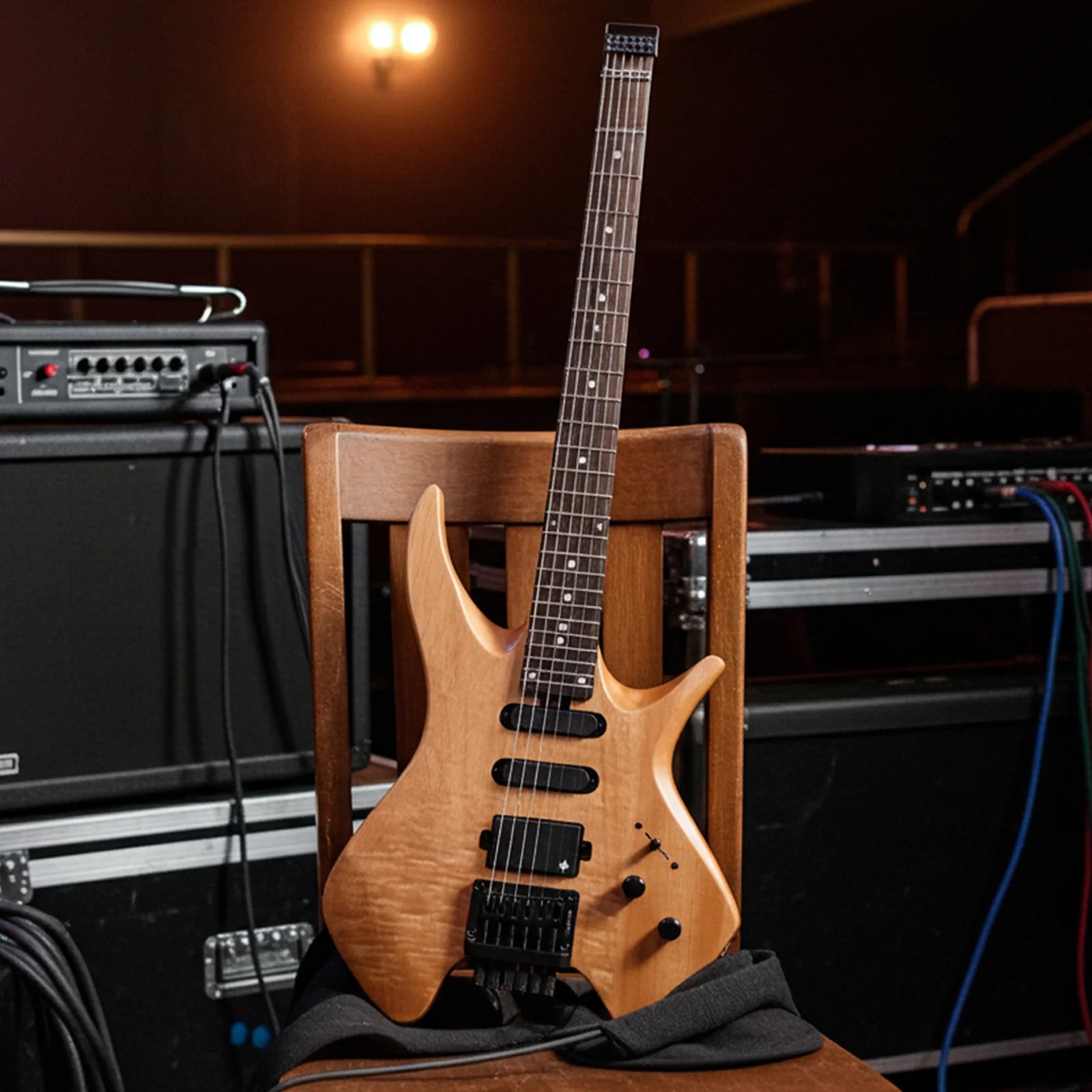
A headless guitar is another distinction altogether. Its tuning hardware sits away from the usual headstock position; that label does not tell you whether it uses magnetic pickups or an acoustic-oriented system. For the same reason, a compact outline does not identify its sound family.
Choose the Pickup Sounds You Want
On a magnetic-pickup electric guitar, start by listening to single coils and humbuckers. A single coil is a useful reference for a clear, bright sound. A humbucker combines two coils to reduce pickup hum and commonly gives a fuller starting sound. Neither confines you to one genre. The amplifier settings and the way you play still matter.
For a clean comparison, play the same slow chord pattern through each pickup position without distortion. Listen for how clearly the notes separate and how much the sound changes from neck to bridge. Then try a short riff with some drive. Compare the attack and thickness without changing everything on the amplifier between guitars.
| Layout | What the letters mean | A useful comparison |
|---|---|---|
| SSS | Three single-coil pickups | Listen across the selector positions for the clean and driven sounds you would use. |
| HSS | A humbucker and two single coils | Compare the humbucker sound with the single-coil positions on the same instrument. |
| HS | One humbucker and one single coil | Check whether the available positions cover the contrast you want. |
These letters identify the pickup types, not every switching option. A coil-split function uses one coil of a humbucker for another sound; it does not promise the identical tone of a separate single-coil pickup. Hum cancellation also does not make the whole signal chain silent. Listen to the actual instrument at the gain setting you plan to use.
Donner DST-80 Single-Coil Starting Point

Pros
- Five pickup positions for comparing single-coil sounds
- One volume and two tone controls for direct sound adjustments
Cons
- Requires an external listening device; headphone use depends on that device
The Donner DST-80 electric guitar set offers a conventional way to explore single-coil sounds. Its three ceramic single coils and five-way selector give you several pickup positions to compare, while one volume and two tone controls let you hear how the controls shape a familiar chord or riff.
It pairs a 25.5-inch scale with a C-profile neck and synchronized tremolo bridge. Try that reach and neck shape rather than assuming a traditional outline will fit everyone. Its 6.35 mm output connects to an external listening device; a bundled amplifier is separate from the guitar, so headphone practice depends on the capabilities of that device.
Compare Neck Feel, Scale and Playing Position
Hold the guitar seated, then try it standing with a strap. Let your shoulders settle before playing. The instrument should stay in a usable position without making your fretting hand carry its weight. Reach the first few frets and then move higher up the neck; notice where your wrist or forearm starts working around the body.
Neck profile is the shape you hold. A C-profile label gives a broad description, but it cannot tell you how the neck will feel in your particular hand. Form a simple chord, release it and form it again. You are comparing a repeatable grip, not testing whether you can already play a difficult song.
Scale length is the vibrating string length, not the overall size of the guitar. A small travel body can still have a familiar full-length playing area. Compare the reach between frets and the feel of the strings together; a compact guitar is not automatically a shorter-scale choice.
Handedness and setup belong in this comparison too. Choose the intended playing orientation, and ask about adjustment if the strings feel unnecessarily hard to press or buzz persistently. Decorative wood names tell you less about the immediate playing experience than a neck you can hold and notes you can fret comfortably.
Choose a Bridge You Can Maintain
A fixed bridge gives you fewer moving parts to manage when learning to tune and change strings. That makes it a straightforward starting choice if tremolo effects are not part of the sound you want.
A tremolo bridge lets you change pitch with an arm. The moving system also adds setup variables, especially when you change string gauge or use the arm frequently. If you want that feature, include tuning after tremolo use in your trial rather than treating the arm as a free extra.
Headless tuning relocates the hardware; it does not remove the need to learn the instrument’s tuning and string-changing procedure. Pick a system you are willing to maintain. No bridge label by itself guarantees tuning stability.
Check the Complete Setup Before Paying
Trace the connection from the guitar to your ears before placing the order. Begin with the instrument’s output, identify the cable it needs, and name the device that will drive the speaker or headphones. This catches gaps that a long accessory list can hide.
- For a conventional electric: guitar output, instrument cable, suitable amplifier or other listening device, then speaker or supported headphone output.
- For an acoustic-electric: the specified pickup/preamp output, a suitable cable and a compatible amplification or monitoring device.
- For a computer arrangement: the supported guitar-to-interface connection and a working monitoring path.
- For any kit: the exact included amplifier, cable, tuner, strap and protective items, plus anything you still need to add.
A guitar jack and a headphone jack serve different jobs. An amplifier in the box is not headphone amplification inside the instrument. USB may serve different functions from model to model, and Bluetooth may receive backing tracks rather than send your playing to wireless headphones. Choose the arrangement by its supported audio functions, not the connector names.
Donner HUSH-X-PRO Integrated Electric Monitoring

Pros
- Onboard 3.5 mm output for wired headphones
- Magnetic pickup choices with built-in modeling and effects
Cons
- Powered headphone and electronic functions require battery charge
The Donner HUSH-X-PRO electric guitar puts wired headphone monitoring inside a compact magnetic-pickup instrument. It combines a neck single coil, bridge humbucker and three-way toggle with onboard modeling and effects. You can compare those electric sounds without making a separate headphone device the center of the setup.
A 3.5 mm headphone output provides the wired listening route, while a 6.35 mm instrument output connects to external equipment. The rechargeable battery powers the electronic functions, so charging becomes part of preparation. True bypass permits ordinary electric-guitar operation without power, but that is distinct from powered headphone monitoring. Bluetooth receives backing-track audio; it is not wireless headphone output.
Price the Complete Playing Setup
Compare complete setups at the checkout stage, even if you began by comparing guitars. A lower instrument price can leave more equipment to buy; a package can include accessories you need without necessarily including your preferred listening route.
| Purchase path | What belongs in the total | The decision it answers |
|---|---|---|
| Magnetic-pickup electric with external monitoring | Guitar, instrument cable, suitable amp or listening device, headphones where supported, tuning, support and protection | Can you play at the volume and in the place you have chosen? |
| Acoustic-electric with its specified output path | Instrument, any required preamp power, suitable cable and compatible monitoring equipment, plus support and protection | Does the complete arrangement deliver the acoustic-oriented amplified sound you want? |
| Electric with onboard headphone functions | Instrument, wired headphones and charging needs, plus tuning, support and protection | Would integrated listening be useful enough to accept the powered functions? |
List the selected kit’s contents next to that total, item by item. Count an accessory only once, and add the essentials the kit does not contain. This is a more useful spending limit than a universal minimum guitar price: it tells you what the purchase will let you do on the first day.
Try These Checks Before You Commit
Use a short, repeatable trial rather than asking a more experienced player to demonstrate everything at speed. A few notes and chords can tell you more about your purchase when you keep the conditions consistent.
- Tune the guitar, then play a familiar chord or a few notes with a clean amplifier sound. Keep the same settings while comparing instruments.
- Move through every pickup position and turn the volume and tone controls. Listen for the expected changes and for intermittent output or other faults.
- Repeat notes across the usable neck. If buzzing persists or a note will not sound properly, ask for an adjustment or inspection before committing.
- Try the instrument seated and standing. Recheck your reach and grip instead of accepting a playing position that hurts.
- Test the listening route you will use at home, including wired headphones or interface monitoring. Confirm it works with the equipment included in your total.
If a setup needs attention, make the purchase decision after the adjustment and another trial. You are looking for a guitar you can play and hear comfortably, not a promise that a fault will stop mattering once you improve.
Questions Before You Buy
Do I Need to Learn Acoustic Guitar First?
No. Start on an electric guitar if that suits the music you want to play and you have a workable listening setup. An acoustic guitar is not a prerequisite. The useful first step is choosing an instrument you can hold comfortably and practice on regularly.
Can I Reverse the Strings for Left-Handed Playing?
Do not assume that reversing the strings will convert any guitar correctly. Nut slots, bridge compensation, control placement and body shape can make that unsuitable. Choose a guitar built for your intended orientation, or get model-specific technical advice before buying an instrument you plan to convert.
Choose the Guitar and the Way You Will Hear It
Bring your choice back to two questions: can you comfortably play the parts you want to learn, and can you hear them through the setup you are buying? For magnetic-pickup electric sounds, compare the pickup positions through your intended listening device. For an acoustic-electric, match the acoustic-oriented output to suitable monitoring. The right purchase includes both the instrument that fits and the connections that make it usable.