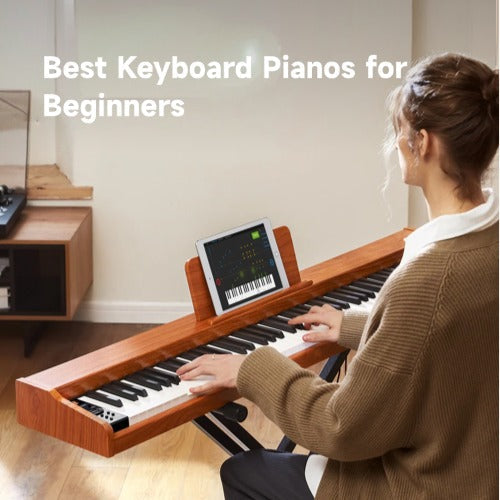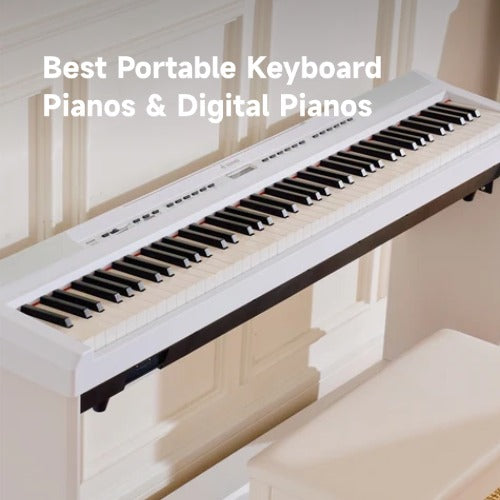






You searched for the best keyboard piano to learn piano — not the best cheap keyboard, not the best toy for a kid who might quit in two weeks. You want to actually learn to play. That changes what matters.
A real piano has 88 weighted keys that push back against your fingers. That resistance builds the muscle memory and finger independence every pianist needs. If you learn on an unweighted 61-key keyboard, you will hit a ceiling fast — your fingers will not have the strength to transition to an acoustic piano, and your hands will not know where to go once the piece moves beyond the middle of the keyboard.
This guide recommends keyboard pianos and digital pianos that give you the tools to build real piano skills. We prioritized instruments with weighted or semi-weighted key actions, 88 keys when the budget allows, and features that support structured learning: app connectivity, lesson modes, and headphone-friendly practice.
On this page:
- Donner DDP-80 — Best Furniture-Style Piano for a Dedicated Practice Space
- Roland FP-10 — Best Weighted Action for Serious Learners
- Yamaha P-145 — Best Brand-Name Digital Piano for Learning
- Donner DEP-20 — Best Value Weighted Piano with Full Furniture Kit
- Donner DEP-1S — Best Bluetooth-Enabled Keyboard for App-Guided Learning
- Donner DP-10 — Best Foldable Keyboard for Practice Anywhere
- Alesis Recital — Best Budget 88-Key for First Lessons
- Yamaha PSR-E383 — Best 61-Key Portable for Young Learners
- How We Selected These Instruments
- Buying Guide — What to Look for in a Keyboard for Learning Piano
- Frequently Asked Questions
- Find the Keyboard That Matches Your Learning Goal
Donner DDP-80
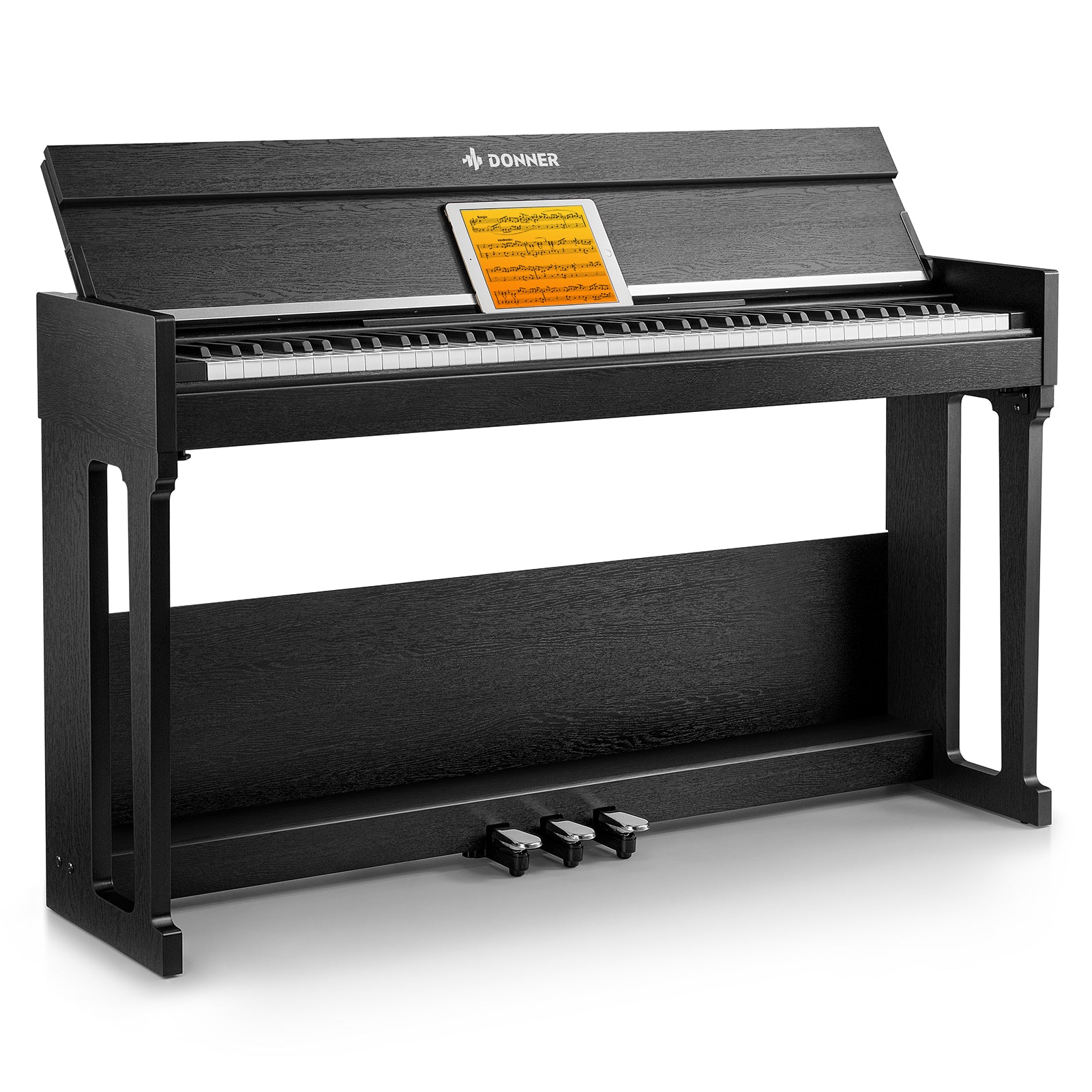
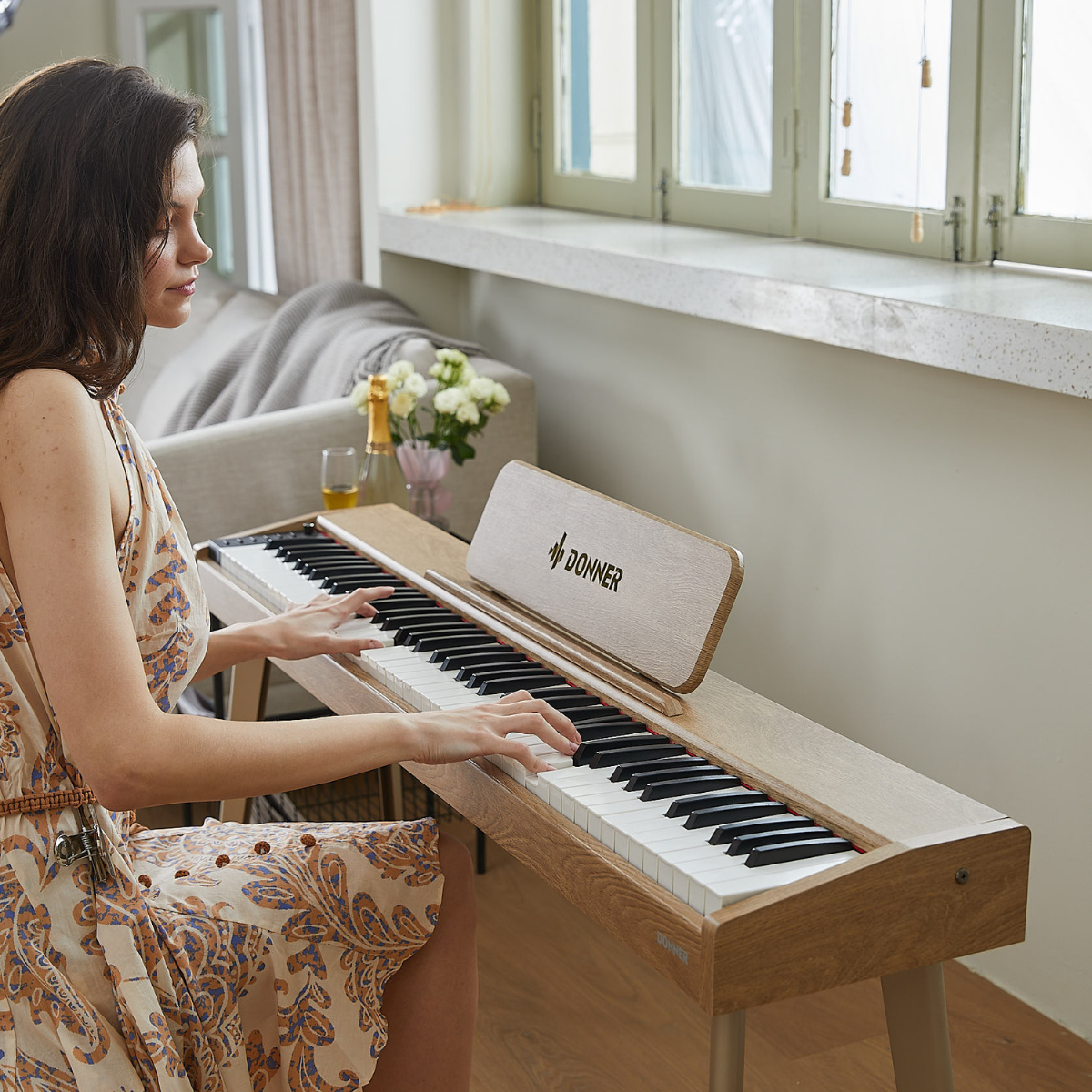
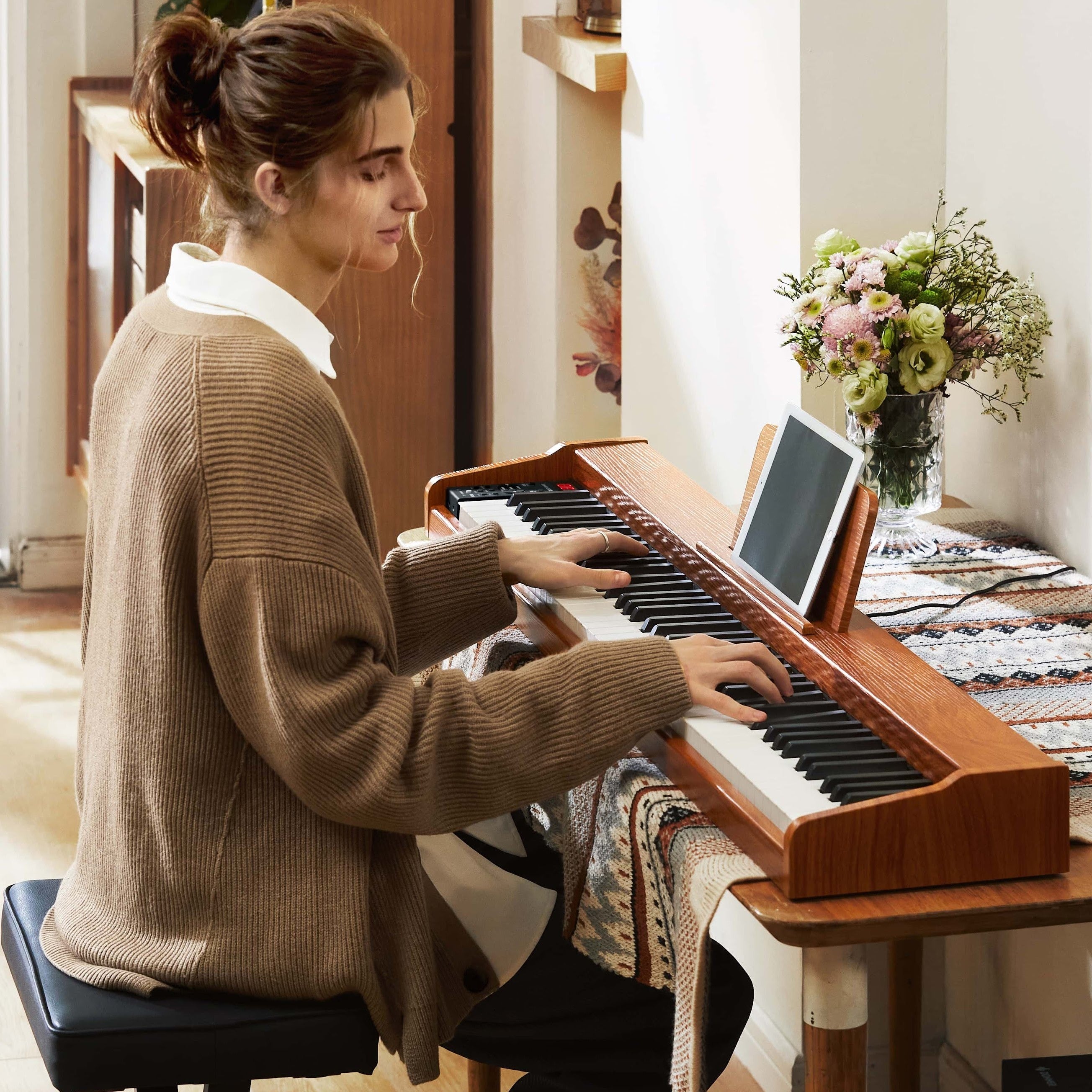
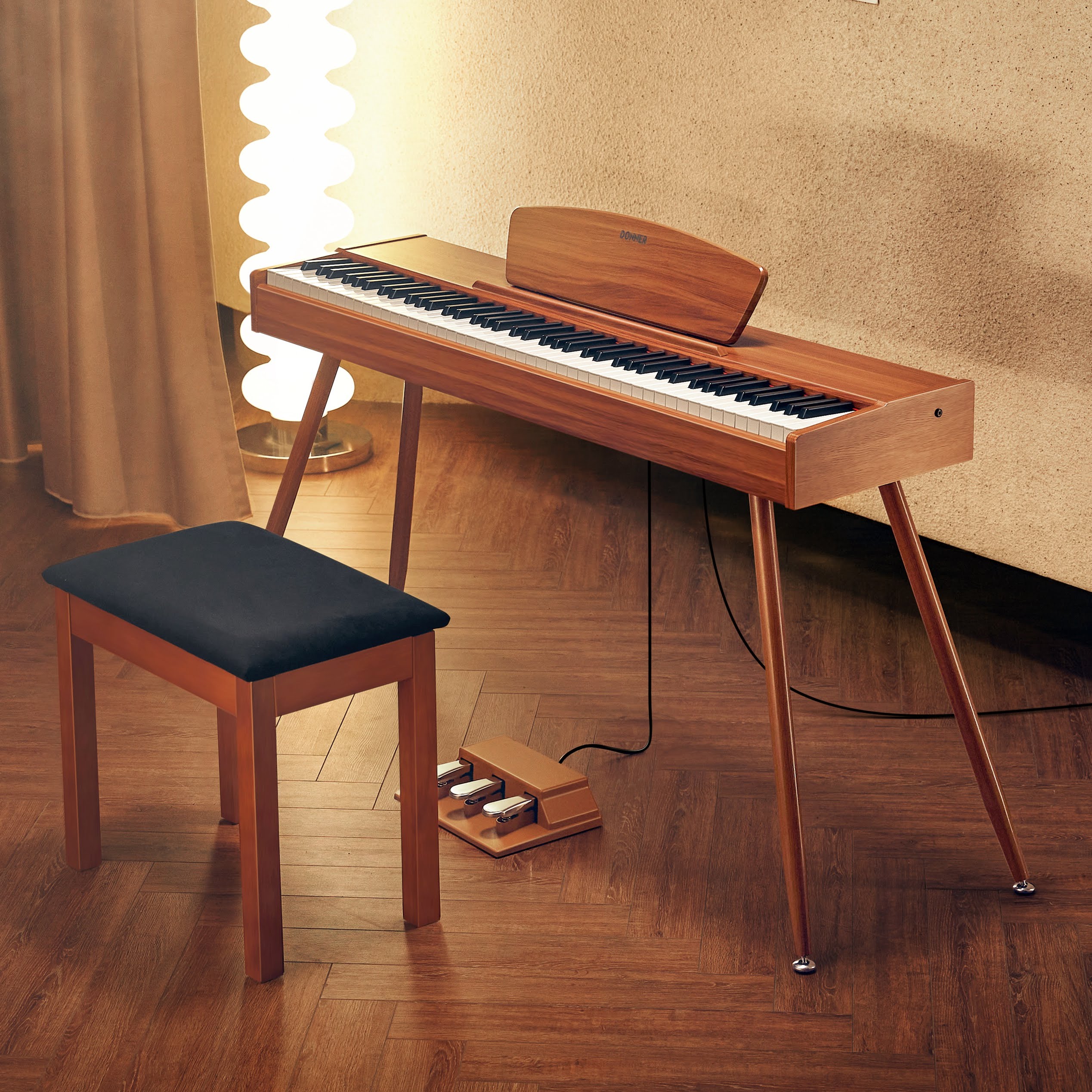
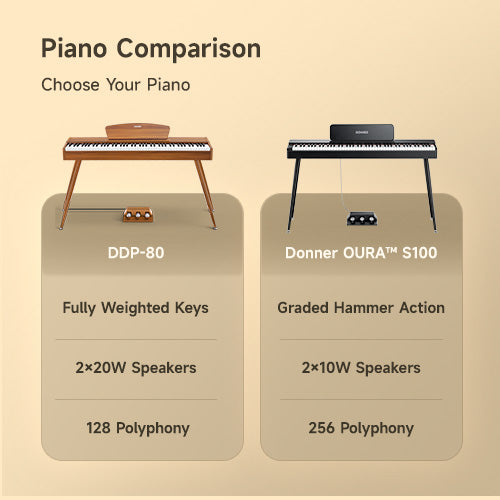
The Donner DDP-80 digital piano is the instrument you buy when you want a dedicated practice space, not a keyboard on an X-stand in the corner. Its furniture-style cabinet with matching bench makes practicing feel like sitting down at a real instrument — and for a learner, that ritual matters.
The DDP-80 has 88 fully weighted keys and 128-note polyphony, with a minimal control surface that keeps the focus on playing. There are no screens, no hundreds of buttons, no accompaniment rhythms — just piano, electric piano, and a handful of essential voices. The cabinet is compact enough for an apartment but substantial enough to feel permanent. A matching bench is included.
Pros:
- Furniture cabinet design creates a dedicated practice environment
- 88 fully weighted keys
- Matching bench included
- Compact footprint fits apartments and small rooms
- Minimalist interface keeps focus on playing
Cons:
- Limited to 2 x 20W speakers — adequate for a small room
- Only one headphone jack
- No Bluetooth connectivity
- Limited sound selection compared to portable keyboards
See the Donner DDP-80 digital piano →

Roland FP-10
The Roland FP-10 is the instrument Google's AI overview recommends first — and for good reason. Its PHA-4 Standard keyboard action is the same mechanism Roland puts in models costing twice as much. For a learner who is serious about classical piano, it provides the most realistic key feel under $600.
The FP-10 uses Roland's SuperNATURAL sound engine, which models piano tone in real time instead of playing back static samples. Play a note softly and it sounds warm and round; dig in and it cuts through with clarity. This dynamic response teaches your ears to connect touch with tone — a fundamental skill for expressive playing. The 88 PHA-4 keys have an ivory-feel texture and escapement, a subtle click at the bottom of the key travel that mimics an acoustic grand's mechanism. Bluetooth MIDI connects wirelessly to learning apps like Simply Piano and Flowkey.
Pros:
- PHA-4 hammer action — best key feel under \$1,000
- SuperNATURAL piano modeling responds to subtle touch differences
- Bluetooth MIDI for wireless app connection
- Roland build quality with three-year warranty
- Headphone output with spatial 3D ambience effect
Cons:
- 12W total speaker output is quiet — headphones or external monitors recommended
- No line outputs for connecting to a PA system
- Single sustain pedal included; triple pedal unit sold separately
- No built-in rhythms or accompaniment for casual playing

Yamaha P-145
The Yamaha P-145 is Yamaha's entry-level answer to the FP-10. It uses Yamaha's Graded Hammer Compact (GHC) action, a newer, lighter hammer mechanism that still provides authentic weighted resistance. For a learner who wants the Yamaha brand and tone without the heavier key feel of the Roland, this is the pick.
The P-145's CFIIIS concert grand piano sample is warm, clear, and immediately recognizable — the same sound engine Yamaha uses across their digital piano line. Bluetooth audio streams backing tracks through the built-in speakers for play-along practice. The GHC action is graded: heavier in the bass register, lighter in the treble, matching the weight curve of a real acoustic piano.
Pros:
- Yamaha CFIIIS grand piano sample — excellent onboard tone
- GHC weighted action, lighter than Roland PHA-4, good for younger players
- Bluetooth audio for play-along practice
- Compact, lightweight slab design
Cons:
- GHC action is lighter than Roland's PHA-4 — less authentic for classical training
- No Bluetooth MIDI (audio only)
- Basic sustain pedal included; triple pedal sold separately
- 14W speakers — adequate but not powerful
Donner DEP-20
The Donner DEP-20 digital piano is the most-reviewed Donner piano on Amazon — over 1,200 ratings averaging 4.5 stars. It is best for the learner who wants a complete weighted piano setup with stand and pedals included, and is willing to trade tonal refinement for exceptional value-per-dollar.
At a price where Roland and Yamaha sell portable slabs alone, the DEP-20 comes bundled with a wooden furniture stand and triple-pedal unit. The graded hammer action is heavier in the bass and lighter in the treble, giving learners a realistic resistance curve. With 238 tones, 200 accompaniment rhythms, and 128-note polyphony, it covers more ground than competitors at this price. Split mode divides the keyboard into two identical zones — helpful for teacher-student work where both sit at the same instrument.
Pros:
- Wooden stand and triple pedal included — no separate accessory purchases
- Graded hammer action builds proper finger strength
- Dual headphone jacks for silent duet practice
- USB MIDI for connecting to learning apps and DAWs
- 50W dual speakers — among the loudest in class
Cons:
- Main grand piano tone is functional for practice, not inspiring for recording
- No Bluetooth audio or MIDI — wired connections only
- Key action is on the heavier side and may fatigue young beginners
- Included music rest is lightweight plastic
See the Donner DEP-20 digital piano →

Donner DEP-1S
The Donner DEP-1S keyboard piano is the learning keyboard with the most connectivity under $300. It has 88 semi-weighted velocity-sensitive keys, Bluetooth audio and MIDI, and a rechargeable battery — it is best for the learner who wants to use apps like Simply Piano and Flowkey without being tethered to a desk by USB cables.
The DEP-1S is an upgraded version of Donner's DEP-1, adding Bluetooth streaming and MIDI support while keeping the full 88-key layout. Semi-weighted keys add spring resistance that unweighted keyboards lack — enough to build basic finger strength while staying light enough for extended practice sessions. With 128 sounds and 100 accompaniment rhythms, it offers enough variety to explore different styles. The rechargeable battery runs for hours, so you can practice on the couch, at the kitchen table, or anywhere a power outlet is inconvenient.
Pros:
- Bluetooth audio and MIDI for wireless app connectivity
- 88 velocity-sensitive keys in a lightweight slab design
- Rechargeable battery for cord-free practice
- 4.5-star average from 80 Amazon reviews
- 128 sounds and 100 rhythms for genre exploration
Cons:
- Semi-weighted only — limits advanced classical technique
- 30W total speaker output — fine for a small room
- Single sustain pedal only
- Key feel is a step up from unweighted but not a replacement for hammer action
See the Donner DEP-1S keyboard piano →

Donner DP-10
The Donner DP-10 foldable keyboard piano solves a specific problem: how do you practice on 88 keys when your living space can not fit a permanent setup? It folds to 24.7 inches and weighs 7.8 pounds — best for students in dorms, travelers, and apartment dwellers whose practice setup needs to disappear into a closet between sessions.
The DP-10 achieves full 88-key coverage through a hinge mechanism that splits the keyboard in half. Unfold it for a standard-width keyboard; fold it into a package smaller than a carry-on. A built-in rechargeable battery runs up to 10 hours on USB-C charging. Bluetooth audio streams backing tracks through the built-in speakers, and Bluetooth MIDI connects wirelessly to learning apps. The semi-weighted keys offer more resistance than unweighted budget keyboards, and 128-note polyphony means complex passages will not cut notes.
Pros:
- Folds to half its playing size for storage and travel
- 10-hour rechargeable battery — practice anywhere
- Bluetooth audio and MIDI for wireless everything
- 88 keys in a 7.8-pound body
- 128 sounds and rhythms with accompaniment
Cons:
- Foldable hinge means key feel is less consistent than solid-body keyboards
- Semi-weighted only — not for advanced technique
- 4.1-star average from 120 reviews — decent, not exceptional
- Speakers are functional, not loud
See the Donner DP-10 foldable keyboard piano →

Alesis Recital
The Alesis Recital is the lowest-price 88-key option in this list, and it shows in the build — but the feature set is surprisingly useful for a learner's first months. It is best for the absolute beginner who needs full-size keys at a price where the commitment feels safe.
The Recital has 88 semi-weighted keys with velocity sensitivity, five built-in voices, and a lesson mode that splits the keyboard into two identical zones — teacher on the left, student on the right. The 20W stereo speakers are acceptable for bedroom practice. The key action is spring-loaded semi-weighted: heavier than unweighted but far from the resistance of a hammer-action digital piano. For a learner testing the waters, the Recital provides enough keyboard to discover whether piano is something worth investing in.
Pros:
- 88 full-size keys at the lowest price in this guide
- Lesson mode splits the keyboard for side-by-side practice
- Acceptable built-in speakers for bedroom use
- Lightweight and easy to move
Cons:
- Semi-weighted action only — not for developing advanced technique
- Five voices total — extremely limited sound palette
- No Bluetooth, no USB audio
- Build quality reflects the price — plastic chassis, basic sustain pedal
Yamaha PSR-E383
The Yamaha PSR-E383 is a 61-key portable keyboard that makes practice feel less like work and more like exploration. With 650 voices, 260 accompaniment styles, and Yamaha's Keys to Success lesson mode, it is best for young learners and adults who want to enjoy the process before committing to a fully weighted instrument.
The PSR-E383 has unweighted keys — this is the main tradeoff. A 61-key range covers most beginner repertoire but will run out of room for intermediate classical pieces. What the PSR-E383 gives you instead is an instrument that rewards curiosity: touch a button and you are playing with a full band accompaniment; switch to a harpsichord or organ voice and suddenly a simple scale feels like a discovery. The Keys to Success lesson mode breaks songs into steps and waits for you to play the right notes before advancing — a built-in teacher for self-guided learning.
Pros:
- 650 voices and 260 styles encourage musical exploration
- Keys to Success lesson mode provides structured, forgiving practice
- Lightweight and portable — easy to set up and put away
- Yamaha brand reliability and sound quality
- Affordable entry price
Cons:
- Unweighted keys — cannot develop proper piano finger technique
- 61 keys — limits intermediate and advanced repertoire
- No Bluetooth connectivity
- Built-in speakers are small and thin
How We Selected These Instruments
Every instrument on this list was evaluated against one question: does it help someone actually learn to play piano?
We started with the SERP consensus. Google's AI overview, the r/piano community on Reddit, and YouTube piano educators all agree: the single most important feature for a learning keyboard is weighted hammer-action keys. Without resistance, your fingers never develop the strength and independence that piano playing requires. That is why the Roland FP-10 and Yamaha P-145 anchor this list as the reference picks.
From there, we mapped the learning journey to specific instrument features. App connectivity matters because learners use Simply Piano, Flowkey, and Skoove for guided practice. Headphone outputs matter because apartment dwellers and parents of young children need silent practice options. Lesson modes matter because not every learner has a teacher sitting next to them. A full 88 keys matters because you will outgrow 61 keys faster than you think — usually within six to twelve months of consistent practice.
We included Donner instruments in four slots because they occupy the value positions that Yamaha and Roland leave open: the DEP-20 gives you weighted keys, a stand, and pedals for what a Roland slab costs alone; the DEP-1S adds Bluetooth MIDI that entry-level Yamahas skip; the DDP-80 provides a furniture experience at a price where competitors sell accessories separately.
Buying Guide
Weighted vs Semi-Weighted vs Unweighted Keys
Weighted hammer-action keys are the non-negotiable feature if your goal is to learn piano. An acoustic piano key is a lever — when you press it, a hammer strikes a string, and the mechanism pushes back. That resistance is what builds finger strength, control, and dynamic sensitivity. Learning on unweighted keys is like learning to drive in a go-kart: the basic motions are the same, but the skills do not transfer.
Semi-weighted keys add spring tension to simulate weight. They are better than unweighted but still lack the mechanical hammer mechanism that makes a digital piano feel connected to the sound. A semi-weighted keyboard is fine for the first three to six months of learning, or for learners who split their time between piano, synth, and organ playing.
88 Keys vs 61 Keys — When Does It Matter?
A full 88-key keyboard gives you the same range as an acoustic piano. A 61-key keyboard cuts off roughly two octaves from each end. In the first months of learning, most pieces stay within the middle range — you will not miss those missing keys. But by month six or eight, when you start playing pieces that use the full keyboard, 61 keys becomes a ceiling that forces you to upgrade.
If your goal is pop songs, basic chord progressions, or casual play, 61 keys is usable. If your goal is classical piano, Chopin, or graded exam preparation, get 88 keys from the start.
App Connectivity and Learning Tools
Most learners today use apps alongside or instead of a teacher. Simply Piano, Flowkey, and Skoove listen to your playing through the device microphone or MIDI connection and give real-time feedback on note accuracy and timing. Bluetooth MIDI makes this connection wireless — put your iPad on the music rest, connect once, and every practice session is guided.
Lesson modes built into the keyboard are also useful: the PSR-E383's Keys to Success mode waits for you to hit the right notes before advancing, and the Alesis Recital's split mode lets teacher and student sit side by side on the same instrument.
Built-in Speakers and Headphone Practice
If you live in an apartment, have roommates, or practice while a baby sleeps, a headphone jack is essential. Every instrument in this guide has one. The quality of built-in speakers varies: the Donner DEP-20's 50W dual speakers can fill a living room, while the Roland FP-10's 12W output is quiet enough that you will want headphones for anything beyond bedroom practice.
Frequently Asked Questions
What is the best budget keyboard to learn piano?
The Alesis Recital at around \$180 gives you 88 semi-weighted keys and a lesson mode — the lowest entry point for full-size learning. Step up to the Donner DEP-20 at around \$350 and you get fully weighted hammer-action keys with a stand and pedals included, which is the best value for serious learning.
Can adults learn piano on a keyboard?
Yes. Adults often progress faster than children because they bring discipline and focus to practice. The instrument matters more than age: a weighted 88-key digital piano gives an adult learner everything they need to reach an intermediate level and beyond. Many adult learners on r/piano report reaching Grade 3–5 ABRSM level within two to three years of consistent practice on a digital piano.
Find the Keyboard That Matches Your Learning Goal
Donner has spent over a decade making beginner instruments that support real musical growth. Browse Donner's keyboard piano to find the instrument that matches your learning goal.
Related Posts
Digital Piano vs Keyboard Piano: The Differences That Matter
Best Weighted Keyboard Pianos for Every Budget