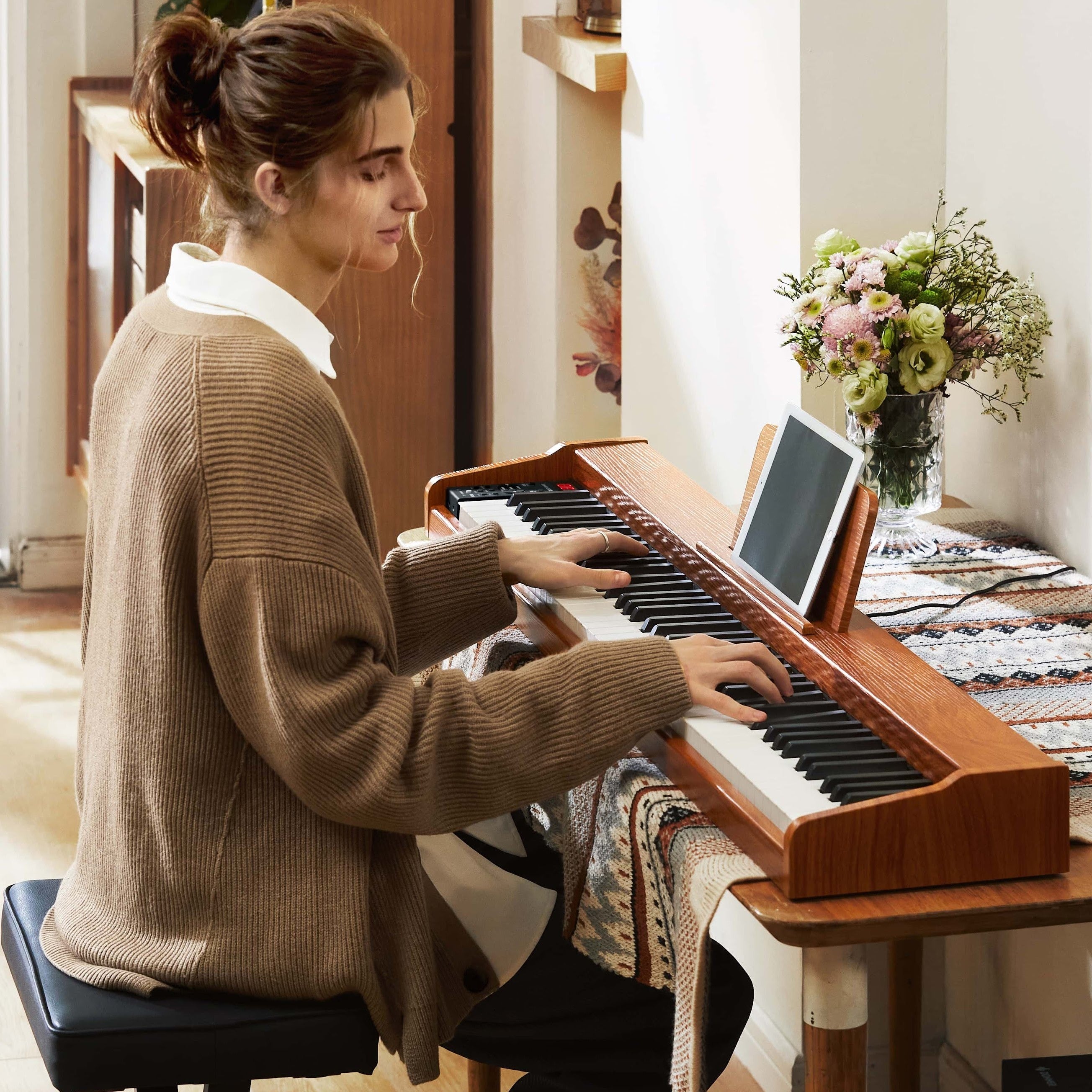






You are really asking one of two questions. Which portable keyboard gets me playing fast for under $300, or which instrument actually feels like a real piano? Both are valid starting points. This guide covers the best options for each path, with clear notes on who should pick which.
A keyboard piano is a portable instrument with 61 or 88 keys, hundreds of built-in voices and rhythms, and a price under $300. It is not the same as a digital piano, which has 88 fully weighted keys and is designed to replicate an acoustic piano's feel. This distinction matters because the instrument you choose shapes your learning path: a keyboard piano prioritizes variety and accessibility for casual playing, while a digital piano prioritizes authentic piano technique for serious study.
We selected eight instruments across both categories, each with a unique "Best for" label tied to a specific beginner scenario. From a foldable 88-key that fits in a backpack to a furniture-style digital piano that looks like mid-century decor, every pick solves a different version of the same problem: getting a beginner from first note to first song.
Our TOP picks of Beginner Keyboard Pianos
- Donner DEP-1S , Best Keyboard Piano with Modern Features
- Yamaha PSR-E383 , Best 61-Key Portable for Casual Playing
- Alesis Recital , Best Budget Full-Size Keyboard Piano
- Donner DP-10 , Best Foldable Keyboard Piano for Travel
- Donner DEP-20 , Best Value Weighted Keyboard Piano Kit
- Roland FP-10 , Best Weighted Action for Serious Beginners
- Yamaha P-145 , Best Brand-Name Digital Piano for Beginners
- Donner DDP-80 , Best Furniture-Style Digital Piano for Home
- How We Selected These Instruments
- Buying Guide , How to Choose the Right Beginner Keyboard Piano
- Frequently Asked Questions
- Find the Keyboard Piano That Fits Your First Note
Donner DEP-1S
The Donner DEP-1S keyboard piano is the beginner instrument that covers the most bases under $300. An 88-key portable slab with semi-weighted velocity-sensitive keys, Bluetooth audio and MIDI, and a rechargeable battery. It is best for the beginner who wants a lightweight, full-size keyboard piano with modern connectivity, without committing to the weight or price of a fully weighted digital piano.
The DEP-1S is an upgraded version of Donner's original DEP-1, adding Bluetooth streaming and MIDI support while keeping the 88-key layout and semi-weighted action. At 88 keys, you get the full note range of an acoustic piano in a portable body that runs on battery power. The semi-weighted keys add spring resistance that unweighted keyboards lack, giving your fingers enough feedback to build basic strength while staying light enough for fast playing and young hands. With 128 sounds and 100 accompaniment rhythms, it offers enough variety to explore different musical styles beyond just piano.
Pros:
- Bluetooth audio plays backing tracks through the built-in speakers
- Bluetooth MIDI connects wirelessly to learning apps like Simply Piano and Flowkey
- Rechargeable battery runs for hours on a single charge
- 88 velocity-sensitive keys in a lightweight slab design
- 4.5-star average from 80 Amazon reviews
Cons:
- Keys are velocity-sensitive, not fully weighted , limits advanced classical technique
- 30W total speaker output , fine for a small room, not for filling a large space
- Single sustain pedal included

See the Donner DEP-1S keyboard piano →
Yamaha PSR-E383
The Yamaha PSR-E383 is a 61-key portable keyboard built for fun first. It is best for kids, absolute beginners who just want to try playing without commitment, and anyone who values entertainment features over authentic piano technique.
This is the keyboard Yamaha recommends for casual learners. It runs on the AWM stereo sampling engine with 650 instrument voices and 260 accompaniment styles. The Yamaha Education Suite (Y.E.S.) walks beginners through songs note by note with a built-in lesson system. A touch tutor function tracks whether you are playing at the right volume and timing. It is light enough to carry under one arm and runs on six AA batteries or an optional AC adapter.
Pros:
- 650 voices and 260 backing styles , the most sonic variety in this list
- Yamaha Education Suite with lesson tracking
- 61 touch-responsive keys with adjustable sensitivity
- Ultra-portable at under 10 lbs
- Yamaha build quality at a reasonable price
Cons:
- 61 unweighted keys , will not prepare you for an acoustic piano
- Sounds prioritize variety over realism , fine for fun, not for serious piano study
- No Bluetooth , wired USB-MIDI only
- Plastic build feels toy-like compared to weighted alternatives
Alesis Recital
The Alesis Recital is the answer when the question is "what is the cheapest 88-key keyboard piano I can buy that still has full-size keys?" It is best for the absolute beginner on a tight budget who wants 88 real-size keys and is not yet sure if piano will stick.
At roughly $150 to $200, the Recital delivers 88 semi-weighted full-size keys with adjustable touch response. It has 5 built-in voices (acoustic piano, electric piano, organ, synth, bass), a basic lesson mode that splits the keyboard into two identical zones for teacher-student practice, and stereo 20W speakers. The key action is spring-loaded semi-weighted , heavier than unweighted but nowhere near the resistance of a hammer-action digital piano.
Pros:
- 88 full-size keys at the lowest price in this list
- Lesson mode splits the keyboard for side-by-side practice
- Acceptable built-in speakers for bedroom practice
- Lightweight and easy to move
Cons:
- Semi-weighted only , key feel is a step above unweighted but far from realistic
- 5 voices total , extremely limited sound palette
- No Bluetooth, no USB audio
- Build quality reflects the price , plastic chassis, basic sustain pedal
Donner DP-10
The Donner DP-10 foldable keyboard piano solves a specific problem: how do you practice on 88 keys in a dorm room, on a tour bus, or anywhere a full-size instrument will not fit? It folds to 24.7 inches , roughly the size of a carry-on bag , and weighs 7.8 pounds. It is best for travelers, students in tight spaces, and anyone whose practice setup needs to disappear into a closet when not in use.
The DP-10 achieves full 88-key coverage through a hinge mechanism that splits the keyboard into two halves. Unfold it, and you have a standard-width keyboard. Fold it, and the entire instrument fits in the included carrying bag. A built-in rechargeable battery runs for up to 10 hours on a 4-hour USB-C charge. Bluetooth audio streams backing tracks through the built-in speakers, and Bluetooth MIDI connects wirelessly to apps. The semi-weighted keys offer more resistance than unweighted budget keyboards, and 128-note polyphony ensures complex passages will not cut notes.
Pros:
- Folds to half its playing size for storage and travel
- 10-hour rechargeable battery , no outlet needed
- Bluetooth audio and MIDI for wireless connectivity
- 88 keys in a 7.8-pound body
- 128 sounds and rhythms with auto accompaniment
Cons:
- Foldable hinge mechanism means the key feel is not as consistent as a solid-body keyboard
- Semi-weighted action only , not for advanced piano technique
- 4.1-star average from 120 reviews , decent but not exceptional
- Speakers are functional, not loud

See the Donner DP-10 foldable keyboard piano →
Donner DEP-20
The Donner DEP-20 digital piano is the most-reviewed Donner piano on Amazon , over 1,200 ratings averaging 4.5 stars. It is best for the beginner who wants a proper weighted piano experience with furniture and pedals included, and accepts a functional piano tone in exchange for exceptional feature-per-dollar value.
The DEP-20 occupies a specific slot: a fully weighted 88-key digital piano sold as a complete furniture bundle at a price where Yamaha and Roland sell portable slabs with no stand. The key action is graded hammer-action , heavier in the bass, lighter in the treble , giving a realistic resistance curve across the keyboard. With 238 tones, 200 accompaniment rhythms, and 128-note polyphony, it offers more sonic variety than most pianos at this price. The piano comes bundled with a wooden furniture stand and triple-pedal unit, so you do not need to buy accessories separately.
Pros:
- Wooden furniture stand and triple pedal included in the box
- Dual headphone jacks for silent duet practice
- Split mode divides the keyboard into two identical zones for teacher-student work
- USB MIDI for connecting to learning apps and DAWs
- 50W dual speakers , among the loudest in its class
Cons:
- Main grand piano tone is functional for practice, not inspiring for recording
- No Bluetooth audio or MIDI , wired connections only
- Included music rest is lightweight plastic and flimsy
- Key action is on the heavier side , may fatigue beginners

See the Donner DEP-20 digital piano →
Roland FP-10
The Roland FP-10 is Google's top pick for a reason. Its PHA-4 Standard keyboard action is the same mechanism Roland puts in models costing twice as much. It is best for the beginner who is serious about classical piano study and wants the most realistic key feel available under $600.
The FP-10 uses Roland's SuperNATURAL sound engine, which models piano tone in real time rather than playing back static samples. The result is a connected, dynamic playing experience where the tone changes with your touch , the same note played softly sounds warm and round, while played hard it cuts through with clarity and edge. The 88 PHA-4 keys have an ivory-feel texture and escapement, a subtle click at the bottom of the key travel that mimics an acoustic grand's mechanism. Bluetooth MIDI is included for app connectivity. The tradeoff: speakers fire downward from the bottom panel at 6W per side, which is quiet even for a bedroom.
Pros:
- PHA-4 key action , best-in-class for under $1,000
- SuperNATURAL piano modeling , dynamic, responsive tone
- Bluetooth MIDI for wireless app connection
- Roland's build quality and three-year warranty
- Headphone jack produces a spatial 3D ambience effect
Cons:
- 12W total speaker output , among the quietest, needs headphones or external monitors
- No line outputs for connecting to a PA system
- Slightly heavy key action may fatigue absolute beginners
- Only 15 onboard sounds , piano-focused, as intended
Yamaha P-145
The Yamaha P-145 replaces the P-45 as Yamaha's entry-level portable digital piano. It is best for the beginner who wants a trusted name with a proven action and authentic piano tone, without paying for features they will not use in the first two years of learning.
The P-145 uses Yamaha's Graded Hammer Standard (GHS) action , 88 keys weighted heavier in the bass and lighter in the treble, just like an acoustic piano. The sound engine samples the Yamaha CFIIIS concert grand at multiple velocity layers. It has 64-note polyphony, a built-in metronome, and a USB-to-host port for connecting to computers and tablets. At roughly 25 pounds, it is portable enough to move from room to room but substantial enough to feel like a real instrument on a stand. The control interface is spare: a single button, with key combinations printed on the panel for advanced functions.
Pros:
- Yamaha CFIIIS grand piano sampling , clear, balanced tone
- GHS keyboard action , proven, reliable, industry standard for entry-level
- Compact body fits small spaces
- USB audio and MIDI in a single cable
- Yamaha brand trust and global service network
Cons:
- 64-note polyphony , lower than most competitors at this price
- No Bluetooth of any kind
- GHS action is slightly lighter and less textured than Roland's PHA-4
- Only 10 onboard voices , functional but limited
Donner DDP-80 Keyboard Piano
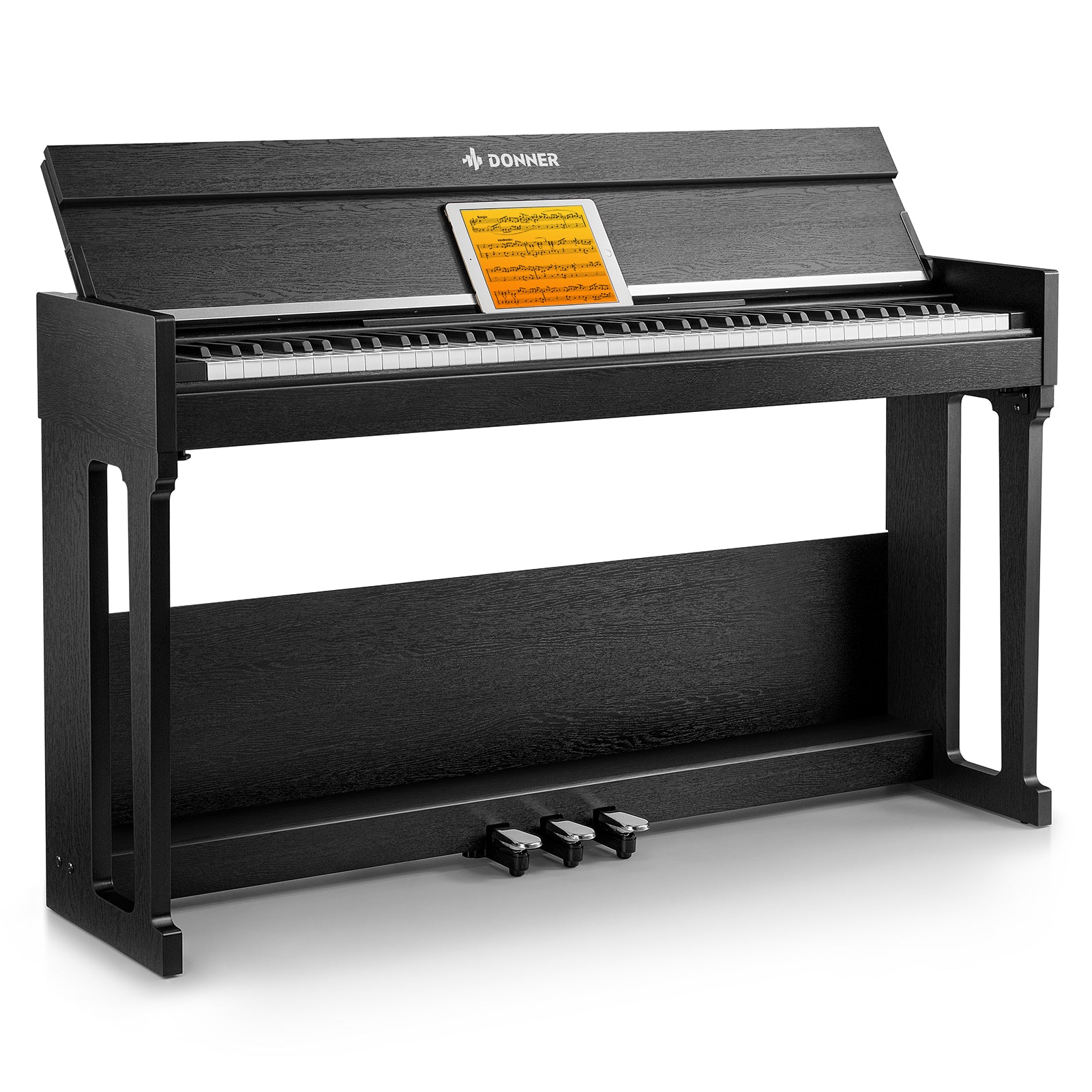
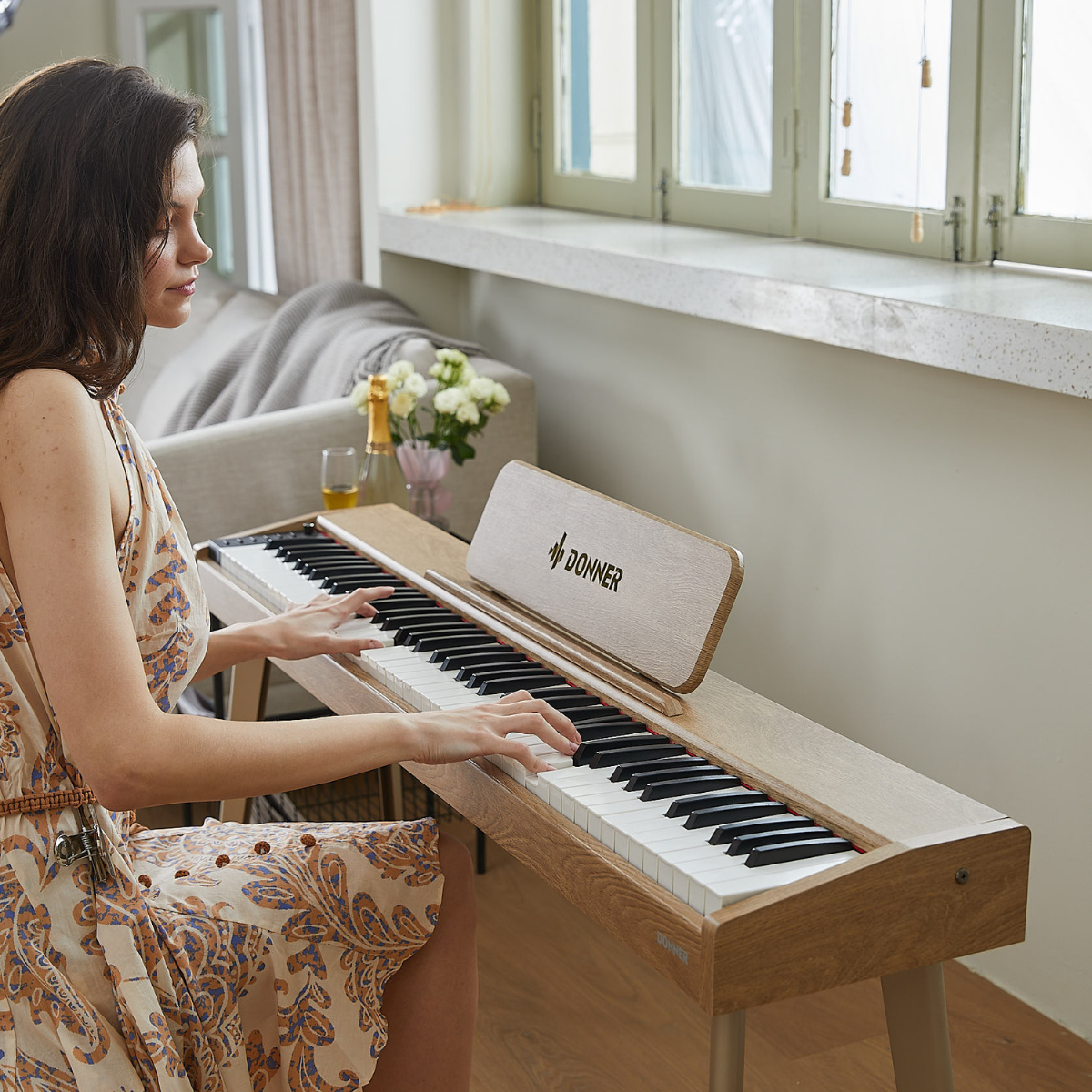
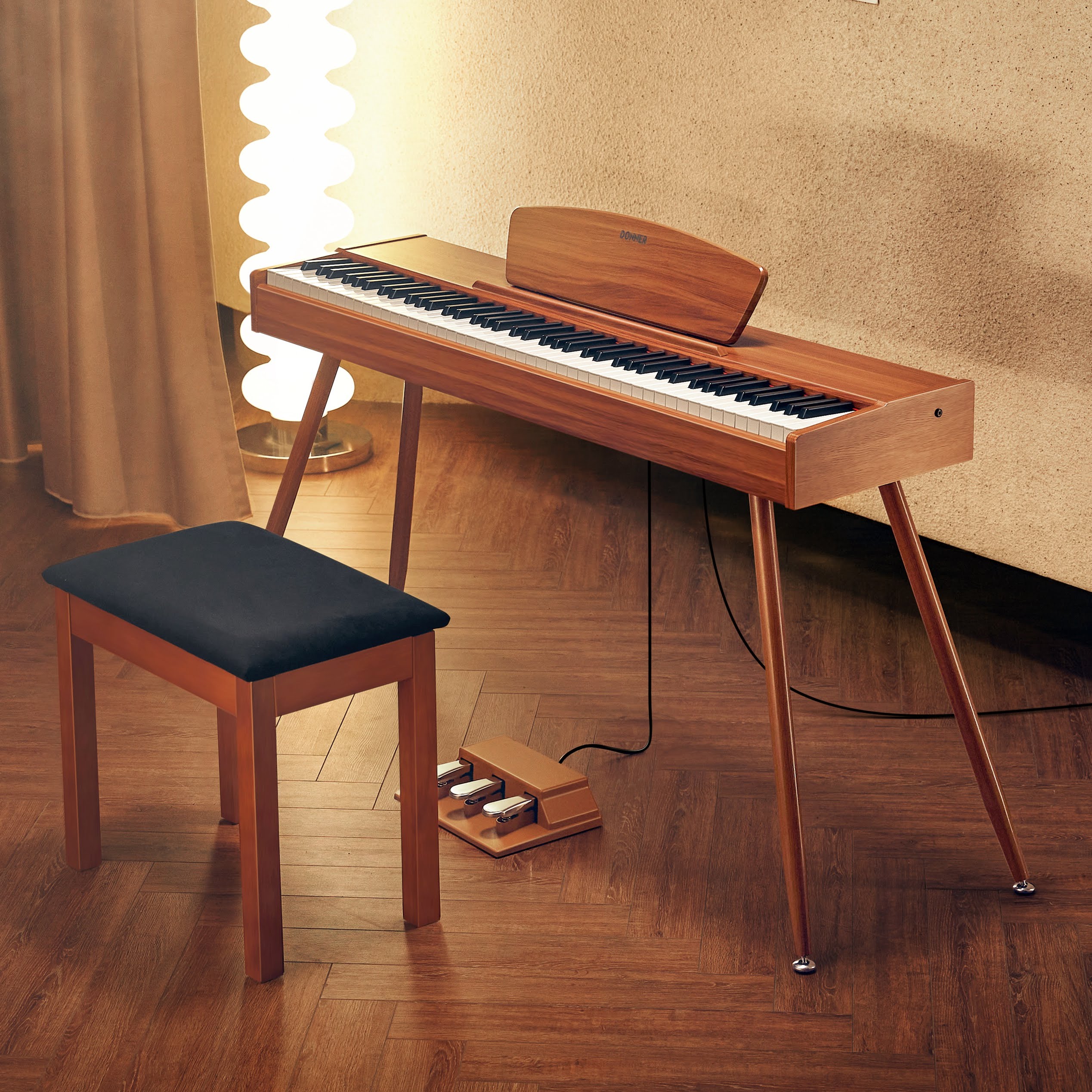
The Donner DDP-80 digital piano is the instrument you buy when the piano needs to live in your living room, not your practice room. It looks like mid-century modern furniture and takes a deliberately focused approach: one grand piano voice, one graded hammer action, and no distractions. It is best for the beginner who wants a permanent home piano that sounds and looks like a real instrument, without a control panel full of buttons they will never touch.
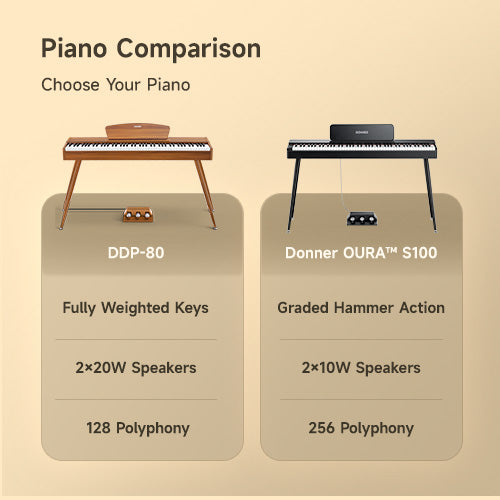
The DDP-80 uses Donner's Hammer Action II keyboard with progressive weighting across 88 keys. The mechanism is graded , heavier in the low register, lighter as you move up , mirroring the feel of an acoustic grand. Power comes from dual 20W speakers housed in a synthetic wood cabinet with three finish options: Natural, Walnut, and Light Oak. The front panel has no buttons, no display, no lights. Everything , power, volume, USB MIDI, line outputs, headphone jack , sits on the rear panel. A triple-pedal unit (sustain, soft, sostenuto) is built into the base.
Pros:
- Furniture-grade mid-century modern design in three finishes
- Hammer Action II keyboard , graded weighting with good dynamic control
- Single grand piano voice, well-executed , no menu diving
- 40W dual speakers in a resonant wooden cabinet
- 1/4" line outputs for external amplification
- USB MIDI for DAW and app connectivity
Cons:
- Only 1 voice , no electric piano, organ, strings, or any alternate sound
- Key action is on the heavier side , some beginners report finger fatigue
- No Bluetooth audio or MIDI
- No display screen , can not see tempo, metronome settings, or current state
- Cabinet is MDF with wood veneer, not solid wood

See the Donner DDP-80 digital piano →
How We Selected These Keyboard Piano for Beginners?
Key action (35%)
Value and completeness (25%)
Sound quality (20%)
Beginner features (15%)
Build and reliability (5%)
Buying Guide
Key Action: The Variable That Defines Your Progress
The way keys feel under your fingers matters more than the number of buttons on the panel.
Unweighted keys press with almost no resistance. They are standard on keyboards under $150 and fine for kids or casual exploration, but they do not build the finger strength needed for acoustic piano playing.61 Keys or 88: What a Beginner Needs
A 61-key keyboard piano covers five octaves , enough for every beginner method book and most pop, rock, and folk repertoire. An 88-key digital piano covers the full seven-plus octaves of an acoustic grand.
For the first two to three years of learning, 61 keys are sufficient. The note layout, finger positions, and music theory transfer directly to an 88-key instrument when you upgrade. The practical limitation only appears in classical repertoire , Chopin nocturnes and Beethoven sonatas routinely use notes outside the 61-key range.
Start with 61 keys if your goal is casual playing, songwriting, or exploring whether piano sticks. Start with 88 keys if classical study is the plan from day one. Most beginners land on the 61-key path and upgrade later , a common and sensible progression.
Features vs Focus: What Actually Matters on Day One
Polyphony, sound count, and rhythm styles are easy to compare and easy to overvalue. Here is what actually matters for a beginner:
Polyphony (64 or higher)Price Bands: What You Get at Each Level
$150 to $250. You get a functional instrument that makes sound and has 61 or 88 keys. Semi-weighted at best, limited speakers, basic sounds. The Alesis Recital sits here. Good for testing the waters.Frequently Asked Questions about Keyboard Piano for Beginners
How much should I spend on a first keyboard piano?
Between $150 and $500. Below $150, you are buying a toy , the keys will not feel like an instrument and the speakers will distort at half volume. Above $500, you are paying for features a beginner will not use in the first year. The sweet spot for a committed adult beginner is $250 to $400 , the DEP-1S and DP-10 live in this range. For serious piano study, $400 to $500 buys a fully weighted digital piano that will last through several years of lessons.
Are budget keyboard pianos worth buying?
Yes, if you match the instrument to your goal. A $150 Alesis Recital with 88 semi-weighted keys is a better starting point than a $400 weighted digital piano that feels too heavy for a young child. Budget instruments compromise on key feel and sound fidelity , not on fundamentals. A beginner can learn note reading, rhythm, and basic technique on any instrument with full-size keys and touch sensitivity. The upgrade path is there when the student outgrows the instrument.
Can you learn piano on a semi-weighted keyboard?
Yes, for at least the first year. Semi-weighted keys provide enough resistance to develop basic finger independence and hand coordination. The musical concepts , note reading, rhythm, dynamics, phrasing , do not depend on key weight. Where semi-weighted keys fall short is advanced classical technique: rapid repeated notes, delicate pianissimo control, and the subtle weight transfer of legato playing all benefit from fully weighted hammer action. Start on semi-weighted, and upgrade when your repertoire demands it.
Find the Keyboard Piano That Fits Your First Note
The best keyboard piano or digital piano for a beginner is the one that gets played every day. Whether you go with a portable 61-key keyboard piano or a furniture-style digital piano with fully weighted keys, the right instrument is the one that makes you want to sit down and play.
Donner has spent over a decade making beginner instruments that do not feel entry-level. Explore the Donner's keyboard piano to find the instrument that fits your first note.