


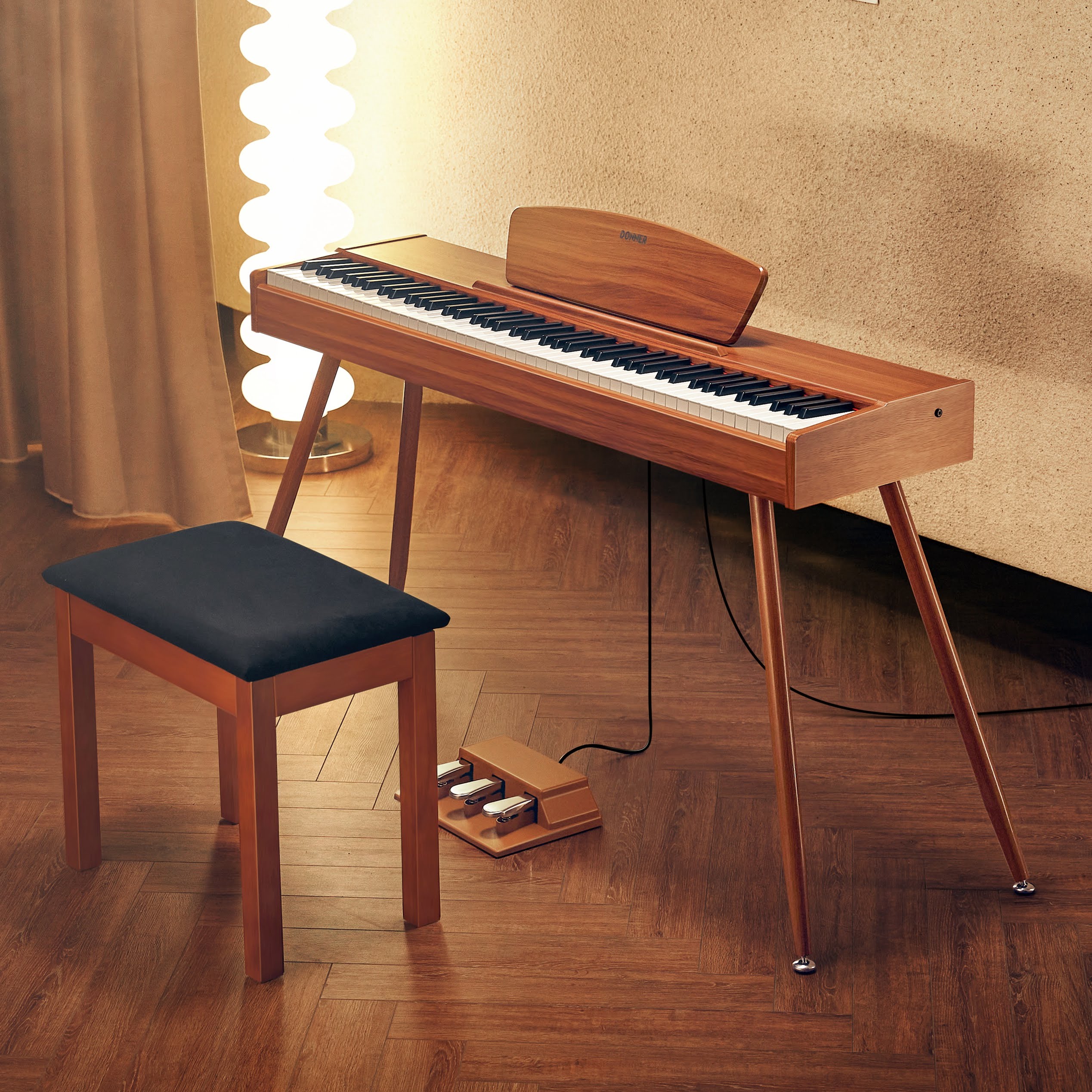




A keyboard piano has to balance key count, key feel, sound, connectivity, and whether it stays in one room or travels with you — and the market spans lightweight 61-key portables to furniture-style 88-key digital pianos. For most home players, the best keyboard piano is the one that matches those trade-offs to your space, budget, and goals, which is why the Donner DEP-1S Beginner Digital Piano Kit takes the number-one spot as Best Keyboard Piano Overall: it pairs a full 88-key semi-weighted board with Bluetooth lessons, built-in sounds, and the stand and pedal you need to start playing the day it arrives.
The ten picks below are chosen for different spaces and budgets, and each one carries a best-for label so you can shortlist by your own priority — from a 4.5 kg 61-key keyboard you can carry between rooms to an 88-key cabinet piano that lives against the wall. If you are still deciding between formats, start with the keyboard piano and digital piano collections to see what fits your home before you settle on a pick.
Best Keyboard Pianos at a Glance
Here is the shortlist in one place, from the overall pick to the budget-weighted option. Each entry links to its full section below, and the table keeps the key differences side by side.
- Donner DEP-1S — Best Keyboard Piano Overall
- Roland FP-10 — Best 88-Key Digital Piano for Beginners
- Casio Casiotone CT-S1 — Best Lightweight Keyboard Piano
- Kawai ES120 — Best Portable Digital Piano for Sound
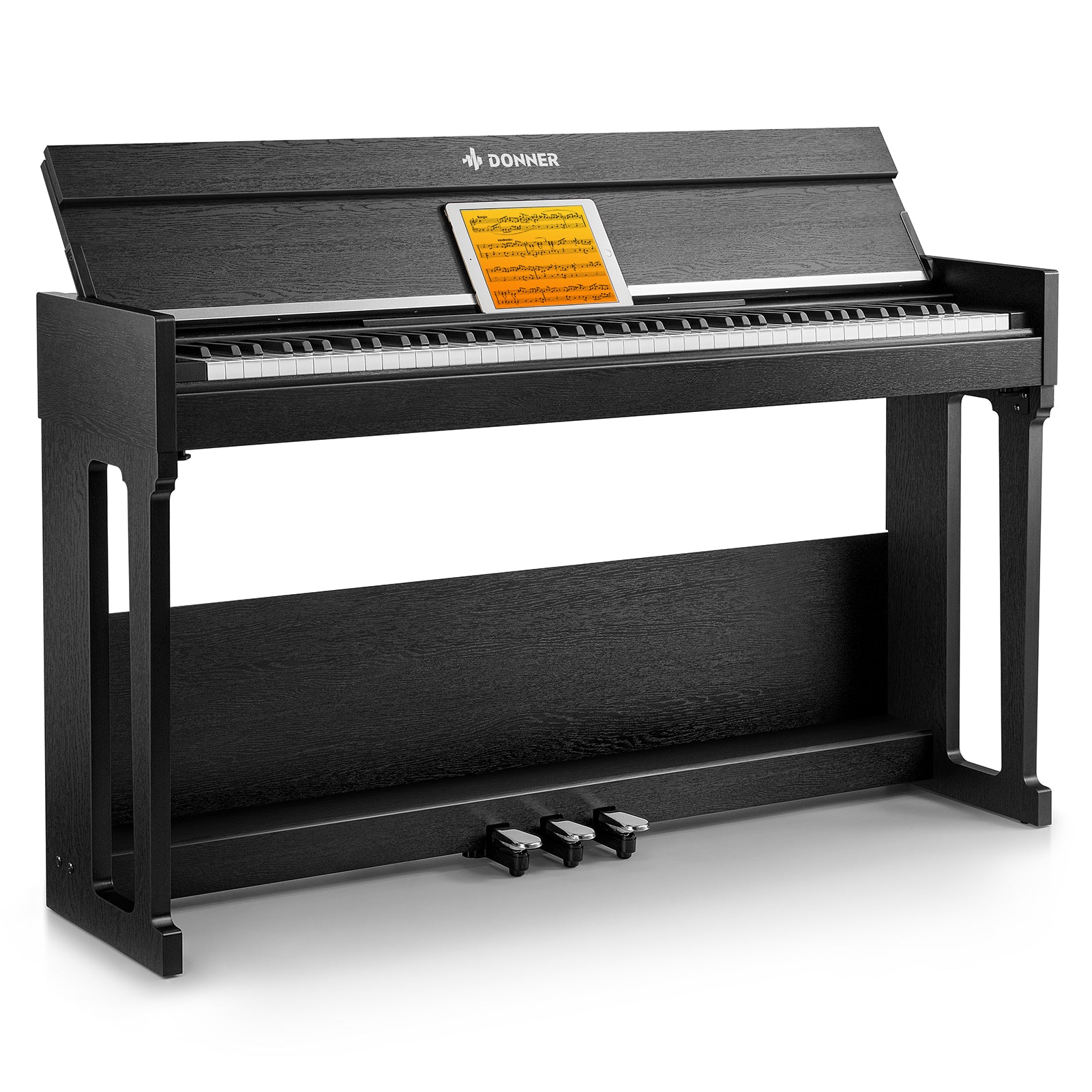
- Donner DDP-60 — Best Upright Home Keyboard Piano
- Casio CT-S400 — Best Keyboard Piano for Sound Variety
- Korg XE20 — Best Auto-Accompaniment Keyboard Piano
- Roland FP-30X — Best Mid-Range 88-Key Digital Piano
- Donner OURA S100 — Best Furniture Home Keyboard Piano
- Williams Allegro IV — Best Budget Weighted Keyboard Piano
| Model | Best For | Keys | Key Action | Bluetooth | Format |
|---|---|---|---|---|---|
| Donner DEP-1S | Overall | 88 | Semi-weighted | MIDI + audio | Portable kit |
| Roland FP-10 | 88-key beginner | 88 | PHA-4 hammer | MIDI | Portable slab |
| Casio CT-S1 | Lightweight | 61 | Touch-sensitive | Optional adapter | Portable 61-key |
| Kawai ES120 | Sound | 88 | Weighted hammer | MIDI + audio | Portable slab |
| Donner DDP-60 | Upright home | 88 | Semi-weighted | None | Upright cabinet |
| Casio CT-S400 | Sound variety | 61 | Touch-sensitive | Optional adapter | Portable 61-key |
| Korg XE20 | Auto-accompaniment | 88 | NH weighted hammer | None | Portable 88-key |
| Roland FP-30X | Mid-range | 88 | PHA-4 hammer | MIDI + audio | Portable slab |
| Donner OURA S100 | Furniture home | 88 | Graded hammer | MIDI + audio | Furniture cabinet |
| Williams Allegro IV | Budget weighted | 88 | Weighted hammer | Audio | Portable slab |
Donner DEP-1S Beginner Digital Piano Kit Best Keyboard Piano Overall

Pros
- 88 velocity-sensitive semi-weighted keys with five touch levels respond to how hard you play.
- Bluetooth audio and MIDI plus USB-MIDI connect lesson apps and devices easily.
- Complete kit with X-stand, sustain pedal, key stickers, and music clip — ready to play out of the box.
- 128 onboard sounds, 100 rhythms, and a 30W speaker system cover home practice and casual playing.
Cons
- Semi-weighted action suits casual play and beginners more than advanced piano technique.
- No LCD display; functions are adjusted with button controls.
The Donner DEP-1S Beginner Digital Piano Kit is the number-one pick for a first-time player who wants a complete 88-key setup and wants to start the same day the box arrives: its 88 velocity-sensitive semi-weighted keys offer five touch levels, so you can shape dynamics as you learn, and the 30W speaker system fills a bedroom or living room with clear sound. Bluetooth audio and MIDI plus USB-MIDI connect lesson apps, videos, and recording software without hunting for cables.
It also arrives as a full kit — X-stand, sustain pedal, key stickers, and music clip included — with 128 onboard sounds and 100 rhythms to explore. Two trade-offs are worth knowing up front: semi-weighted keys suit casual play and beginners more than advanced piano technique, and there is no LCD display, so settings are adjusted with button controls.
Roland FP-10 Digital Piano Best 88-Key Digital Piano for Beginners
Pros
- PHA-4 Standard hammer action with escapement and ivory-feel key surfaces feels close to an acoustic piano.
- SuperNATURAL Piano sound with 96-voice polyphony keeps piano tones expressive.
- Bluetooth MIDI and a USB computer port connect apps and lessons.
- Compact 12.6 kg slab design moves easily around the home.
Cons
- 6W speakers are modest for larger rooms.
- Half-pedaling needs the optional DP-10 pedal.
The Roland FP-10 Digital Piano is the pick for a beginner who wants a realistic hammer feel on a first instrument: its 88-key PHA-4 Standard action adds escapement and ivory-feel key surfaces, and the SuperNATURAL Piano engine delivers an expressive acoustic-style voice with 96-voice polyphony and 36 tones.
At 12.6 kg in a compact slab format, it sits on a desk or X-stand and still moves between rooms, and Bluetooth MIDI plus a USB computer port connect lesson apps and recording software. Keep two limits in mind: the 6W x 2 speakers are modest for larger rooms, and half-pedaling needs the optional DP-10 pedal rather than the included damper pedal.
Casio Casiotone CT-S1 Best Lightweight Keyboard Piano
Pros
- Slim 4.5 kg body runs on AC or AA batteries for easy transport.
- Strong piano tones from the AiX sound source with 61 built-in tones.
- Touch-sensitive keys with three sensitivity levels respond to playing dynamics.
- Optional WU-BT10 adapter adds Bluetooth MIDI and audio.
Cons
- 61 keys limit access to the full piano repertoire.
- Touch-sensitive keys, not a weighted hammer action.
- 2.5W + 2.5W speakers suit quiet rooms and practice.
The Casio Casiotone CT-S1 is the easiest keyboard piano to live with when space and portability come first: at 4.5 kg it is slim enough for a desk or shelf and runs on AC or AA batteries, so you can practice in the bedroom, the kitchen, or on the move.
Its 61 touch-sensitive keys offer three sensitivity levels plus off, the AiX sound source serves up 61 built-in tones with 64-note polyphony, and the 2.5W + 2.5W speakers suit quiet rooms and practice. Bluetooth MIDI and audio are available through the optional WU-BT10 adapter, and because the keys are touch-sensitive rather than weighted, this is a casual-play keyboard more than a technique-building piano.
Kawai ES120 Digital Piano Best Portable Digital Piano for Sound
Pros
- 88-key weighted hammer action gives a realistic piano feel.
- Harmonic Imaging sound with 88-key stereo sampling and 192-note polyphony.
- Bluetooth 5.0 MIDI and audio plus USB-MIDI connectivity.
- About 12 kg portable slab with a 20W (10W x 2) speaker system.
Cons
- No USB audio recorder to a device.
The Kawai ES120 Digital Piano is for players who hear the instrument first: its Harmonic Imaging sound engine uses 88-key stereo sampling, and 192-note polyphony keeps dense passages and pedal work clean, making it one of the most organic-sounding portable digital pianos in this roundup.
It still feels like a piano under the fingers, with an 88-key weighted hammer-action keyboard, and the 20W (10W x 2) speaker system projects well for a slab model. Bluetooth 5.0 MIDI and audio plus USB-MIDI cover apps and streaming, and the PianoRemote app exposes Virtual Technician adjustments. At about 12 kg it travels when needed, though there is no USB audio recorder to a device, so capture happens through software instead.
Donner DDP-60 Semi-Weighted Digital Piano Best Upright Home Keyboard Piano

Pros
- Furniture-style upright with 30W x 2 speakers and a 3-pedal unit (sustain, soft, sostenuto).
- Dual mode for side-by-side playing plus two headphone outputs — ideal for lessons.
- 128 onboard sounds, 128-note polyphony, and 83 rhythms.
- 88 semi-weighted keys with four-level touch sensitivity.
Cons
- 18.5 kg upright cabinet is less portable than slab models.
- No Bluetooth; USB-MIDI only.
The Donner DDP-60 Semi-Weighted Digital Piano is the upright option for a home player or teacher who wants a furniture-style instrument with a 3-pedal unit and a room-friendly footprint: its 88 semi-weighted keys offer four-level touch sensitivity, and the cabinet's 30W x 2 speakers fill a living room.
Dual mode lets two players sit side by side for lessons, and two headphone outputs make quiet practice easy for teacher and student. It carries 128 onboard sounds, 128-note polyphony, and 83 rhythms. The trade-offs are the usual ones for an upright: at 18.5 kg the cabinet is less portable than a slab, and there is no Bluetooth — connectivity is USB-MIDI only.
Casio CT-S400 Best Keyboard Piano for Sound Variety
Pros
- 600 built-in tones and 200 one-touch presets for huge sound variety.
- Reverb, chorus, DSP, and master EQ effects for shaping styles.
- Lightweight 4.5 kg body with battery or AC power.
- 61 touch-sensitive keys with three sensitivity levels.
Cons
- 48-note polyphony sits below the 64-note minimum that keeps dense passages clean.
- Touch-sensitive keys, not weighted.
- Bluetooth MIDI and audio require the optional WU-BT10 adapter.
The Casio CT-S400 is the keyboard piano for a player who wants a huge palette of styles in one lightweight board: 600 built-in tones, 200 one-touch presets, and reverb, chorus, DSP, and master EQ effects mean you can move from piano practice to synth and pop presets without plugging in a computer.
The 61 touch-sensitive keys respond with three sensitivity levels, and the 2.5W + 2.5W speakers keep it bedroom-friendly; at 4.5 kg with battery or AC power it is easy to carry. Two things to weigh: 48-note polyphony sits below the 64-note minimum that keeps dense passages clean, and the keys are touch-sensitive rather than weighted. Bluetooth MIDI and audio require the optional WU-BT10 adapter.
Korg XE20 Digital Ensemble Piano Best Auto-Accompaniment Keyboard Piano
Pros
- 280 accompaniment styles plus 41 drum kits and over 705 sounds for full backing bands.
- 88-key NH (Natural Weighted Hammer) action.
- 184-voice polyphony and an 18W x 2 speaker system with eight speaker EQ types.
- USB MIDI plus an MP3/WAV audio player.
Cons
- No Bluetooth; wired connections only.
The Korg XE20 Digital Ensemble Piano is for a home musician who wants a full backing band built in: over 705 sounds, 41 drum kits, and 280 accompaniment styles let you layer rhythm and harmony behind your playing, while the 88-key NH (Natural Weighted Hammer) action keeps the piano side honest.
With 184-voice polyphony and an 18W x 2 speaker system that includes eight speaker EQ types, it sounds big for a portable. USB MIDI and an MP3/WAV audio player handle song practice and recording. Note that connectivity is wired only — there is no Bluetooth — so plan for cables if you want to use apps.
Roland FP-30X Digital Piano Best Mid-Range 88-Key Digital Piano
Pros
- PHA-4 Standard hammer action with escapement and ivory feel.
- SuperNATURAL Piano sound with 256-voice polyphony and 321 tones.
- Bluetooth audio and MIDI plus WAV/MP3 playback via USB.
- 11W x 2 speakers with line outputs for larger sound.
Cons
- About 14.8 kg with music rest — heavier than compact slabs.
The Roland FP-30X Digital Piano is the step-up for a player who has outgrown entry models: the same PHA-4 Standard hammer action with escapement and ivory feel anchors the keyboard, while the SuperNATURAL Piano sound engine expands to 256-voice polyphony and 321 tones.
The 11W x 2 speakers with line outputs deliver noticeably more presence than the FP-10 for living-room playing or small gigs, and Bluetooth audio and MIDI plus WAV/MP3 playback over USB cover streaming, apps, and backing tracks. The Piano Designer app lets you shape the sound in detail. At about 14.8 kg with the music rest, it is portable enough to move, but heavier than the compact FP-10.
Donner OURA S100 Home Digital Piano Best Furniture Home Keyboard Piano

Pros
- 88 graded hammer-action keys (Graded Hammer Standard) for an acoustic-style feel.
- Furniture-style cabinet with 20W x 2 speakers and a 3-pedal unit.
- Bluetooth MIDI and audio plus USB-MIDI for apps and lessons.
- 256-note polyphony keeps dense playing clean.
Cons
- 15 onboard sounds is a smaller library than feature-heavy keyboards.
- Furniture cabinet is a permanent home setup, not portable.
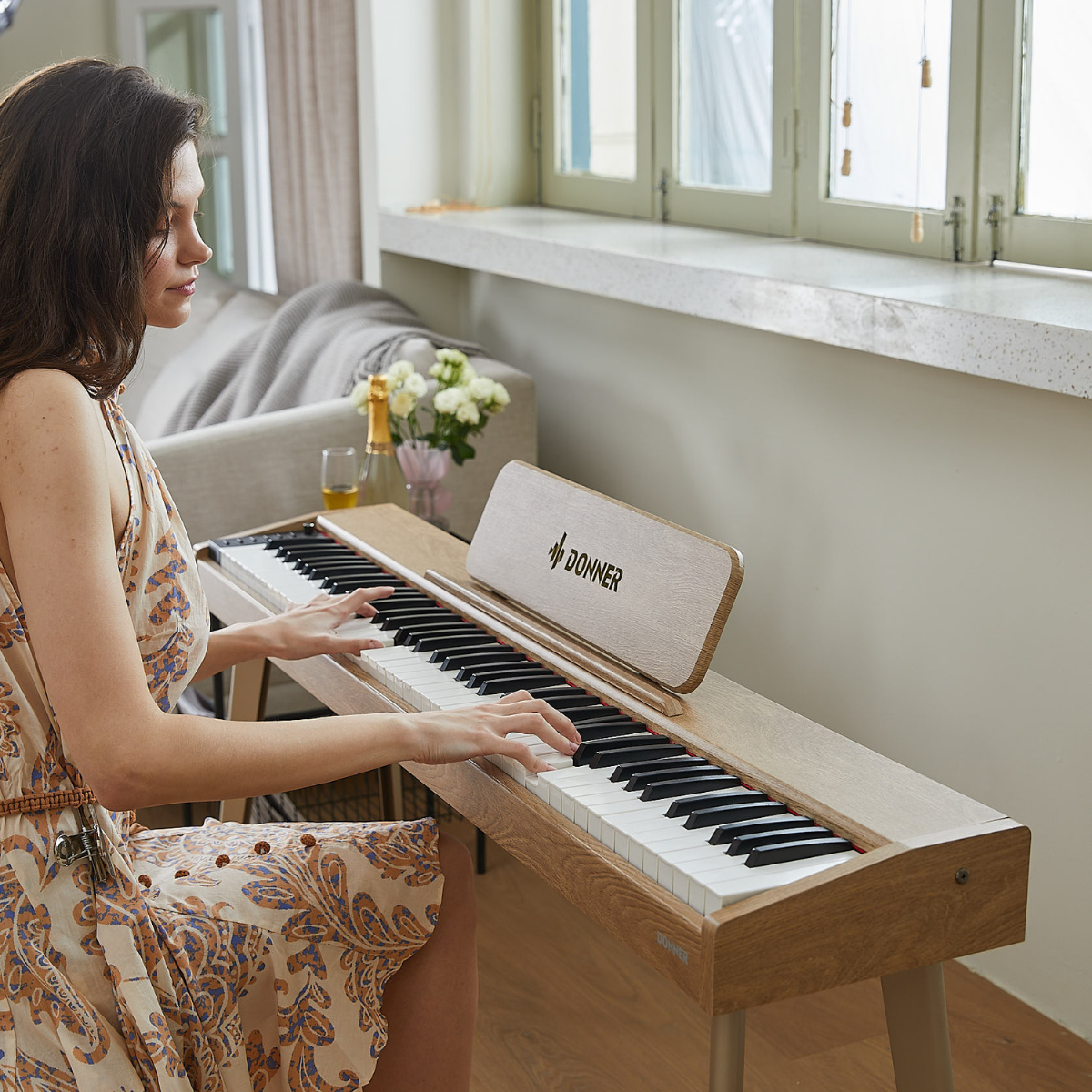
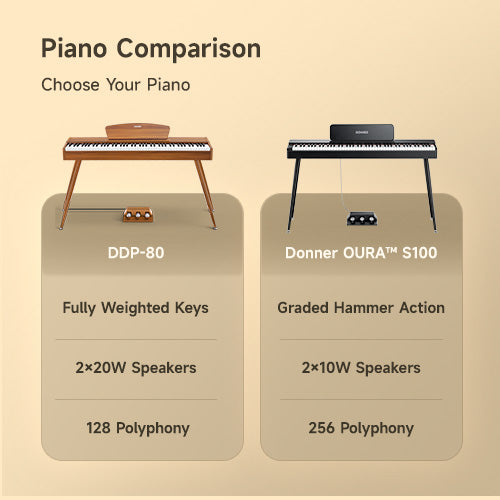
The Donner OURA S100 Home Digital Piano is the furniture-style pick for a player who wants the look and feel of a real piano in the living room: its 88 graded hammer-action keys (Graded Hammer Standard) reproduce the heavier bass and lighter treble response of an acoustic, and the cabinet with 20W x 2 speakers and a 3-pedal unit is a complete home setup.
Bluetooth MIDI and audio plus USB-MIDI connect lesson apps, and 256-note polyphony keeps layered playing clean. Two trade-offs: 15 onboard sounds is a smaller library than feature-heavy keyboards, and as a furniture cabinet it is a permanent home setup rather than a portable instrument.
Williams Allegro IV Digital Piano Best Budget Weighted Keyboard Piano
Pros
- 88 weighted hammer-action keys, velocity-sensitive and graded across the keyboard.
- Bluetooth audio for streaming and playing along.
- USB interface with MIDI in/out and stereo audio out.
- Aux input, dual headphone outputs, and stereo line outputs.
Cons
- 35.5 lbs is heavier than lightweight keyboards.
The Williams Allegro IV Digital Piano is the budget route to a real weighted feel: its 88 weighted hammer-action keys are velocity-sensitive and graded across the keyboard, and the onboard speaker system delivers room-filling sound for practice and small performances.
Bluetooth audio lets you stream and play along, while a USB interface handles MIDI in/out and stereo audio out; aux input, dual headphone outputs, and stereo line outputs round out the connections. At 35.5 lbs it is a portable slab, but noticeably heavier than lightweight keyboards, so it suits a home that moves it occasionally rather than daily.
How We Choose the Best Keyboard Pianos
Every pick below had to clear the same four checks, and each one maps to a real decision a buyer makes: how many keys, how the keys feel, whether the sound and practice features will keep you playing, and how the instrument connects and fits your home. Here is what each factor means and the standard a model had to meet to make this list.
Key Count
How many keys a keyboard has sets the ceiling on what you can play. 61 keys suit casual play, young beginners, and small spaces; 76 keys cover most beginner material; and 88 keys cover the full piano repertoire. Because the goal here is an instrument that stays useful as you progress, the picks aimed at piano technique all carry 88 keys, while the 61-key models earn their spot for portability and casual play — a trade-off worth weighing before you buy, and one that how many keys on a beginner keyboard explains in more detail.
Key Action and Touch Response
Key action decides how the instrument feels under your fingers. Weighted keys build finger strength and technique, semi-weighted keys are a middle step, and touch-sensitive non-weighted keys are fine for casual playing. The standard for this list: models positioned for serious piano practice had to offer a weighted or hammer action, every pick responds to how hard you play, and the difference between fully weighted vs semi-weighted keys is worth understanding before you commit.
Sound, Speakers, and Practice Features
Sound is what makes practice feel rewarding, and speakers decide whether that sound reaches you across the room. Polyphony matters too: 64 to 256 notes of polyphony prevent dropped notes in dense passages, which is why the 88-key picks here clear that bar. Speaker power was matched to room size — from 2.5W x 2 bedroom boards to 30W x 2 uprights — and practice features such as rhythms, dual mode, and headphone outputs added real value.
Connectivity and Format
Connectivity shapes how easily a keyboard fits into lessons and recording: Bluetooth or USB-MIDI lets you connect to lesson apps and record to a computer or tablet, and models that skip wireless still offer a wired path. Format decides where the instrument lives: furniture-style cabinets and uprights stay put in a living room, while portable slabs and 61-key boards move between rooms or travel.
FAQ about Keyboard Pianos
Should I get a 61-key or 88-key keyboard piano?
88 keys cover the full piano repertoire, 76 keys cover most beginner material, and 61 keys suit casual play and young beginners but limit repertoire. If your goal is to play standard piano pieces, an 88-key model means you never run out of range. If you want the lightest, most affordable start, or a young child is learning, a 61-key keyboard is a fine first step.
What is the difference between a keyboard and a digital piano?
A keyboard is typically lighter, more affordable, and easier to move, often with 61 keys and a wide range of sounds and rhythms, while a digital piano focuses on realistic piano feel and sound, usually with 88 weighted keys and a dedicated piano tone. If building piano technique is your goal, a digital piano is the closer match. For casual play and portability, a keyboard is easier to live with.
Are weighted keys necessary for a beginner?
Not for every beginner. Weighted keys build finger strength and technique, semi-weighted keys are a middle step, and touch-sensitive non-weighted keys are fine for casual playing. If your goal is piano technique, weighted keys help from day one. If you are playing casually or want the lightest option, a touch-sensitive keyboard is a perfectly good place to start.
What keyboard piano feels most like a real piano?
Graded hammer action feels closest, because it mimics the heavier low notes and lighter high notes of an acoustic piano more closely than a uniform weighted action. Sound quality also depends on the sound engine and speaker system, and polyphony of 64 to 256 notes prevents dropped notes in dense passages. Look for an 88-key model with a graded or hammer action and a speaker system sized to your room.
Find the Keyboard Piano That's Right for You
Match the instrument to your space, budget, and goals, and the right keyboard piano usually makes itself clear: a light 61-key board if you need portability, an 88-key model with a weighted or semi-weighted action if you are building piano technique, and a cabinet-style model when you want a permanent, dedicated instrument.
Donner's mission is to make music-making accessible for players at every level, and that approach runs through everything from entry kits to full-size instruments. Start at Donner Music to browse the range, and take a look at the digital piano collection for full-size instruments.