






The best electric guitar amp is the one that reaches the right volume in your room and gives you the controls and connections you will actually use. A bedroom player may need headphones and compact dimensions, while rehearsal or small-stage use calls for more speaker area, volume headroom, or a power-reduction setting.
The eight picks below cover straightforward beginner combos, modeling amps with digital sound options, desktop units, portable designs, multi-instrument support, and a pedal-friendly platform. Each amp is matched to a situation so wattage becomes one part of the decision instead of the whole decision.
The Best Electric Guitar Amps at a Glance
Choose the use case first, then compare the speaker, controls, effects, and connections inside the matching card.
- Donner DEA-20 20W Electric Guitar Amplifier — Best compact beginner amp
- Fender Mustang LT25 Guitar Amplifier — Best beginner modeling amp
- BOSS Katana-50 Gen 3 Guitar Amplifier — Best overall practice amp
- Donner GO Electric Guitar Amplifier — Best ultra-portable smart amp
- Positive Grid Spark 2 Smart Guitar Amp — Best desktop practice amp
- Yamaha THR10II Desktop Guitar Amplifier — Best compact home amp
- Donner DKA-20 20W Amplifier — Best multi-instrument amp
- Blackstar Debut 50R Guitar Amplifier — Best pedal platform
Donner DEA-20 20W Electric Guitar Amplifier Best compact beginner amp

Pros
- Clean and overdrive switch
- Reverb with bass and treble controls
- Headphone output for quiet practice
Cons
- No onboard preset library
The Donner DEA-20 20W Electric Guitar Amplifier gives a newer player the essential controls without a menu or preset system. A one-click switch moves between clean and overdrive sounds, built-in reverb adds space, and separate bass and treble controls provide simple tone shaping.
The 20-watt amp drives a built-in 6.5-inch speaker and covers a stated 40 Hz to 20 kHz frequency response. A 1/4-inch instrument input accepts the guitar, and a 1/4-inch headphone output supports quiet practice. The rugged compact housing fits small spaces and transport, although the smaller speaker and simple control set are aimed at practice rather than a feature-heavy modeling workflow.
Fender Mustang LT25 Guitar Amplifier Best beginner modeling amp
Pros
- 20 amp models and 25 effects
- Expandable preset library
- Headphone, auxiliary, and USB connections
Cons
- Preset system adds more choices to manage
The Fender Mustang LT25 Guitar Amplifier suits a beginner or home player who wants many sounds without adding pedals. The modeling system provides 20 amp models, 25 effects, 30 preloaded presets, and access to 30 more presets, giving the player ready-made starting points instead of requiring every sound to be built from scratch.
The 25-watt combo uses an 8-inch Fender Special Design speaker. A stereo headphone output supports silent sessions, an auxiliary input accepts backing tracks, and USB handles recording or firmware updates. Fender Tone desktop app compatibility adds computer-based editing, but players who want only a few physical controls may find the larger sound library more than they need.
BOSS Katana-50 Gen 3 Guitar Amplifier Best overall practice amp
Pros
- 50 watts through a 12-inch speaker
- Power Control for lower-volume practice
- Five effects sections and four memories
Cons
- More controls require a learning period
The BOSS Katana-50 Gen 3 Guitar Amplifier fits a player who wants one combo for home practice and louder group use. Its 50-watt Class AB power section drives a custom 12-inch speaker, while Power Control reduces the output level and preserves the response and feel of a driven amplifier for lower-volume sessions.
Six amp characters include selectable variations, and five independent effects sections cover Booster, Mod, FX, Delay, and Reverb. Tone Studio expands the library to as many as 60 effect types, while four Tone Setting memories store preferred combinations. A stereo headphone output and USB-C recording cover private practice and computer connection. The broad control and effects range takes more time to learn than a simple two-channel amp.
Donner GO Electric Guitar Amplifier Best ultra-portable smart amp

Pros
- True analog clean and overdrive tones
- Bluetooth audio and USB-C charging
- 720 g compact design
Cons
- No built-in effects
The Donner GO Electric Guitar Amplifier is built for a player who wants analog guitar tone in a small rechargeable unit that can also play desktop audio. Its true analog circuit provides clean and gritty overdrive sounds, while Bluetooth accepts backing tracks and everyday music playback. The design focuses on portability and direct controls rather than built-in effects.
Dual speakers combine a 25-watt woofer and 15-watt tweeter for a wide sound field. A headphone jack supports silent practice, USB-C handles charging, and the unit weighs 720 g with dimensions of 19.7 by 7.4 by 12.6 cm. The compact size makes the GO easy to move, but players who want delay, reverb, or modulation inside the amp will need another solution.
Positive Grid Spark 2 Smart Guitar Amp Best desktop practice amp
Pros
- Onboard looper and eight presets
- Stereo FRFR speaker system
- Headphone, line, and USB-C outputs
Cons
- App workflow may not suit every player
The Positive Grid Spark 2 Smart Guitar Amp suits a home player who wants sound design, looping, and app-guided practice in a desktop format. Upgraded HD amp models and effects run on a dedicated audio chip, and two 4-inch FRFR horn stereo speakers provide the playback system for guitar tones and Bluetooth audio.
Eight onboard presets make saved sounds accessible without opening the app, and onboard looper controls support layered practice. A headphone output, stereo line outputs, and USB-C audio interface cover quiet playing, external connection, and recording. The Spark app adds practice, tone-discovery, and song-learning tools, although the app-centered workflow may not suit a player who prefers a fully stand-alone analog control panel.
Yamaha THR10II Desktop Guitar Amplifier Best compact home amp
Pros
- 15 guitar amp models and eight effects
- Bluetooth playback and remote editing
- USB recording and playback
Cons
- Desktop format is not a stage combo
The Yamaha THR10II Desktop Guitar Amplifier is a compact home choice for a player who wants modeled guitar sounds, Bluetooth playback, and recording connectivity without a floor combo. Virtual Circuitry Modeling provides 15 guitar amp models, while three bass amp models and three mic models expand the unit beyond standard electric-guitar practice.
Eight effects are built in, Bluetooth handles audio playback and THR Remote editing, and USB provides recording and playback connection. The 20-watt desktop format fits a desk or small room well, but it is designed around close home listening rather than the physical spread of a larger stage combo.
Donner DKA-20 20W Amplifier Best multi-instrument amp
Pros
- Two channels with separate volume controls
- Woofer and tweeter speaker system
- Headphone, auxiliary, and DI outputs
Cons
- Not a guitar-only effects amp
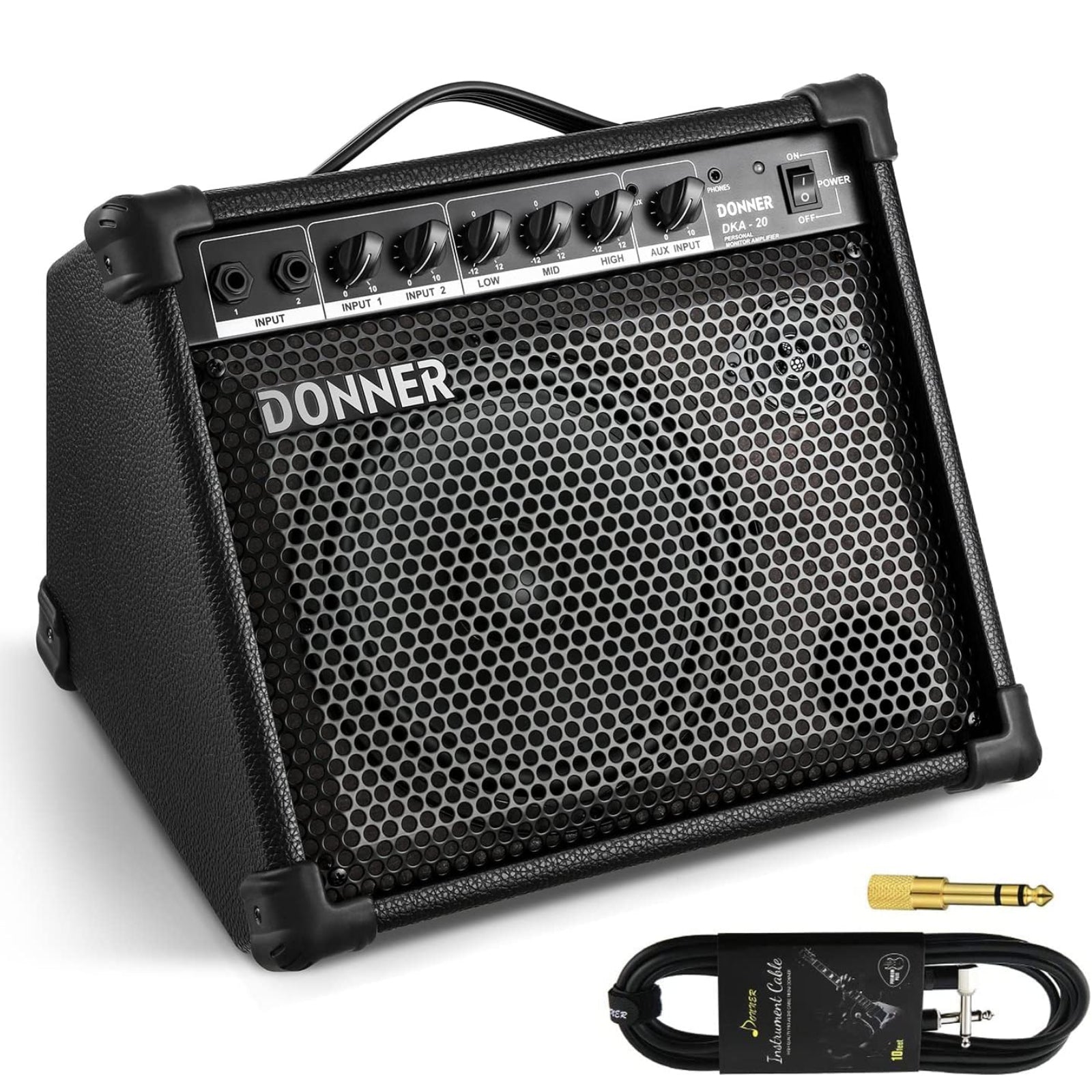
The Donner DKA-20 20W Amplifier fits a household, lesson space, or player who needs one compact amp for guitar, keyboard, bass, electronic drums, and microphone use. Two channels have separate volume controls and two 1/4-inch instrument inputs, while the microphone input supports as much as 48 dB of gain.
The 20-watt system combines an 8-inch low-frequency woofer with a 2-inch high-frequency tweeter. Gain, boost select, volume, treble, middle, and bass controls shape the signal, while a 1/8-inch auxiliary input, 1/8-inch headphone output, and DI output add playback, quiet practice, and external-speaker options. The rugged angled cabinet supports general-purpose use, but the DKA-20 is not a traditional guitar-only amp with a dedicated library of guitar effects.
Blackstar Debut 50R Guitar Amplifier Best pedal platform
Pros
- 50-watt output with 5-watt reduction
- Series effects loop for pedals
- Hall and Plate reverb
Cons
- No large modeling preset library
The Blackstar Debut 50R Guitar Amplifier is for a player who wants an analog combo with enough headroom for pedals and a lower-power option for home use. Its 50-watt MOSFET preamp design includes a 5-watt power reduction switch, allowing the same amp to move between louder playing and reduced-volume practice.
Clean and overdrive channels can be switched by foot, while Hall and Plate reverb and the ISF tone control provide core onboard shaping. A series effects loop places external pedals or processors in the signal path, and an MP3 or line input supports backing tracks. Silent-practice features extend home use. The straightforward platform works well with external effects, but it does not replace a modeling amp with a large preset library.
How We Choose the Best Electric Guitar Amps
Match the amplifier to the room and workflow before comparing feature counts. Check how much controllable volume you need, decide whether you want analog simplicity or modeled sounds, identify the effects and practice tools you will use, and confirm that the physical size and connections fit your guitar, headphones, computer, backing tracks, or other instruments.
Volume and Room Size
Wattage describes available amplifier power, but the speaker and power controls also shape real-world use. A compact 20- or 25-watt practice combo can cover a bedroom or home studio, while a 50-watt amp and larger speaker provide more volume headroom for rehearsals or a small stage. A power-reduction switch is useful when you want the response of a larger amp at a lower level.
Amp Type and Tone
An analog amp creates its core clean and overdrive sounds through a direct circuit and usually keeps the controls simple. A modeling amp digitally recreates several amplifier characters and can store presets. A desktop amp prioritizes close listening and compact placement, while a pedal platform provides a strong clean foundation, useful headroom, and an effects loop for external pedals or processors.
Effects and Practice Tools
Built-in reverb, delay, modulation, presets, Bluetooth playback, looping, and app support can reduce the need for separate gear. Those tools help when you want quick sound changes, backing tracks, or structured practice. Simple clean and overdrive channels are often better when you already own pedals or want to learn how a small number of controls changes the sound.
Portability and Connections
A headphone output matters for silent practice, while an auxiliary input or Bluetooth connection brings in backing tracks. USB or USB-C can support recording, playback, charging, or firmware updates depending on the amp. A line or DI output helps connect external equipment. Check the exact connection type, power source, weight, and cabinet size before assuming a portable amp fits your routine.
FAQ About Electric Guitar Amps
These answers focus on the volume, controls, and connections that determine whether an amp works in your room and playing routine.
What is the best electric guitar amp?
The best electric guitar amp depends on the use case. Choose a straightforward compact combo for beginner practice, a modeling amp for many presets and effects, a desktop unit for close home listening, an ultra-portable amp for movement, a multi-instrument amp for shared gear, or a pedal platform for external effects and louder clean headroom.
What size amp do I need for home practice?
A lower-wattage practice amp is usually enough for home use when it has a controllable volume and the speaker suits the room. A larger amp can also work if it includes power reduction or a strong master-volume control. More wattage becomes useful when you need clean headroom alongside drums or on a stage.
Are modeling amps good for beginners?
Yes, modeling amps are good for beginners when the interface is clear and the presets make usable sounds easy to find. They let a new player explore several amp styles and effects without buying separate pedals, but an overly complex menu can distract from basic practice.
Do I need built-in effects?
No, you do not need built-in effects. Reverb, delay, modulation, and presets can reduce extra purchases and make practice more varied, while a simple clean-and-overdrive amp can be the better choice if you prefer physical pedals or want fewer controls to manage.
Can I use headphones with a guitar amp?
Yes, many practice amps include a headphone output for silent playing, but you should verify the connection before buying. Check whether the jack is 1/4 inch or 1/8 inch so you know whether your headphones need an adapter.
Find the Right Electric Guitar Amp at Donner
Start with the room and volume, then decide whether you need presets, effects, Bluetooth, recording, multiple inputs, or a simple analog signal path. Donner offers compact options for different practice routines, and the guitar amps collection lets you compare the connections and controls that fit your setup.