






Choosing a new keyboard instrument often brings you face-to-face with technical terms that dramatically affect your playing experience. Among these, the choice between weighted keys and unweighted keys stands out as the single most important decision. This choice determines not just the initial cost and weight of the instrument, but how the keys feel under your fingers, how you build technique, and what genre of music you can comfortably play.
Whether you are browsing digital pianos for a home setup or looking at lighter portable options, understanding key action helps you avoid frustration. Choosing the wrong mechanism can form bad playing habits that are difficult to correct later. This guide compares weighted and unweighted key actions across key dimensions—including feel, dynamic expression, technique development, portability, and value—to help you select the ideal instrument for your musical path.
Quick Summary
Choose weighted keys if you want to learn traditional piano technique and transition smoothly to acoustic pianos. They build finger strength and provide authentic physical resistance. Choose non-weighted keys if you prioritize maximum portability, lower cost, or plan to play synth leads and classical organ sounds. Semi-weighted keys offer a practical middle ground for casual, multi-genre players.
Quick Comparison Between Weighted and Non Weighted Keys
| Dimension | Weighted Keys | Non-Weighted Keys |
|---|---|---|
| Key Feel | Heavier, substantial, authentic resistance | Light, springy, effortless return |
| Mechanism | Physical hammers and levers | Coil springs and plastic hinges |
| Dynamic Control | Precision control over soft and loud notes | Basic velocity mapping with minimal feedback |
| Finger Strength | Builds hand muscles and proper joint technique | Does not develop acoustic-style hand strength |
| Portability | Heavy (typically 25 to 80 lbs), needs stand | Ultra-light (typically 5 to 15 lbs), battery-powered |
| Price | Typically starts at $300 to $500 | Highly affordable, starting around $50 to $200 |
| Best For | Classical piano, formal lessons, acoustic prep | Synth solos, organ playing, portable production |
Table of Contents
- Key Feel & Mechanism
- Playing Experience & Dynamics
- Skill Development
- Portability
- Price & Value
- How to Choose Between Weighted and Non-Weighted Keys
- Semi-Weighted Keys
- Best Digital Pianos with Weighted Keys
- FAQ: Weighted Keys vs Non Weighted Keys
- Find Your Sound with the Right Keyboard Action
- Related Posts
Key Feel & Mechanism
The fundamental difference between key types lies in the physical mechanism housed underneath the keys. Weighted keys simulate the hammer action of an acoustic piano. When you press an acoustic piano key, a wooden hammer swings upward to strike a string. Weighted keyboards replicate this weight and resistance using physical metal weights and levers.
Premium models utilize graded hammer action. High-quality graded keyboards feature heavier keys on the bass-end and lighter keys on the treble-end, copying the natural string-thickness variation of an authentic piano.
Conversely, non-weighted keys rely entirely on a simple spring-loaded mechanism. When pressed, the plastic key turns on a hinge and pushes against a metal spring, which snaps the key back to its initial position. The resistance is uniform and exceptionally light across all eighty-eight keys.
Semi-weighted keys are a practical middle ground: they use spring tension but add small weights to the underside of each key to provide a moderate level of heft.
Winner: Weighted keys win for realistic feel, while non-weighted keys win for lightning-fast synth or organ-style play.
Playing Experience & Dynamics
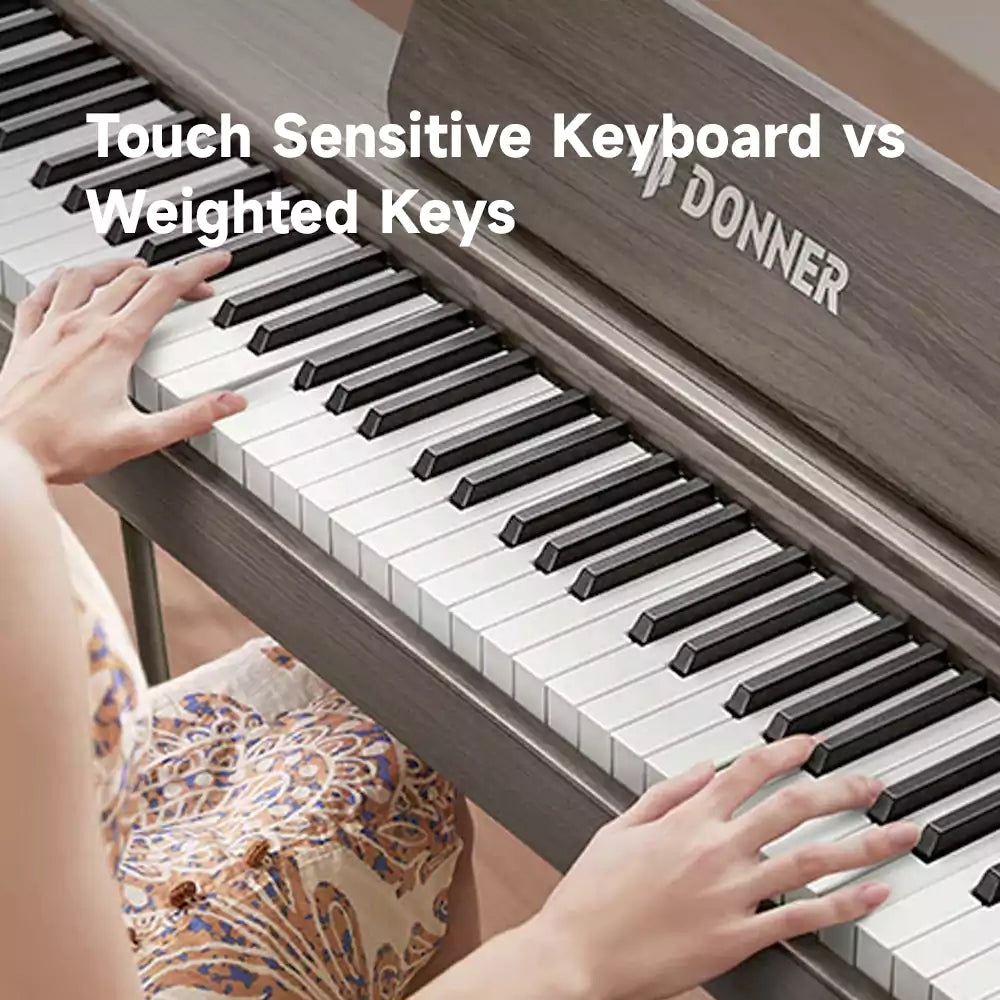
A major benefit of weighted key action is the level of dynamic expression it unlocks. Because weighted keys have mass, you can control the speed and force of your key stroke with immense precision. Pressing a key slowly results in a soft, delicate note; striking it with force produces a loud, punchy tone. This tactile feedback makes playing expressive classical or jazz pieces feel intuitive and rewarding, allowing for smooth crescendos and decrescendos.
Unweighted keys present a different playing experience. While most modern non-weighted keyboards are velocity-sensitive—meaning they play louder when hit harder—the lack of physical resistance makes finding the subtle middle ground between loud and soft incredibly difficult. Your fingers have no physical substance to press against, so keys often feel either fully "on" or "off."
For non-piano genres, this light response is actually an advantage. Organ players prefer unweighted keys because they enable rapid-fire trills and glissandos without causing hand fatigue. Synthesizer players use light keys for executing fast solos, modulating pitch-bend wheels, and controlling electronic soundscapes where progressive physical resistance is unnecessary.
Winner: Weighted keys excel for classical piano, jazz, and expressive acoustic mock-ups; non-weighted keys excel for modern electronic music, synthesizers, and vintage organ styles.
Skill Development
If you plan to study traditional piano, starting on weighted keys is critical. Playing a weighted keyboard builds necessary hand muscles, finger independence, and wrist flexibility. This physical resistance teaches your fingers how to apply pressure correctly, allowing you to control the tone and maintain a steady rhythm. Without weighted practice, transitioning to an acoustic piano is extremely challenging because your hands will lack the stamina and strength required to press the heavier wooden keys.
Training on unweighted keyboards can lead to technical issues. Beginners often develop a flat-finger playing style when practicing on soft, springy keys, because unweighted keys do not require proper finger arching to produce a sound. Over time, this bad habit limits your speed, strain control, and accuracy.
For those looking at beginner digital pianos, choosing a weighted keybed ensures you build transferrable skills that apply at any lesson studio or recital hall. If your goal is playing casual keyboard melodies in a pop band, using a non-weighted set is acceptable, but it remains a secondary choice for serious students.
Winner: Weighted keys are the clear winner for skill transfer, muscle development, and formal piano education.
Portability
For performing musicians and students on the move, instrument weight and size are critical factors. Fully weighted keyboards house complex mechanical levers, internal frames, and metal weights under the hood. Consequently, a professional 88-key weighted digital piano typically weighs between 25 and 55 pounds for portable slab designs, while furniture-cabinet models can easily exceed 80 pounds. This makes moving them a two-person task and requires a heavy-duty, double-braced keyboard stand.
Non-weighted keyboards are incredibly light. Because they use hollow plastic keys and simple plastic spring strips, an unweighted 61-key or 88-key instrument rarely weighs more than 10 to 15 pounds. Many of these portable keyboards can run on standard AA batteries, allowing you to play in parks, take your instrument on public transit, or fit it easily into tight student dorm rooms. They can rest on lightweight stands or even a dining room table without causing damage.
Winner: Non-weighted keys win for portability, ease of travel, and flexible space saving.
Price & Value
Budget often dictates which instrument you can take home. Non-weighted keyboards are much cheaper to manufacture because they utilize simple plastic moldings and basic circuit boards. Entry-level unweighted keyboards are highly accessible, starting anywhere from $50 to $200. This makes them a risk-free choice for parents of young children who are not yet certain of their long-term musical commitments.
Weighted instruments require sophisticated physical planning and denser structural materials. An entry-level fully weighted digital piano typically ranges from $300 to $500, with intermediate furniture setups climbing past $800. While the upfront investment is higher, a weighted model retains its value far longer. It supports a student from their first day of lessons all the way through advanced multi-year grading, saving you from having to purchase an upgrade a few months down the road.
Winner: Non-weighted instruments win for low cost under $200; weighted digital pianos win for long-term educational value and durability.
How to Choose Between Weighted and Non-Weighted Keys
To select the right key action, match your decision to your specific playing scenarios and long-term musical goals:
- Scenario 1: You are a serious student, taking piano lessons, or playing classical music. Choose fully weighted keys with graded hammer action. This is the only way to develop the hand strength, finger coordination, and touch control required to play acoustic pianos.
- Scenario 2: You focus on pop production, play in a garage band, or require something highly portable. Choose non-weighted keys. The lightweight build, low cost, and fast return rate enable seamless portability and quick synth runs.
- Scenario 3: You are on a budget but want a versatile compromise for multiple styles. Choose semi-weighted keys. This action gives you some musical feedback for piano sounds while remaining light enough for synth leads and lightweight gigging.
For most starting piano players, investing in reliable Donner digital pianos is the smartest route to ensuring your technique develops correctly from day one.
Semi-Weighted Keys
Semi-weighted keys serve as a helpful alternative for keyboardists who require a mixed-use setup. This action combines the spring-loaded return of non-weighted keyboards with small physical weights attached to each key. The result is a touch that feels significantly more responsive than a pure budget keyboard, without the added bulk, weight, and price of a full hammer-action block. It is a fantastic option for modern gigging musicians who need to play a piano piece in one song and an electronic synthesizer solo in the next, all using a single lightweight keyboard.
Best Digital Pianos with Weighted Keys
These premium weighted digital pianos combine authentic key action with quality sound engines:

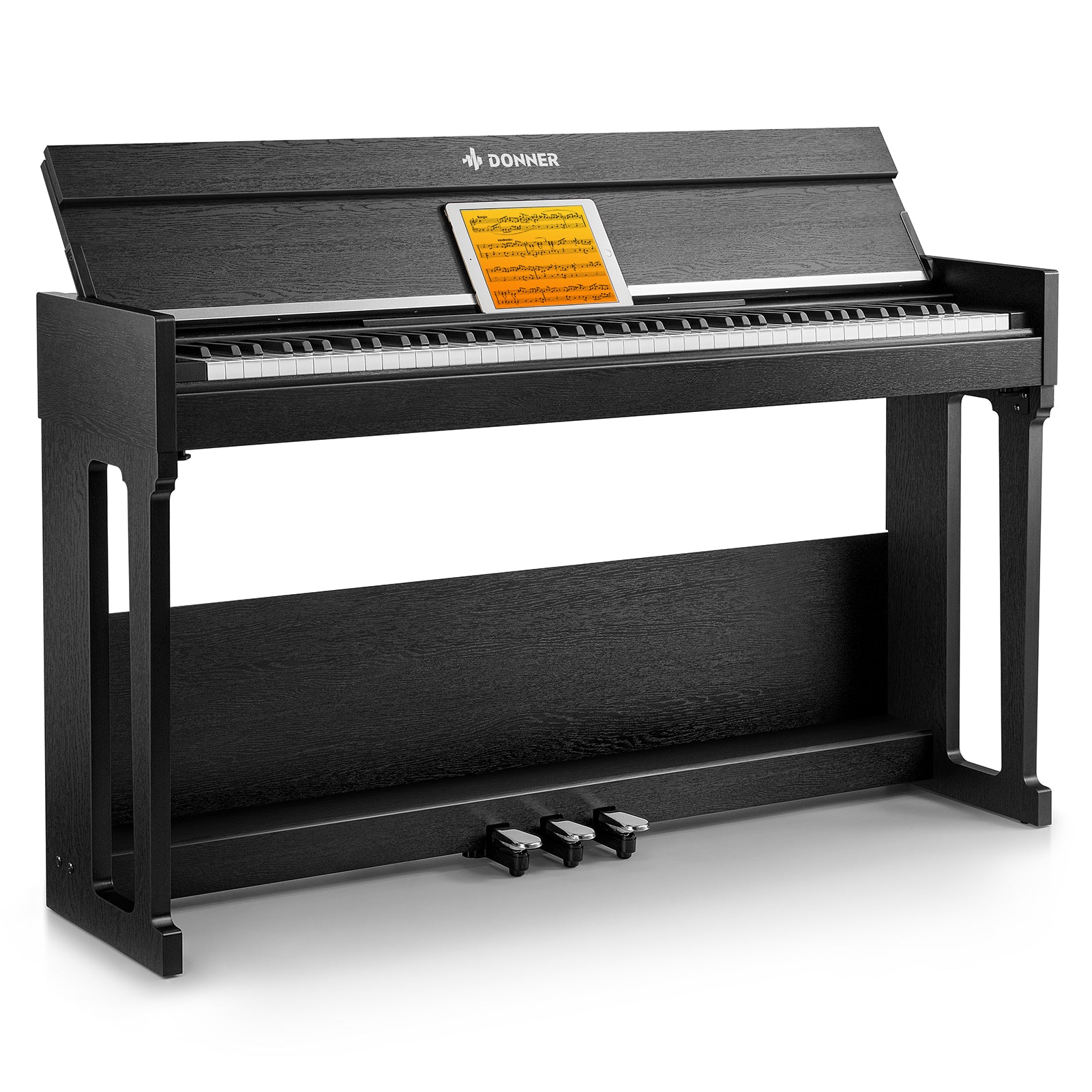
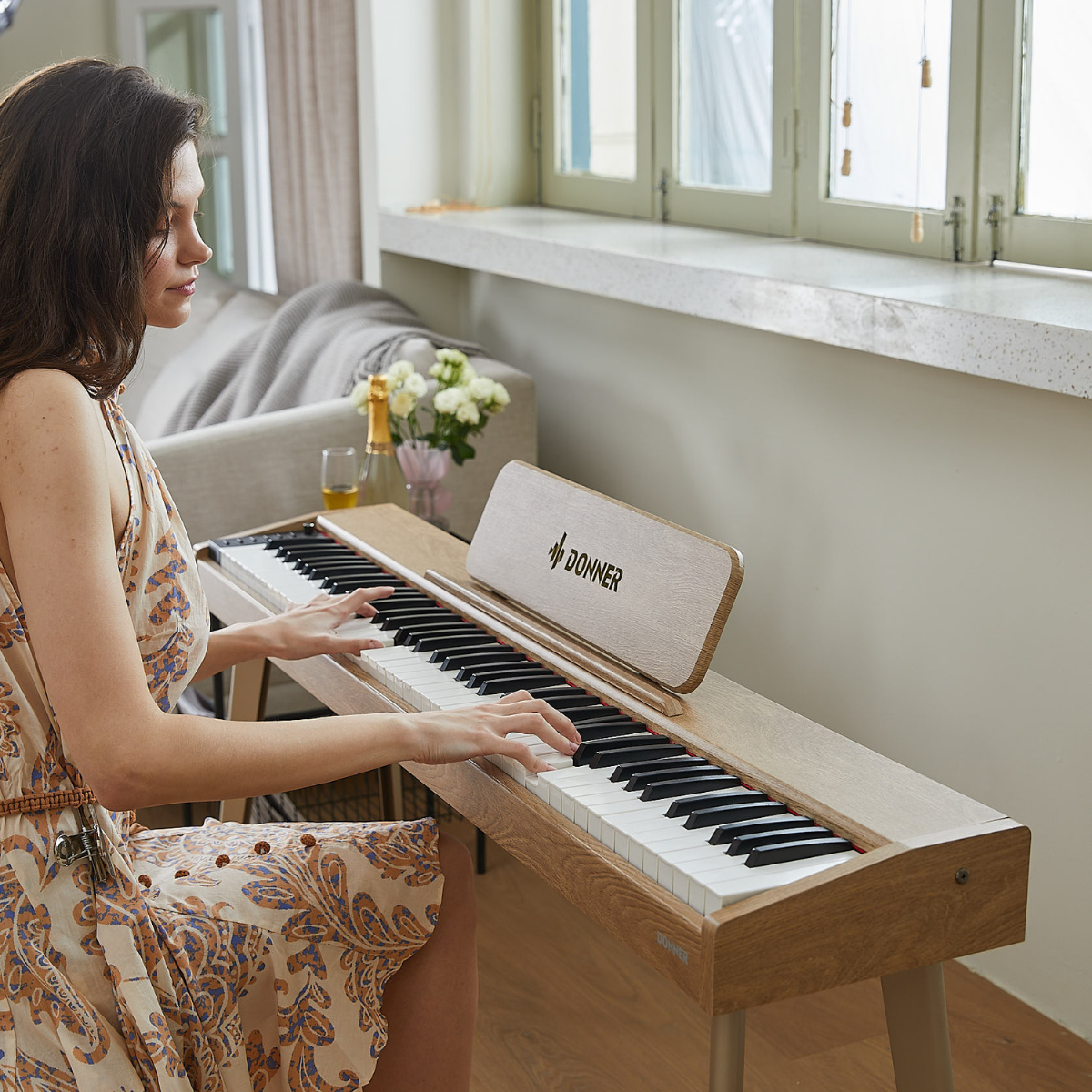
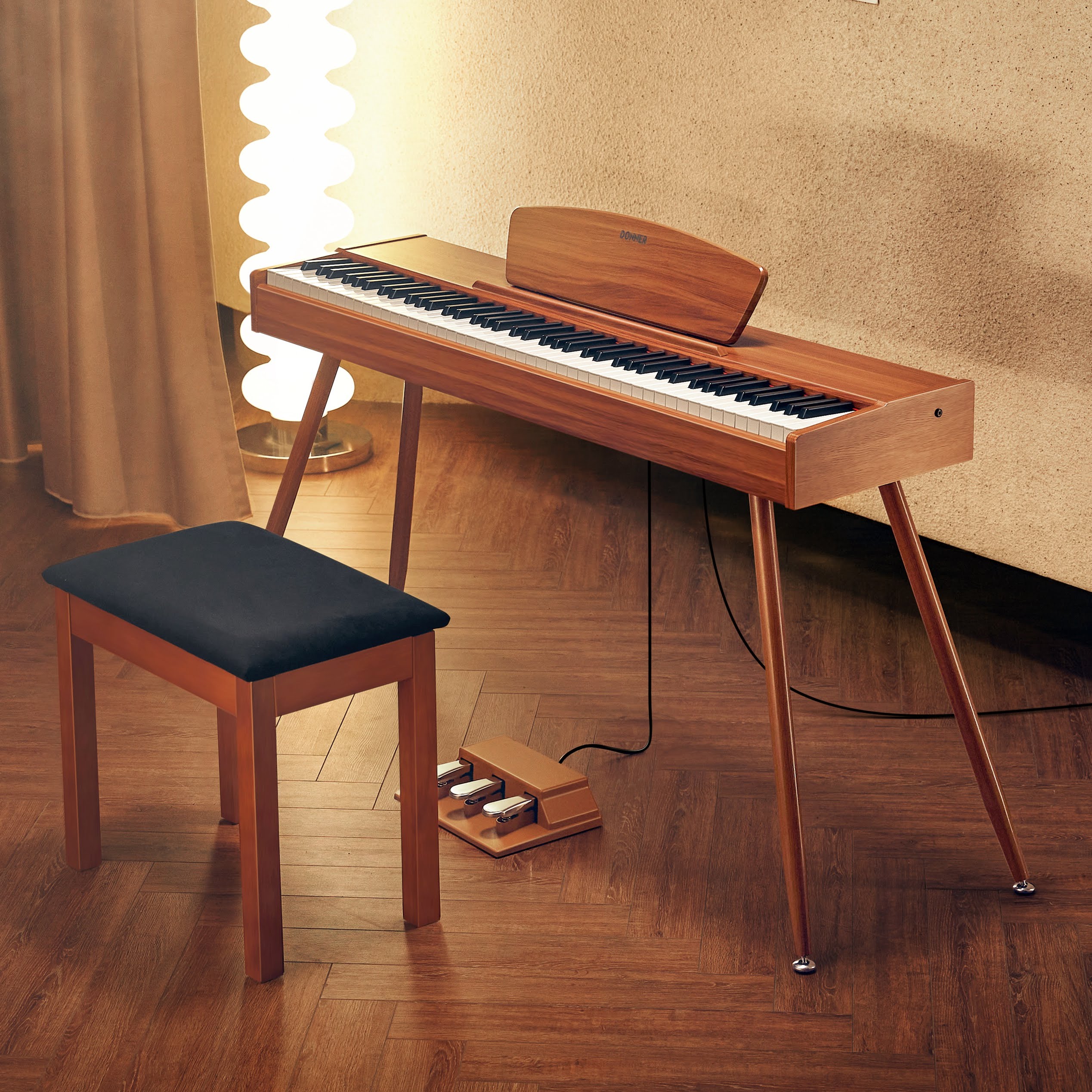
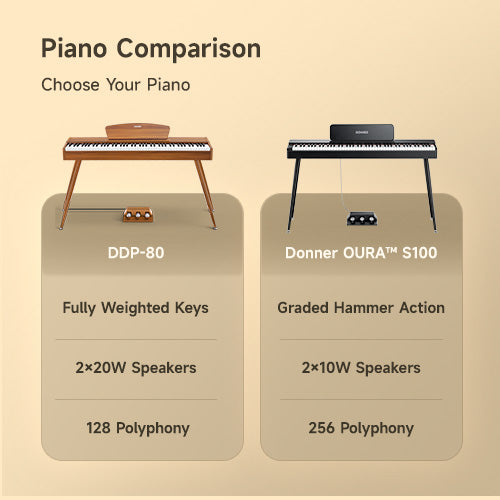
Donner DDP-80 Digital Piano
Choose this if: You want an authentic progressive acoustic resistance starter set built in a highly minimalist, wooden home cabinet.
- Progressive Hammer Action (Hammer Action II) with authentic weighted feel
- 128-note polyphony powered by the Dream5704 chip source sound engine
- Minimalist wooden cabinet design with built-in dual 20W speakers (40W total)

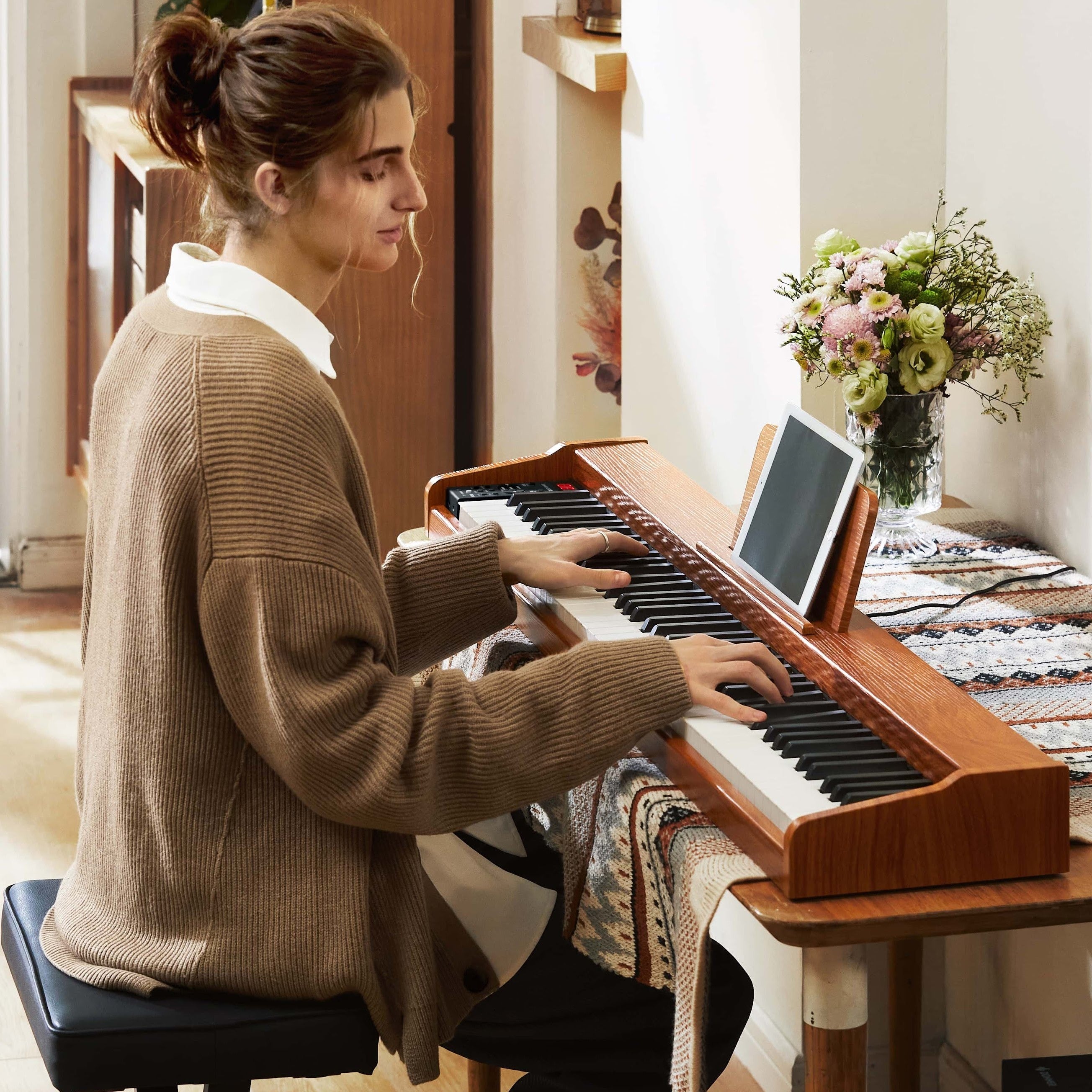
Donner DDP-95 Digital Piano
Choose this if: You are a student who wants a classic cabinet piece combined with dynamic interactive parameters and back-lit display checks.
- 88-key graduated heavy action featuring progressive touch resistance control
- Massive acoustic and electronic dynamic selection with 610 tones and 600 accompaniment rhythms
- Classical upright cabinetry with built-in double-pedal system and 4.3-inch LCD interface
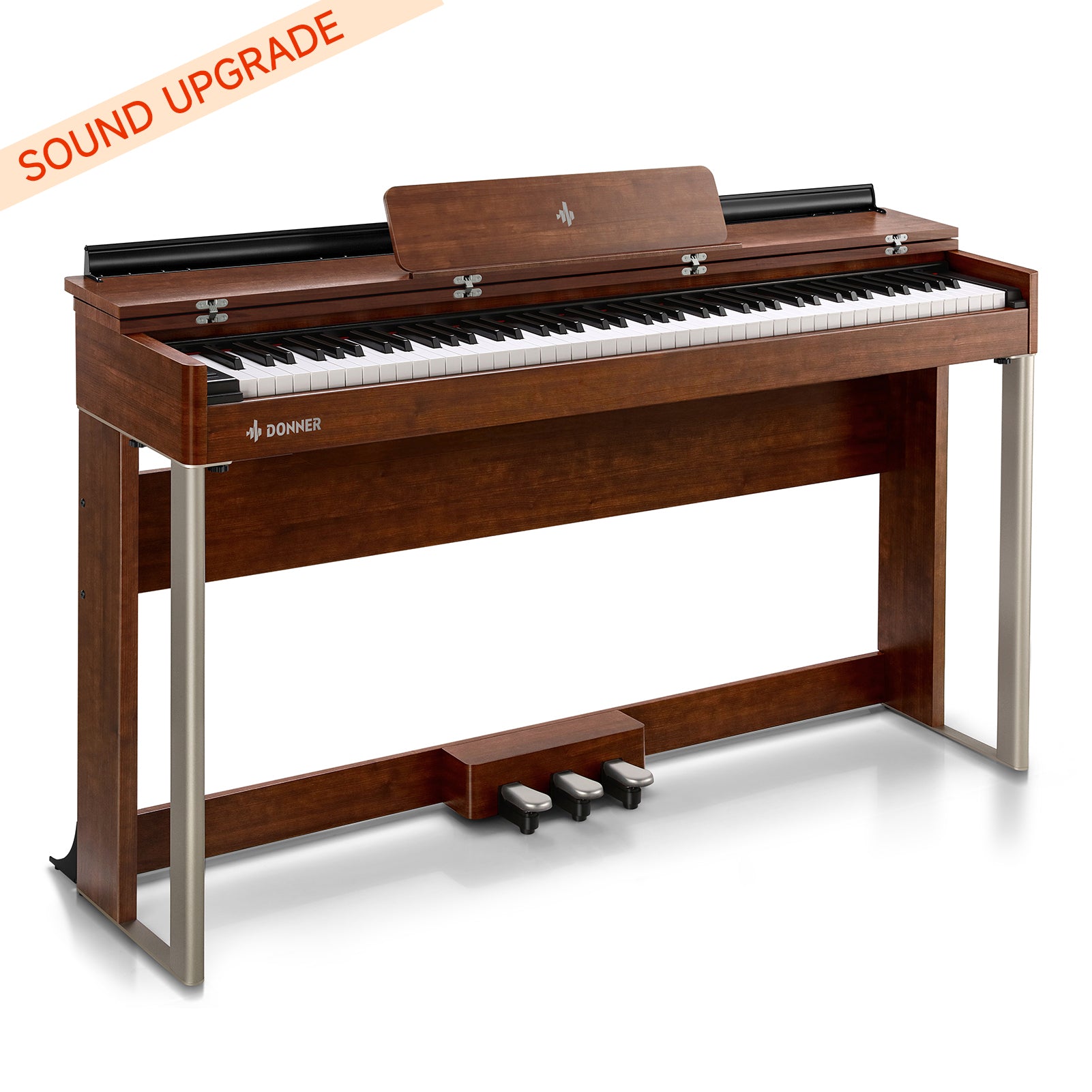
Donner DDP-200 Digital Piano
Choose this if: You are looking for a professional-grade furniture home centerpiece with a highly responsive, double-sensor grand-style action.
- Premium Graded Grand Hammer action (Dynamic Grand Hammer DGH) with micro-action timing response
- Custom Donner DSP sound engine coupled with 128-note polyphony and 3D hanging speakers
- Luxurious enclosed wooden upright furniture featuring dual headphones and sliding-glide protective cover
FAQ: Weighted Keys vs Non Weighted Keys
What do weighted keys feel like compared to non-weighted keys?
Weighted keys possess a physical heft, requiring deliberate finger pressure to press down and rising back up with a controlled, realistic bounce. In contrast, non-weighted keys feel light, snappy, and springy, offering almost no physical resistance under your fingertips.
How can I tell if a keyboard has weighted keys without playing it?
Look for words like fully-weighted, hammer action, or graded hammer action on the product page. Check the unit's weight: fully weighted 88-key instruments usually weigh over 25 pounds, whereas non-weighted keyboards are lightweight and can be easily lifted with one hand.
Are weighted keyboards better for beginners than non-weighted ones?
Yes, weighted keyboards are superior if you want to learn proper piano technique. They train your finger muscles and allow you to control note dynamics. Non-weighted keyboards are only preferable if you need a casual, highly budget-friendly instrument for synth leads.
Find Your Sound with the Right Keyboard Action
Selecting the correct keyboard action is a decision that directly shapes your technical growth and playing enjoyment. There is no single superior choice; instead, the right key mechanism is the one that aligns with your musical aspirations and daily workspace. Every time you strike a note, the physical response of your keyboard should inspire confidence and match the style of music you love.
We at Donner Music believe that making highly inspiring, beautifully constructed electric musical instruments accessible to everyone is essential for a fulfilling musical journey. If you are ready to dive in and experience authentic hammer action, we invite you to explore our compact and powerful digital pianos to find your perfect home musical companion.