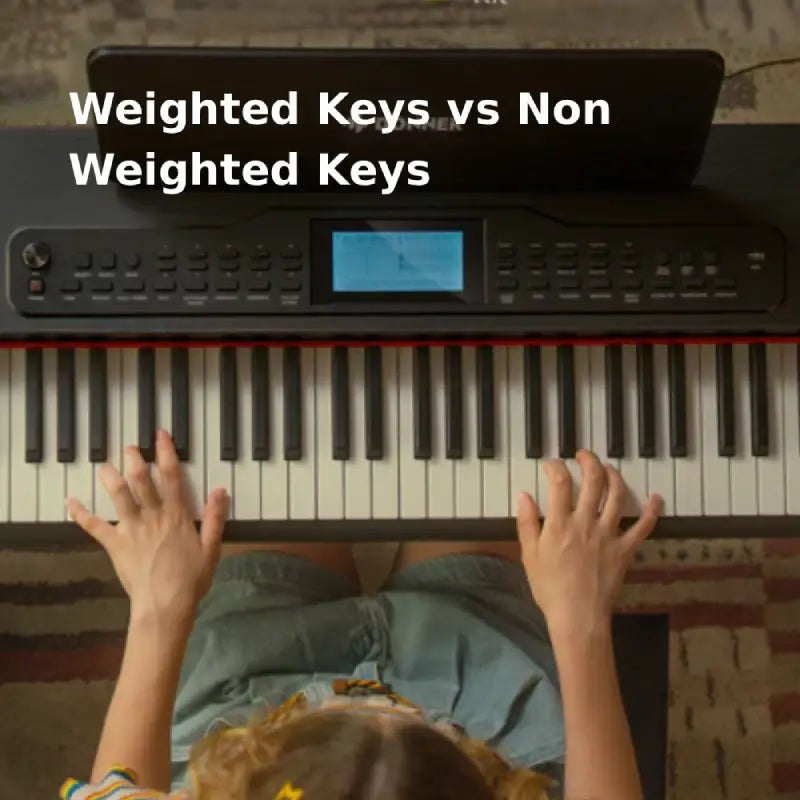







When shopping for an electronic keyboard, you will frequently encounter the terms "touch sensitive" and "weighted keys" in product specifications. While these terms sound incredibly similar, they refer to two completely different aspects of keyboard engineering. Understanding the distinct roles of key weight and physical velocity sensitivity is crucial for selecting an instrument that matches your musical goals.
Confusing these electronic features can lead to purchasing a digital piano that is unsuited for your daily practice. This guide compares touch-sensitive keyboards and weighted digital pianos across key parameters—including key feel, dynamic range, skill development, portability, and price—allowing you to determine which action fits your routine.
Quick Summary
Weighted keys physically simulate the heavy hammer action and wooden resistance of an acoustic piano, making them building blocks for serious piano students who need to establish hand strength and traditional playing form. Touch-sensitive keyboards are typically unweighted, spring-loaded instruments where the volume responds to how hard or fast you hit a key, making them highly portable, affordable, and practical choices for casual play or electronic sound production.
Quick Comparison Between Touch Sensitive and Weighted Keys
| Dimension | Touch Sensitive Keys | Weighted Keys |
|---|---|---|
| Key Feel | Light, bouncy, spring-loaded | Heavy, substantial, realistic hammer weight |
| Dynamic Control | Digital velocity sensors change volume | Physical lever weight and sensor response dictate tone |
| Learning Suitability | Okay for basic note learning, bad for acoustic prep | Essential for building finger muscles and classical form |
| Portability | Ultra-light (under 10 lbs), easily gigged | Heavy (25 to 55 lbs), best for stationary setups |
| Price Range | Highly budget-friendly ($50 to $200) | Mid-to-high investment ($300 to $800+) |
| Best For | Casual playing, synthesizer leads, traveling | Traditional lessons, home practice, serious piano study |
Table of Contents
- Key Feel & Action
- Dynamics & Expression
- Learning & Skill Transfer
- Portability
- Price & Value
- How to Choose Between Touch Sensitive and Weighted Keys
- Best Digital Pianos for Different Key Actions
- FAQ About Touch Sensitive and Weighted Keys
- Find the Right Keyboard for Your Playing Style
- Related Posts
Key Feel & Action
To understand these instruments, it is helpful to look at the core physical relationship: all weighted keyboards are touch-sensitive, but not all touch-sensitive keyboards are weighted. Touch sensitivity is an electronic function. Underneath each key sits a velocity sensor that measures how quickly the key is pressed. The electronic sound engine then translates this speed into a corresponding volume—striking the key quickly produces a loud sound, while pressing it slowly results in a soft tone.
Weighted keys are a physical mechanical function. Instead of relying solely on plastic hinges and coil springs, weighted instruments integrate metal levers and counterweights designed to copy the physical response of acoustic piano hammers. When you press a weighted key, you are physically hoisting a small lever that mimics the natural weight, momentum, and gradual drag of an acoustic action.
Pressing a touch-sensitive, non-weighted keyboard feels exceptionally light, bouncy, and plastic. The keys bounce back instantly via spring tension, offering no progressive resistance. A weighted keyboard has a noticeable heft and physical drag that slows down the key release slightly, providing a natural bounce-back that mimics an acoustic piano. For players who want a true, realistic touch, top-rated weighted digital pianos deliver the most authentic experience.
Winner: Weighted action wins for realistic piano feel; touch-sensitive unweighted action wins for low-fatigue synth runs.
Dynamics & Expression
Dynamics refer to the volume gradations between soft (pianissimo) and loud (fortissimo). On an unweighted, touch-sensitive keyboard, the electronic sensors provide volume control, allowing you to alternate between quiet and loud notes. However, because the keys are virtually weightless, finding the middle ground between these extremes is highly difficult. Fingers lack physical feedback to measure how much pressure is being applied, making delicate crescendos or steady middle-volume lines difficult to execute consistently.
To overcome this, many unweighted keyboards offer menu settings to adjust touch sensitivity curves, allowing you to select between soft, medium, hard, or fixed velocity responses. While helpful for tailoring the keyboard to different playing styles, electronic customization cannot replace physical substance.
Weighted digital pianos supply natural dynamic control. Because your hand is pushing against physical mass, you can master delicate, quiet passages or deliver robust, punchy chords with complete predictability. The mechanical counterweight works in tandem with the internal sound card, giving you an organic connection between the physical force of your fingers and the acoustic output of the speakers without requiring you to dive into system settings.
Winner: Weighted action wins decisively for nuanced classical expression and professional digital piano dynamic control.
Learning & Skill Transfer
Starting formal piano lessons on a non-weighted, touch-sensitive keyboard can lead to learning hurdles. Because unweighted keys require almost no physical effort to activate, practicing on them fails to develop the finger muscles, arch posture, and independent joint control required for classical training. Students who train exclusively on unweighted keyboards often struggle when performing on acoustic pianos, experiencing hand fatigue and losing notes because they cannot press down the heavier wooden keys.
Educational publications and professional piano instructors consistently recommend weighted action of eighty-eight keys. Working with physical weights on the best keyboards for learning piano teaches your fingers and wrists how to distribute force properly, preparing you for recitals and exams. Reading about digital piano vs acoustic piano highlights how premium digital designs attempt to minimize this transition gap.
For casual hobbyists or children learning simple melodies, a touch-sensitive keyboard is a reasonable starting point. However, understanding how many keys a beginner keyboard needs helps you select the correct length and action, ensuring you do not outgrow your instrument within the first six months of study.
Winner: Weighted keys win for technique building, long-term learning value, and standard lesson prep.
Portability
For performing musicians, giging keyboardists, and apartment renters, physical portability is heavily valued. Touch-sensitive, unweighted keyboards are incredibly light because they are made from hollow plastic mouldings and simple electronic components. A full-size touch-sensitive keyboard can easily weigh under 10 pounds. This allows for simple travel in lightweight gig bags, and many units run on standard batteries, letting you practice anywhere.
Fully weighted mechanical actions are heavy. Because they house 88 individual weighted metal levers, structural steel supports, and solid wood cabinets — a key factor in 61 vs 88 key keyboard decisions — weighted digital pianos start at 25 pounds for portable slab designs and can extend past 80 pounds for upright furniture setups. Selecting 88-key digital pianos with heavy hammer-action blocks means dedicating a permanent space in your home and investing in a sturdy keyboard stand.
Winner: Touch-sensitive unweighted keys win for travel, flexible setup, and physical portability.
Price & Value
Unweighted, touch-sensitive instruments are highly affordable to manufacture. High-quality spring-loaded keyboards are highly accessible, starting between $50 and $200. This lower price point is highly popular with parents who are unsure if their child will stick with piano lessons over the long run, minimizing initial financial exposure.
Weighted digital pianos are more intricate, requiring detailed internal construction and premium structural materials. Entry-level models start around $300 to $500, with advanced furniture models ranging from $800 to $1,500. These affordable digital pianos worth buying represent a smart investment for serious learners. While the upfront investment is higher, a quality weighted piano will support a learner for five to ten years of study, saving you from having to buy a second instrument when a child's skills progress. If you are comparing starter digital pianos, dedicating a slightly higher budget to a weighted model delivers superior long-term educational value.
Winner: Touch-sensitive unweighted instruments win for low budget under $200; weighted digital pianos win for multi-year durability and educational returns.
How to Choose Between Touch Sensitive and Weighted Keys?
Select your key action by matching your instrument to your specific playing scenario:
- Scenario 1: You are a serious beginner, taking formal lessons, or learning classical piano pieces. Choose fully weighted keys. Developing your hand posture, finger speed, and dynamic control requires practicing on an action that replicates physical acoustic hammers.
- Scenario 2: You are on a budget, need a portable instrument for travel, or plan to play synth melodies. Choose a touch-sensitive keyboard. These units offer great sound library variations, weightless portability, and affordable starts.
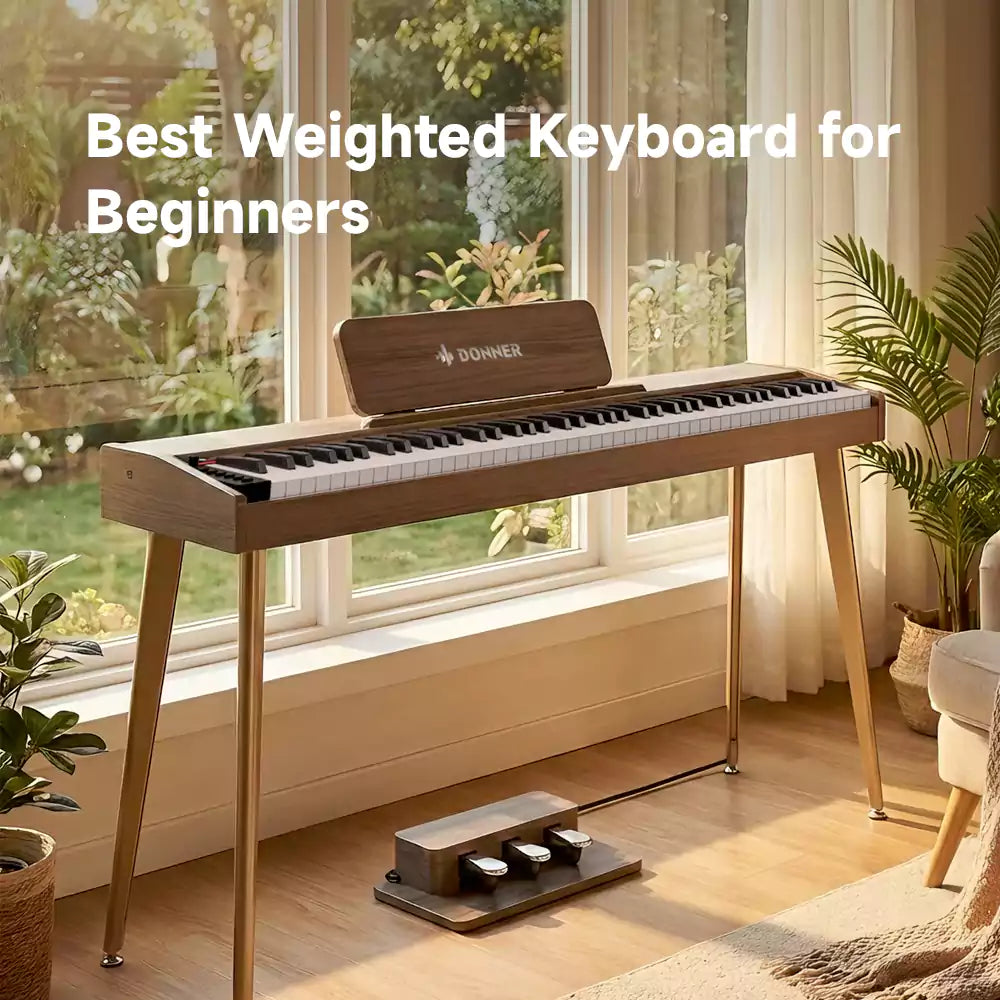
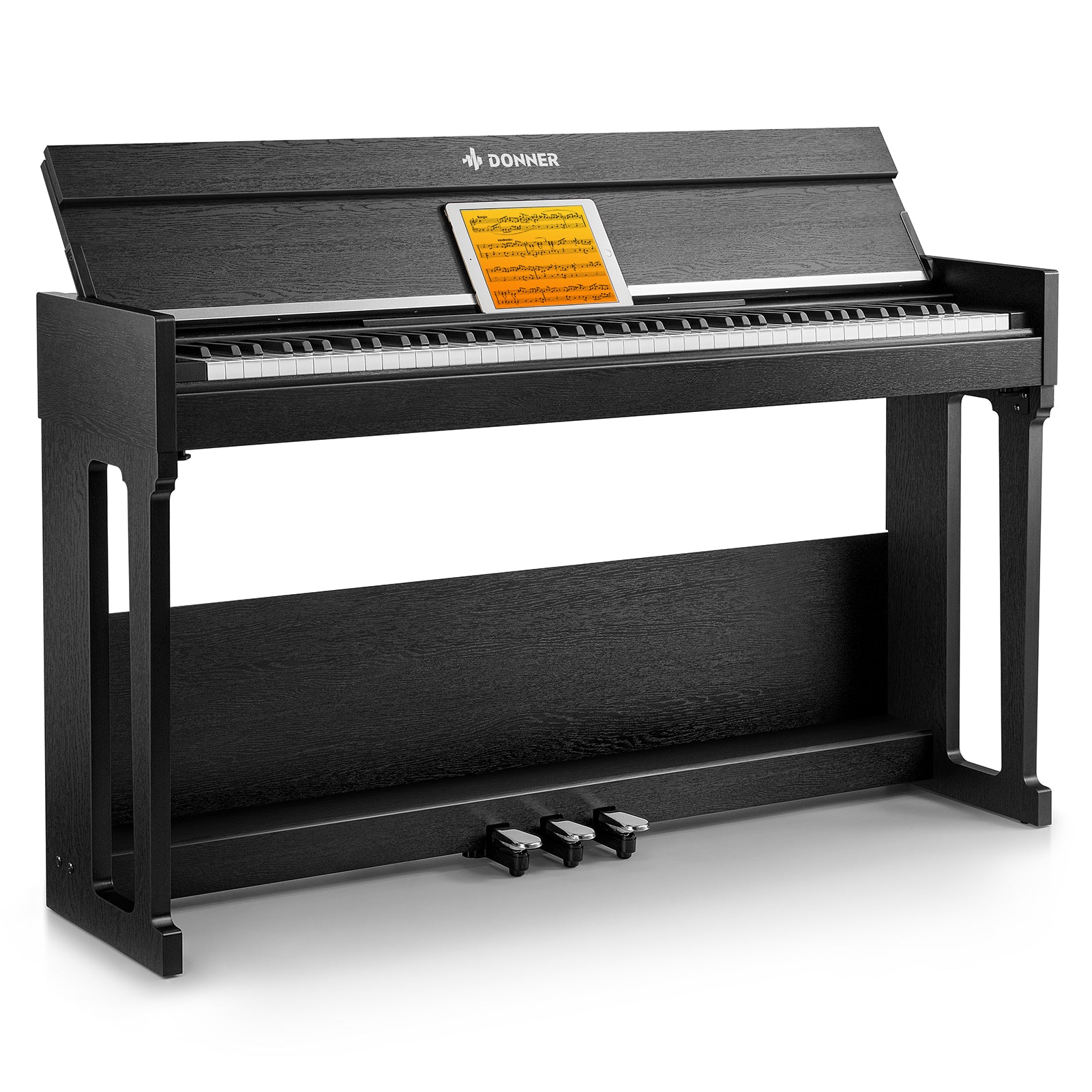
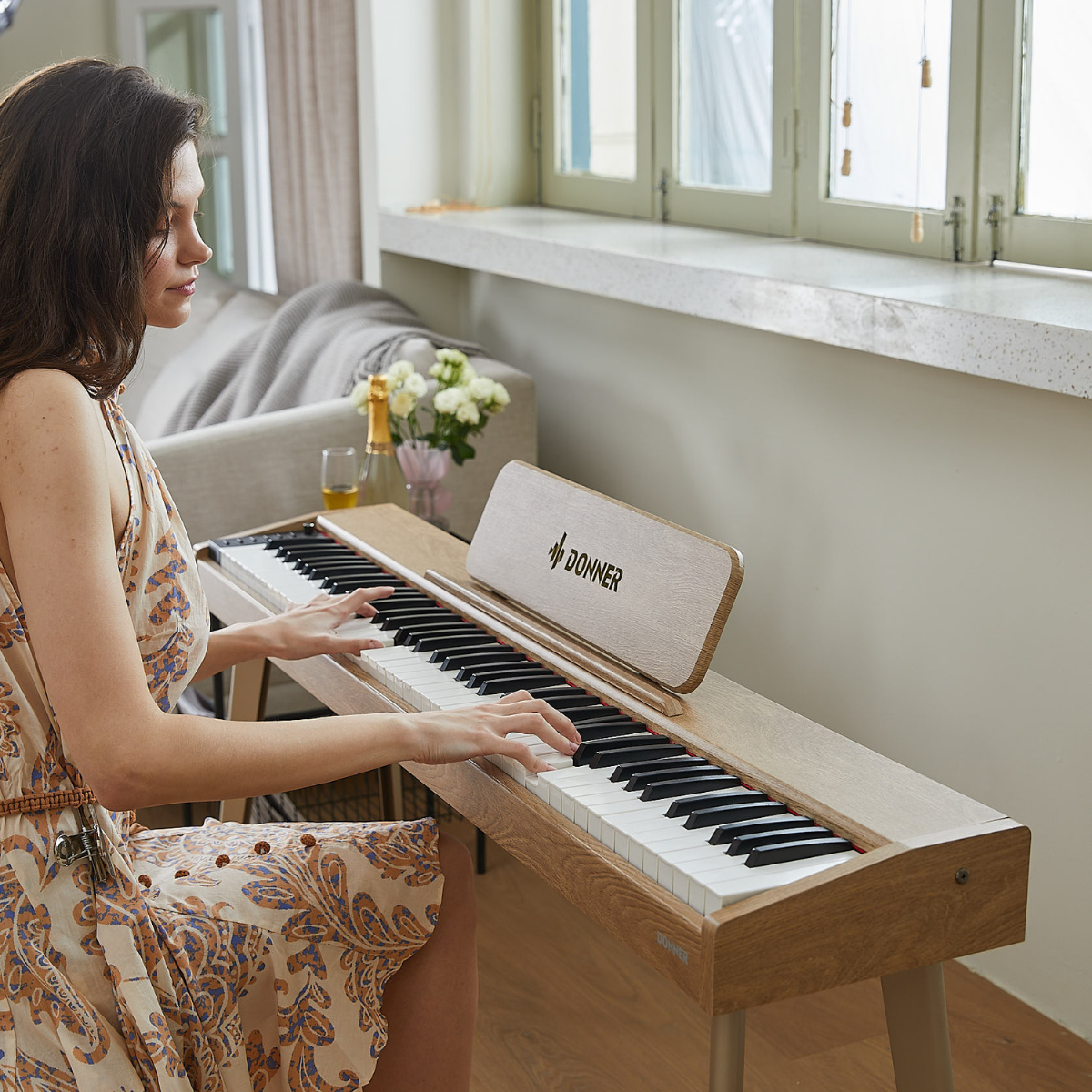
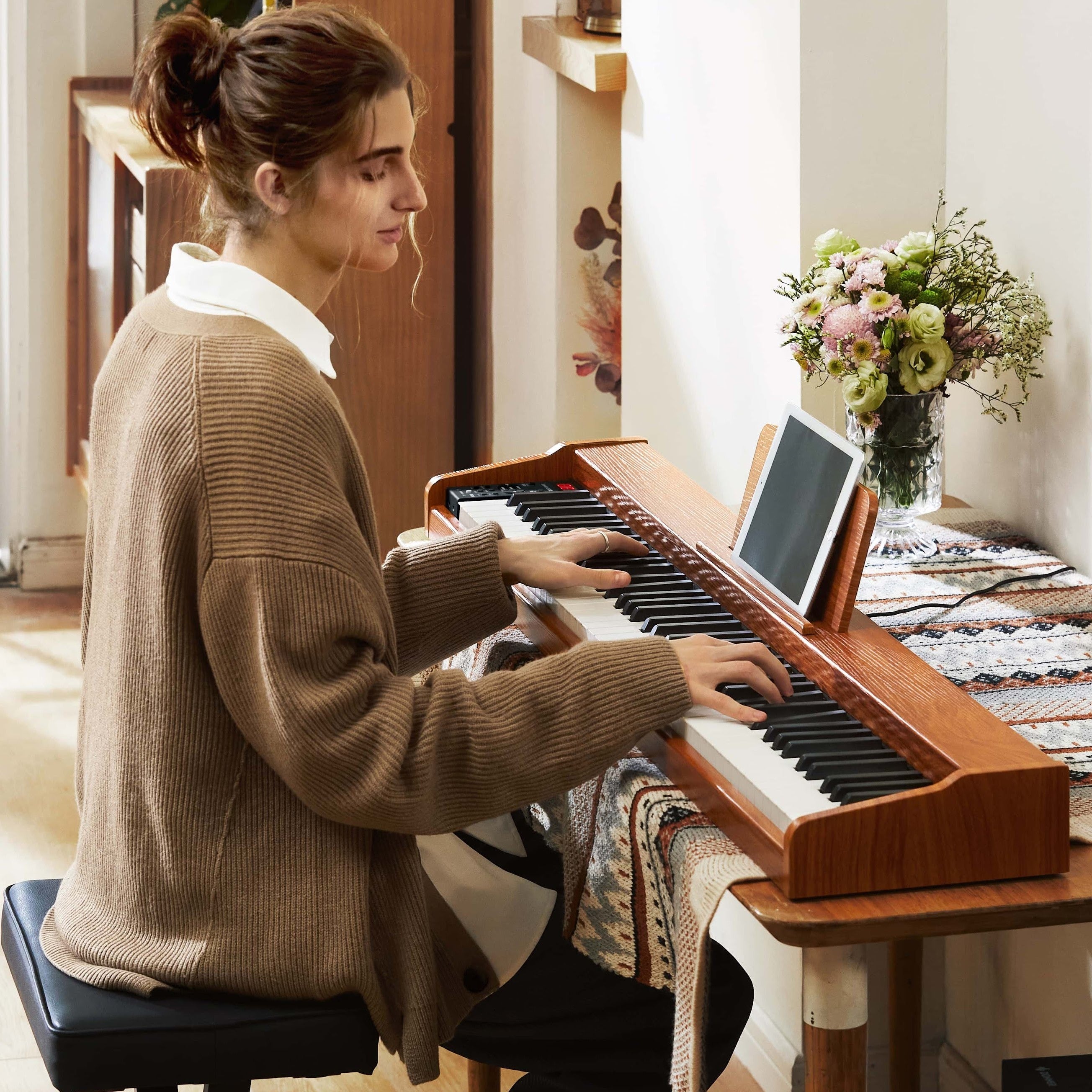
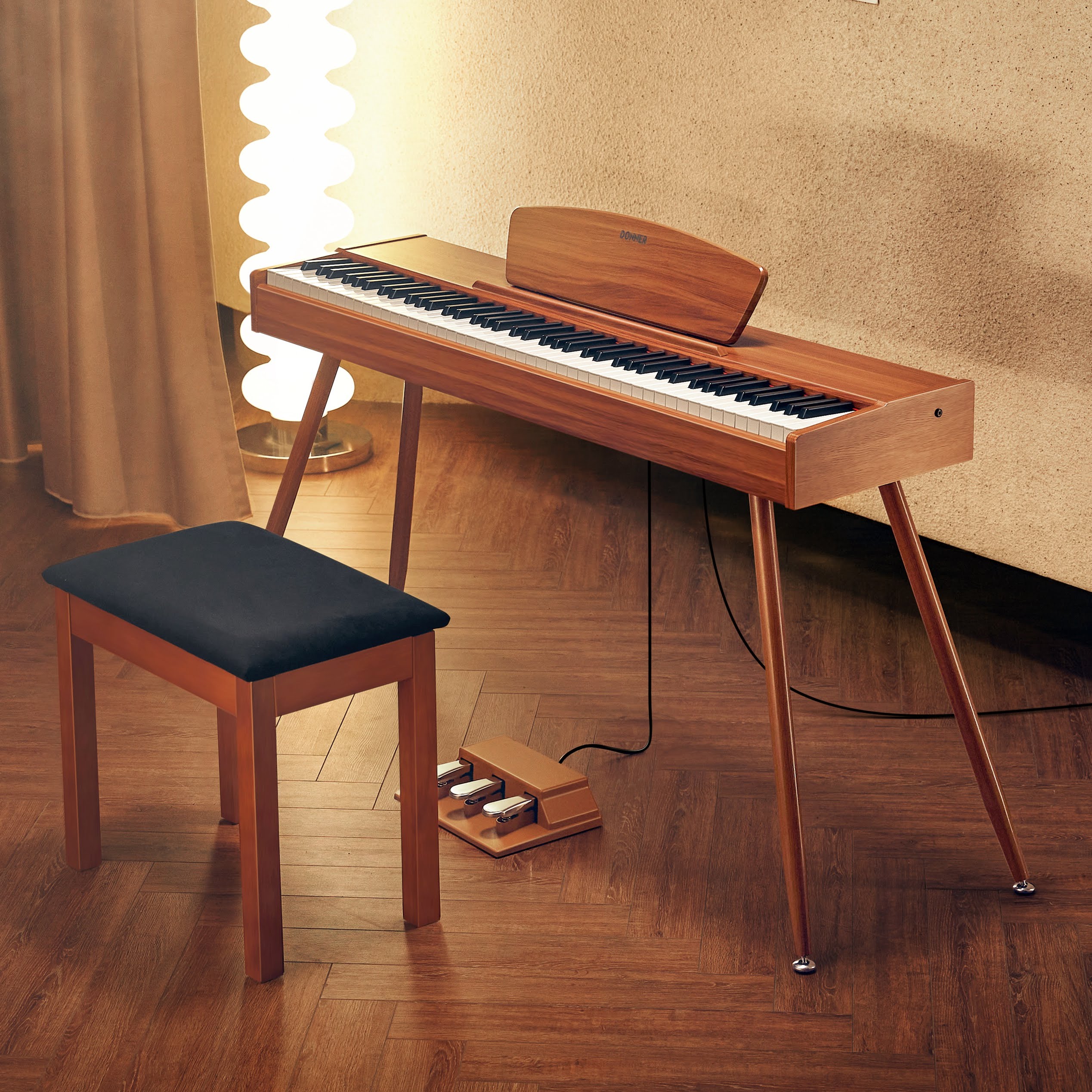
- Scenario 3: You want realistic weighted play in a permanent, high-quality home furniture design.Donner DDP series digital pianos for elegant woodworking and robust hammer action are built for long-term technique growth.
Best Digital Pianos for Different Key Actions
These featured models provide exceptional tone and specific keybed mechanisms to match your individual style:

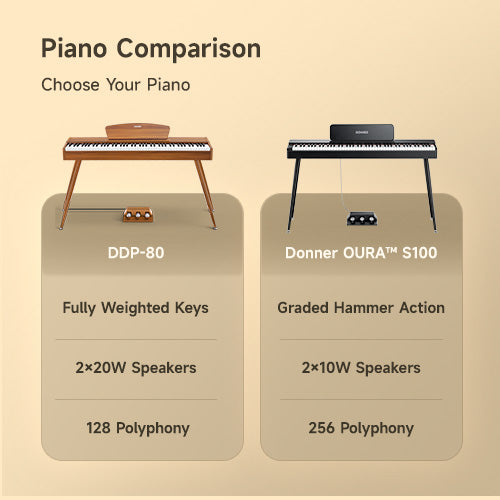
Donner DDP-80 Digital Piano
Choose this if: You are a serious piano learner who wants a highly design-oriented wooden keyboard stand with solid resistance support.
- Progressive Hammer Action (Hammer Action II) with authentic acoustic resistance
- 128-note polyphony paired with the majestic custom grand sound source engine
- Minimalist wooden cabinet design suited for high-end home and apartment spaces — a stylish digital piano for elegant interiors

Donner DEP-20 Digital Piano
Choose this if: You need a highly capable, heavy portable slab design equipped with robust sound parameters and heavy-duty 50W sound projection.
- 88-key fully-weighted hammer action keyboard with 16 selectable electronic sensitivity settings
- Dual built-in 25W sound speakers (50W total output) for grand, room-filling stereo volume
- Wooden frame design with custom LED parameter screen and triple-pedal support interface
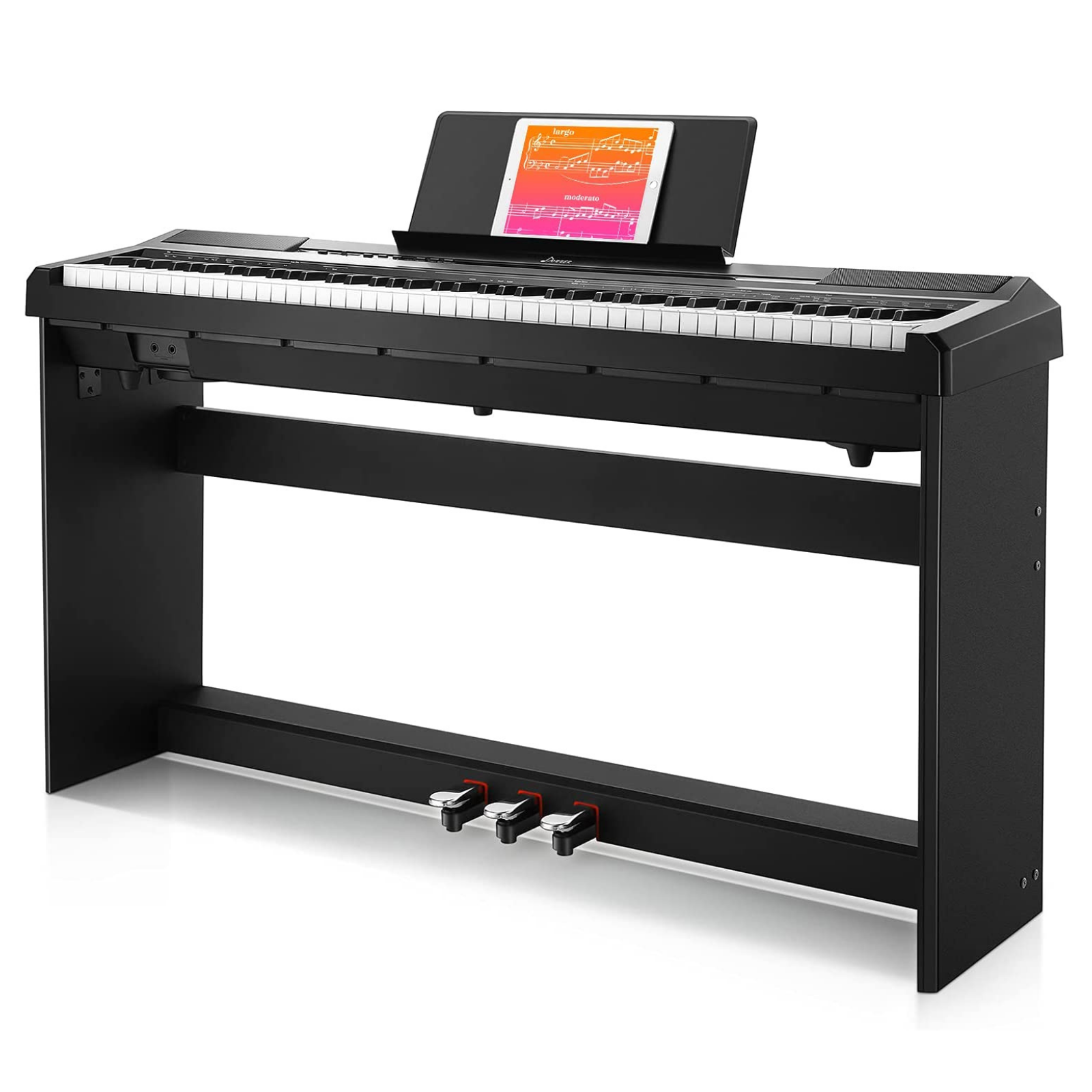
Donner DP-10 Digital Piano
Choose this if: You are a traveler or casual hobbyist looking for micro-weight space savings paired with touch-sensitive bluetooth capabilities.
- 88-key semi-weighted, touch-sensitive action that records keystroke velocity accurately
- Foldable, ultra-portable design weighing just 3.5kg (7.8 lbs), with an included carrying case
- Dual Bluetooth audio and MIDI technology for instant interactive app companion integrations
FAQ About Touch Sensitive and Weighted Keys
Do I need a touch sensitive keyboard?
Yes, a touch-sensitive keyboard is highly recommended even if you are on a strict budget. Without touch sensitivity, the keyboard will play at a single uniform volume regardless of how hard or softly you press the keys, making it impossible to add dynamic emotion or play expressive modern music.
What does touch sensitive mean on a keyboard?
Touch sensitivity means the keyboard is equipped with velocity sensors that detect the speed and force of your keystroke. It adjusts the volume of the sound accordingly: playing with energy produces a loud note, while pressing gently outputs a soft, quiet tone.
Are weighted keyboards better for beginners?
Yes, weighted keyboards are far superior for beginners who are studying traditional piano. A home digital piano with weighted keys offers the ideal practice environment. Practicing on a weighted action builds physical hand stamina, encourages proper wrist posture, and ensures a seamless transition to any acoustic piano you encounter.
Find the Right Keyboard for Your Playing Style
Determining the correct keybed mechanism is a personal decision that shapes your journey as a musician. For classical players and formal students, investing in a robust, traditional key weight is the bridge to authentic acoustic play. For multi-genre gigging musicians and casual hobbyists, unweighted touch sensitivity provides the freedom to travel lightly and explore endless electronic tones.
At Donner Music, we design high-quality, exceptionally engineered key actions to help every student connect with their creative voice. If you are ready to explore a responsive touch, we invite you to browse our full selection of digital pianos and keyboard pianos to discover the home setup that fits your musical aspirations.