





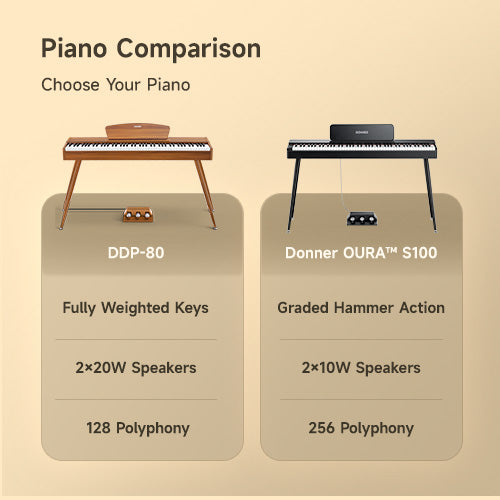
Looking for the best weighted keyboard piano that feels like a real acoustic instrument? We tested and compared the top 88-key weighted keyboard pianos across every budget — from beginner bundles under $300 to flagship stage keyboards — so you can find the right weighted keyboard piano for your goals.
Our Top Picks of Weighted Keyboard Piano
If you need a quick starting point before diving into the detailed comparisons below, here is how our top eight picks for the best weighted keyboard piano in 2026 stack up across key action type, primary use case, and estimated street price.
| Model | Best For | Key Action | Est. Price |
|---|---|---|---|
| Donner DEP-20 | Best value complete bundle | 88 full-size weighted | ~$400 |
| Alesis Recital Pro | Budget hammer-action | 88 hammer-action | ~$380 |
| Yamaha P-225 | Safest starter pick | 88 Graded Hammer Compact | ~$550 |
| Roland FP-30X | Long-term practice | 88 PHA-4 weighted | ~$700 |
| Yamaha P-525 | Flagship portable | 88 GrandTouch weighted | ~$1,600 |
| Kawai ES120 | Best piano tone | 88 Responsive Hammer | ~$850 |
| Donner DEP-16 | Entry-level under $350 | 88 semi-weighted | ~$300 |
| Alesis Prestige | Cheap graded hammer | 88 graded hammer | ~$450 |
[IMG: Product comparison infographic showing price range, key action type, and best-use scenario for each weighted keyboard piano]
Best Weighted Keyboard Pianos for Beginners
If you are just starting your piano journey, the instrument you choose will shape your technique from day one.
A weighted keyboard for beginners needs to provide at least 88 keys with enough physical resistance to mimic the feel of an acoustic piano.
The three full-weighted keyboard pianos below represent the best entry points across different priorities — value, action quality, and brand reliability.
Donner DEP-20 — Best Value Complete Bundle (~$400)
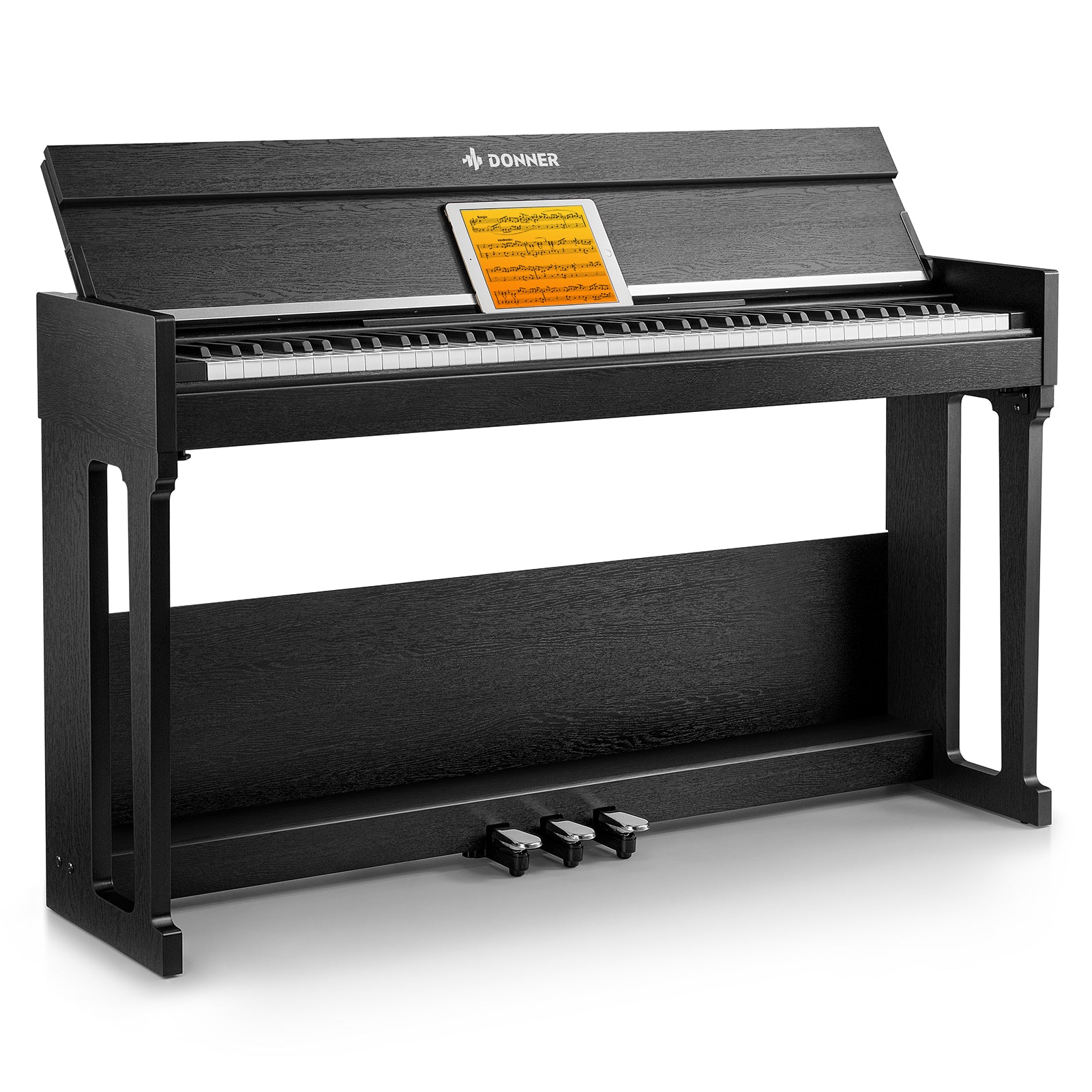
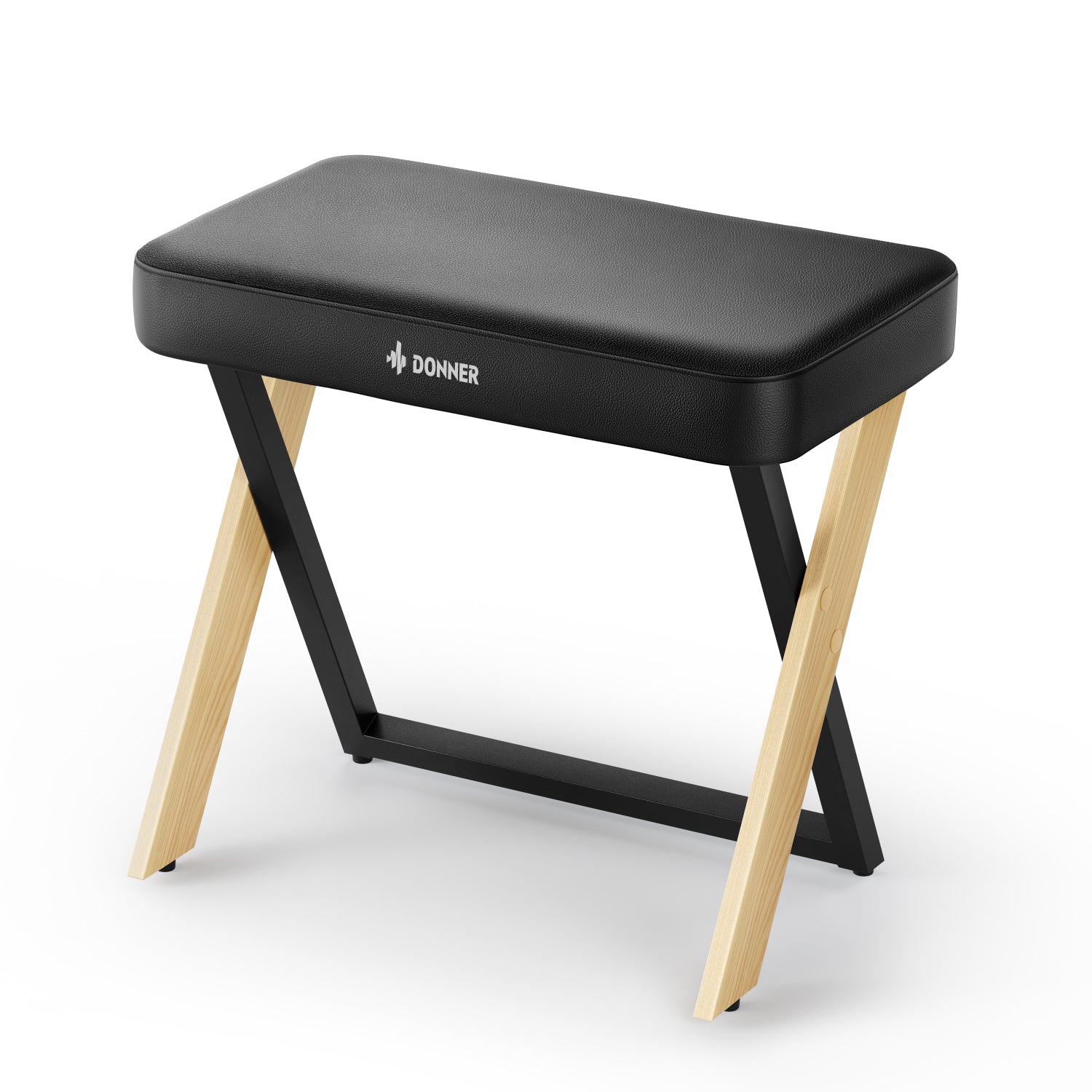
The Donner DEP-20 keyboard piano is the most practical beginner purchase in the weighted keyboard piano category right now, and the reason is refreshingly simple: Donner ships a complete playing setup in a single box. While most entry-level weighted keyboard pianos arrive as a bare instrument that requires you to hunt down a stand, bench, and sustain pedal separately, the DEP-20 bundle includes a sturdy Z-style metal stand, a three-pedal unit that replicates the soft, sostenuto, and sustain functions of an acoustic piano, and a padded bench that sits at a comfortable playing height out of the box. You can be seated and practicing within thirty minutes of the delivery arriving at your door.
The keyboard itself features 88 full-size weighted keys that offer enough resistance to build proper finger strength and dynamic control during daily practice. The graded weighting is entry-level — it does not deliver the kind of nuanced, escapement-equipped feel you would find on a $2,000 instrument — but for a beginner or returning player who needs to develop foundational technique, the action is entirely appropriate and far more credible than any unweighted or lightly-sprung alternative at this price. The dual 25-watt speakers project cleanly enough to fill a medium-sized living room, and the 128-note polyphony ensures that sustained chords and pedal-heavy passages do not cause notes to cut off prematurely, which is a common frustration on cheaper beginner keyboards.
Beyond the core piano experience, the DEP-20 packs in 238 built-in tones covering everything from electric pianos and organs to strings and synth pads, plus 200 accompaniment rhythms that make solo practice feel more musical. Bluetooth connectivity allows you to pair the keyboard with learning apps like Simply Piano, Skoove, or Flowkey, which is a feature some keyboards at twice this price still omit. For a beginner who wants to minimize friction and maximize practice time from the very first day, no other full-weighted keyboard piano at this price point offers a more complete package.
Pros:
- Complete bundle includes stand, three-pedal unit, and bench — no separate accessory shopping required
- 88 full-size weighted keys with adequate resistance for developing proper technique
- 128-note polyphony handles sustain-heavy music without note dropout
- Bluetooth connectivity for pairing with piano learning apps
- 238 tones and 200 rhythms provide variety beyond basic piano sounds
Cons:
- Weighted action is entry-level and lacks the escapement feel of more expensive hammer-action keyboards
- Speaker quality is functional rather than impressive — sufficient for home practice but not for performance
- Less brand recognition and resale value compared to Yamaha or Roland

Alesis Recital Pro — Best Budget Hammer-Action Pick (~$380)
The Alesis Recital Pro occupies a unique position in the budget weighted keyboard piano market because it delivers genuine hammer-action keys — a feature normally reserved for instruments costing $600 and above — at a street price that hovers around $380. The 88 fully weighted, velocity-sensitive keys use an internal hammer mechanism that provides a satisfying, realistic resistance when you press down, which makes a tangible difference when you start working on dynamics and expressive playing.
Alesis has built several thoughtful practice features into this weighted keyboard piano that go beyond what most competitors offer at this price. The lesson mode splits the keyboard into two identical zones with the same pitch range, allowing a teacher and student to sit side by side and play the same passages simultaneously — a feature that in-person instructors genuinely appreciate. The built-in recorder captures your practice sessions so you can listen back critically and hear mistakes that are easy to miss in the moment. With 12 built-in voices, the sound selection is more restrained than keyboards that offer hundreds of tones, but the core acoustic piano, electric piano, and organ sounds are usable and responsive.
A notable practicality: the Recital Pro can run on six D-cell batteries, meaning you can take this weighted keyboard piano to a park, a friend's house, or an outdoor gathering without needing access to a power outlet. The 2x20-watt speakers are adequate for solo practice and small rooms, though they will not fill a large space with authority.
Pros:
- Genuine hammer-action keys at a sub-$400 price point — rare in this category
- Lesson mode splits the keyboard for side-by-side student-teacher practice
- Built-in recorder for self-assessment and tracking progress
- Battery-powered operation adds portability for practice outside the home
- Lightweight enough to move between rooms easily
Cons:
- Key mechanism can develop an audible clicking sound over extended use
- Hammer action, while genuine, is less refined than Roland's PHA-4 or Yamaha's GHS actions
- Only 12 built-in voices — limited variety compared to keyboards with larger sound libraries
- Accessories (stand, bench, upgraded pedal) must be purchased separately

Yamaha P-225 — Safest Starter Pick (~$550)
The Yamaha P-225 is the weighted keyboard piano you choose when you want zero regrets about your first instrument purchase. As the successor to the massively popular P-125, the P-225 refines Yamaha's entry-level formula with a new Graded Hammer Compact (GHC) action that feels lighter and more balanced than the older GHS action, making this keyboard approachable for younger students while still providing the graded resistance that builds proper finger strength. The keys are heavier in the bass register and progressively lighter toward the treble — exactly the tactile gradient that acoustic pianos create through their larger, heavier bass hammers.
The sound engine inside the P-225 is the same CFX concert grand sampling technology that Yamaha deploys in keyboards costing three times as much, and the difference is immediately audible. The piano tone has a rich, present attack with natural decay characteristics that make practice sessions feel more musical and less like you are fighting a sterile digital sound. At 25.5 pounds, this full-weighted keyboard piano is genuinely portable — you can carry it from room to room or transport it to a lesson without hiring a moving crew. The onboard USB audio interface is a forward-looking feature that lets you record directly into a DAW like GarageBand, Logic Pro, or Ableton without needing an external audio interface, which is a meaningful convenience for students who want to start recording their playing.
Pros:
- Yamaha CFX concert grand sound engine delivers professional-grade piano tone
- Graded Hammer Compact action is balanced and approachable for all ages
- Lightweight at 25.5 pounds — genuinely portable for lessons and moving between rooms
- Built-in USB audio interface for direct recording into a DAW
- Strong brand reputation and resale value
Cons:
- Stand, bench, and pedal are sold separately — total accessorized cost often reaches $700+
- 64-note polyphony is functional but can feel limiting during dense classical repertoire with heavy sustain
- No Bluetooth audio streaming — only Bluetooth MIDI

Best Advanced Weighted Keyboard Pianos for Serious Learners
Once you have moved past the beginner stage and established a consistent practice routine, a weighted keyboard with realistic feel transitions from a nice-to-have into an absolute necessity.
The difference between a budget-friendly weighted keyboard piano and a serious mid-range or flagship instrument shows up most clearly in the key action: the subtle gradations of resistance, the tactile feedback under your fingertips, and the way the instrument responds when you push into the keys for fortissimo passages versus feathering them for delicate pianissimo lines.
These three full-weighted keyboard pianos represent the strongest options for players who are committed to long-term growth.
Roland FP-30X — Best Long-Term Practice Piano (~$700)
The Roland FP-30X earns its reputation as the keyboard piano that serious learners buy once and keep for years. At the heart of this instrument is Roland's PHA-4 Standard action, which includes two features rarely found below the $1,500 mark: an escapement mechanism that recreates the subtle "notch" you feel when pressing an acoustic piano key slowly, and textured key surfaces made from moisture-absorbing material that prevents your fingers from slipping during long practice sessions. These are not marketing bullet points — they are physical details that affect how your hands interact with the instrument every single day, and they separate the FP-30X from keyboards that feel plasticky and disposable after six months of regular use.
The onboard SuperNATURAL piano engine uses a combination of sampling and physical modeling to produce a tone that responds dynamically to your playing. Unlike entry-level keyboards that simply play back a recorded sample at different volumes, the FP-30X adjusts timbre, resonance, and decay characteristics in real time based on how hard and how quickly you strike each key, which is the kind of nuance that keeps practice sessions engaging as your skills progress. The 22-watt speakers project a full, room-filling sound, and the Bluetooth audio streaming feature lets you play along with recordings wirelessly through the keyboard's own speakers — a small feature that makes daily practice far more convenient than fiddling with cables or separate speakers. With 256-note polyphony, this weighted keyboard piano handles the densest Romantic-era repertoire and multi-layered recording sessions without breaking a sweat.
Pros:
- PHA-4 Standard action with escapement and textured key surfaces — details usually reserved for $1,500+ instruments
- SuperNATURAL piano engine adjusts tone and resonance dynamically based on playing style
- 256-note polyphony provides massive headroom for complex music and multi-track recording
- Bluetooth MIDI and audio streaming for wireless practice and app integration
- Build quality and key feel justify keeping this instrument for 5+ years of regular use
Cons:
- At $700 for the keyboard alone, it is double the cost of entry-level options before accessories
- Stand and pedal unit must be purchased separately, adding $100–$200 to the total investment
- Heavier and bulkier than ultra-portable models — less convenient for frequent transport

Yamaha P-525 — Best Flagship Portable Weighted Keyboard Piano (~$1,600)
The Yamaha P-525 represents the ceiling of what you can achieve in a portable full-weighted keyboard piano without moving into furniture-style console territory. It pairs Yamaha's flagship GrandTouch-S keyboard action — the same keybed found in the company's Clavinova CLP series — with a dual sound engine that includes both the bright, cutting CFX concert grand and the warmer, more rounded Bösendorfer Imperial grand piano voices, giving you two distinct tonal personalities in a single instrument.
What makes the P-525 feel premium is the combination of wooden white keys, a true escapement mechanism, and internal counterweights that replicate the mass and momentum of an acoustic piano's hammer assembly. When you play softly, the keys respond with a delicate, controlled resistance; when you dig in for fortissimo chords, the keyboard pushes back with physical authority rather than collapsing under your fingers like a budget action. The 40-watt speaker system is genuinely loud enough for small venue performances, which is rare in a portable keyboard form factor, and the onboard audio interface, recording features, and rhythm accompaniments make this a self-contained practice and performance tool rather than something that needs an external setup to sound complete.
Pros:
- GrandTouch-S action with wooden white keys provides the most authentic acoustic piano feel in a portable keyboard
- Dual CFX and Bösendorfer Imperial sound engines offer two distinct concert grand voices
- 40-watt speaker system is powerful enough for small live performances
- Built-in USB audio interface and multi-track recording capabilities
- Comprehensive connectivity including Bluetooth audio and MIDI, line outputs, and headphone jacks
Cons:
- At 48.5 pounds, it stretches the definition of "portable" — better suited to staying in one room
- Premium pricing at ~$1,600 puts it beyond the budget of most beginners and casual players
- Large footprint compared to compact stage pianos like the Casio Privia PX-S1100

Kawai ES120 — Best Piano Tone & Musical Expression (~$850)
If you prioritize sound quality and musical inspiration over spec-sheet bragging rights, the Kawai ES120 deserves a serious look. Kawai has been building acoustic pianos for nearly a century, and that institutional knowledge transfers directly into how this full-weighted keyboard piano voices its piano tones. The Responsive Hammer Compact II action is not the most technically advanced keybed in this roundup on paper, but the way Kawai's harmonic imaging sound engine interacts with that action creates a playing experience that feels warm, organic, and genuinely rewarding during long practice sessions.
The 88-key graded weighting across the ES120 is smooth and progressive, with no abrupt transitions between the bass and treble registers — a subtle detail that matters when you are playing passages that sweep across the full range of the keyboard. The built-in speakers are adequate for home use, though they benefit from being positioned against a wall for natural bass reinforcement. Bluetooth audio connectivity allows you to stream backing tracks or recordings through the speakers while playing along, and the overall package feels thoughtfully designed around the needs of a pianist rather than a feature-checklist marketer.
Pros:
- Exceptionally warm, musical piano tone derived from Kawai's acoustic piano heritage
- Smooth, progressive graded weighting across all 88 keys with no jarring transitions
- Harmonic imaging sound engine responds expressively to playing dynamics
- Compact and relatively lightweight for a mid-range weighted keyboard piano
- Bluetooth audio for wireless play-along with recordings
Cons:
- Kawai has significantly less retail presence in the US compared to Yamaha or Roland
- Built-in speakers are adequate but not as powerful or full-bodied as those on the Roland FP-30X
- Fewer onboard voices and features than comparably priced competitors
- Try-before-you-buy may require visiting a specialty piano dealer rather than a general music store

Best Budget Weighted Keyboard Piano Under $500
Not every musician needs a flagship instrument to make meaningful progress, and spending more money does not always translate to a better playing experience for your specific situation. If you are searching for the best budget weighted keyboard that still delivers a credible, satisfying piano feel, the two full-weighted keyboard pianos below demonstrate that you can get started for well under $500 without sacrificing the fundamentals that matter most for developing proper technique.
Donner DEP-16 — Best Entry-Level Weighted Keyboard Piano for Beginners (~$300)
The Donner DEP-16 keyboard piano is the most affordable path to an 88-key weighted keyboard piano that arrives with everything you need to start playing immediately. Like its higher-end sibling the DEP-20, Donner includes a complete accessory kit in the box: the Z-style stand, the padded bench, and the sustain pedal are all packed alongside the keyboard itself, which means your total cost is the sticker price with no hidden accessory budget required. For someone testing the waters of piano playing or buying for a child whose commitment level is still uncertain, this all-inclusive approach removes the friction that often delays or derails the first practice session.
The keyboard features 88 semi-weighted keys that provide noticeably more resistance than the springy, unweighted action found on budget synth keyboards and toy-like instruments. Semi-weighted keys use a combination of springs and light counterweights to add physical pushback, which means your fingers encounter real resistance during practice — not the heavy, graded feel of a full hammer-action keyboard, but a clear step up from completely unweighted alternatives. For casual learners, family members who want to explore piano as a hobby, and younger beginners whose hands are still developing strength, this level of weighting hits a practical sweet spot: enough resistance to build awareness of dynamics without causing fatigue or frustration during 20-minute practice sessions.
The DEP-16 includes 300 built-in tones, 300 accompaniment rhythms, and Bluetooth MIDI connectivity for wireless pairing with piano learning apps. At roughly 26 pounds, this weighted keyboard piano is light enough to carry from room to room or load into a car for lessons without strain. The speakers are adequate for solo practice; plugging in headphones provides a cleaner, more isolated sound for focused sessions.
Pros:
- Complete all-in-one bundle includes stand, bench, and sustain pedal in the box
- Most affordable 88-key weighted keyboard piano with full accessories on the market
- 300 built-in tones and 300 rhythms provide extensive variety for exploration
- Bluetooth MIDI connects wirelessly to learning apps like Simply Piano and Flowkey
- Lightweight and portable at ~26 pounds — easy to move between rooms or transport
Cons:
- Semi-weighted action does not replicate the full hammer mechanism of acoustic pianos
- Serious classical students will eventually need to upgrade to a full hammer-action keyboard
- Speaker output is modest — best for solo practice rather than group settings
- Less dynamic range and tonal expressiveness compared to fully weighted keyboard pianos

Alesis Prestige — Best Cheap Graded Hammer-Action Keyboard (~$450)
The Alesis Prestige delivers a feature that is genuinely hard to find under $500: fully weighted, graded hammer-action keys. On this keyboard piano, the lower register keys feel physically heavier than the upper register keys, which mimics the way an acoustic piano's larger bass hammers create more resistance compared to the smaller, lighter treble hammers. This graded weighting is a detail that many $700+ keyboards include, and its presence at this price point makes the Prestige a compelling option for budget-conscious buyers who refuse to compromise on the most fundamental aspect of piano realism.
The Prestige includes 16 built-in voices with 128-note polyphony, which covers the basics — acoustic piano, electric piano, organ, strings — without venturing into the hundreds-of-sounds territory where quality often takes a backseat to quantity. The lesson mode, built-in metronome, and onboard recording function give beginners the core toolkit needed for structured, effective practice. The speakers produce clear, balanced sound at practice volumes, though they are not designed to compete with dedicated external amplification in larger spaces.
Pros:
- Fully weighted, graded hammer-action keys at a sub-$450 price
- Graded weighting creates realistic bass-to-treble resistance gradient
- 128-note polyphony handles complex passages and heavy sustain without note dropout
- Lesson mode, metronome, and recording function support structured daily practice
- Solid, substantial build quality for the price
Cons:
- Speakers are serviceable for practice but lack the power to fill larger rooms
- Key weight can feel slightly heavier than comparable Yamaha graded actions — a matter of personal preference
- Only 16 voices — limited sound variety for players who enjoy exploring different instrument tones
- Accessories like stand, bench, and upgraded pedal must be purchased separately

Weighted Keys vs Hammer Action: What's the Difference?
The terminology around weighted keyboard piano key actions causes more confusion than almost any other topic for first-time buyers, largely because manufacturers use terms like "weighted," "semi-weighted," "hammer action," and "graded hammer action" inconsistently and sometimes interchangeably on product pages. Understanding what each term actually means in practice will help you avoid buying a keyboard that does not match your playing goals.
Semi-Weighted Keys — The Middle Ground
Semi-weighted keys sit between the spring-loaded, resistance-free feel of a basic synth-action keyboard and the substantial physical weight of a fully weighted instrument. These keyboards use a combination of light springs and small counterweights to add a degree of pushback when you press a key, creating a sensation that is firmer and more deliberate than unweighted keys but far lighter than any acoustic piano. Semi-weighted keyboard pianos work well for synth players, organists, music producers who need quick key return for fast passages, and casual hobbyists who do not plan to transition to an acoustic piano. They do not, however, build the specific finger and forearm strength required for dynamic, expressive acoustic piano playing, which is why piano teachers consistently steer serious students toward fully weighted or hammer-action alternatives.
Fully Weighted / Hammer Action Keys — The Gold Standard
Fully weighted keys use physical hammers, counterweights, or a combination of both to replicate the mechanical action of an acoustic piano. When you press a key on a hammer-action weighted keyboard piano, an internal hammer component physically swings upward — just as a real piano's hammer swings toward the string — and the resistance you feel comes from actual mass being moved rather than a spring being stretched. This distinction between moving mass and spring tension is what makes hammer-action keyboards feel fundamentally different from lighter-weight alternatives. For anyone pursuing classical training, formal piano lessons, or serious self-directed study, a hammer-action weighted keyboard piano is the baseline, not an upgrade.
Graded Hammer Action — Why Weight Varies Across the Keyboard
Inside an acoustic piano, the bass hammers are physically larger and heavier than the treble hammers because they must strike thicker, longer strings that require more force to produce a full-bodied tone. Graded hammer action replicates this real-world physics by making the lower keys of a weighted keyboard piano progressively heavier and the higher keys progressively lighter. A keyboard without grading — sometimes called "balanced" hammer action — applies the same uniform resistance to every key from bottom to top, which is functional and often preferred by synth players and organists, but less authentic for pianists who regularly navigate the full range of the instrument.
[IMG: Diagram showing hammer action mechanism inside a weighted keyboard piano — side cutaway view]
How to Choose the Right Weighted Keyboard Piano
Selecting the right weighted keyboard piano comes down to matching four core specifications with your playing goals, practice environment, and budget. Here is what to evaluate before making a purchase.
Key Action Types — Matching the Action to Your Goals
Different playing styles and skill levels demand different key actions, and buying the wrong type can either hold back your progress or waste money on features you will never use. Choose a hammer-action or graded hammer-action weighted keyboard piano if you are learning classical piano, taking formal lessons, or planning to perform on acoustic pianos — the physical feedback loop between your fingers and the keyboard will directly shape your technique. A fully weighted keyboard with a non-hammer mechanism can work for casual learners and players focused on pop, rock, or contemporary styles where nuanced classical dynamics are less critical. Semi-weighted keyboard pianos make sense for synth players, beatmakers, music producers who split time between keys and production, and absolute beginners who are still deciding whether piano is a long-term pursuit.
88-Key vs 76-Key vs 61-Key — When Key Count Matters
An 88-key weighted keyboard piano is the standard for piano repertoire because the majority of the classical and contemporary piano canon was written for the full range of an 88-key instrument. Most students encounter pieces that use notes below the 61-key range within their first year of lessons, which means a shorter keyboard creates a hard ceiling on your repertoire progress almost immediately. A 76-key board works acceptably for pop, rock, and accompaniment playing where extreme high and low registers are rarely used, while a 61-key keyboard is best reserved for synth-focused music production, mobile rigs, and absolute beginners on the tightest possible budget. If you plan to read sheet music and follow a structured curriculum, get 88 keys and avoid the upgrade cycle entirely.
Polyphony — Why the Number Matters in Practice
Polyphony determines the maximum number of individual notes a weighted keyboard piano can produce simultaneously before it begins cutting off older notes to make room for new ones.
At 64 notes, you will rarely notice dropouts during simple practice pieces and beginner repertoire, which is why Yamaha uses this count on the P-225.
However, when you start layering sounds — piano plus strings, for example — or using the sustain pedal heavily to let notes ring over each other, or playing dense Romantic-era music by composers like Chopin and Rachmaninoff, 128-note polyphony provides a meaningful buffer that prevents the instrument from sounding clipped or artificial at climactic moments.
This is one specification where more headroom genuinely translates to a better playing experience as your skills advance.
Connectivity — USB MIDI, Bluetooth, and Audio Outputs
Modern weighted keyboard pianos double as powerful music-production tools, and the connectivity options determine how well your instrument integrates with the rest of your setup. USB MIDI allows you to connect to a computer or iPad for recording performances, controlling virtual instruments in a DAW like Logic Pro or Ableton, and interacting with piano learning apps that provide real-time feedback on your playing. Bluetooth audio streaming lets you play backing tracks and recordings wirelessly through the keyboard's speakers, which is far more convenient than managing separate speakers and cables for practice sessions. Dedicated line outputs become essential if you plan to connect your weighted keyboard piano to external studio monitors, a PA system for live performance, or an audio interface for professional recording.
Accessories — The Hidden Cost of Your Setup
Most weighted keyboard pianos ship as a standalone instrument, and the accessories you need for a functional practice setup can add $100 to $300 to your total investment. A stable, height-appropriate stand prevents the keyboard from wobbling during energetic playing — Z-style metal stands offer better stability than X-style stands, which can sag under heavy playing and constant adjustment. The sustain pedal included with budget keyboards is typically a small, square plastic switch that slides around on hard floors and lacks the graduated resistance of a proper piano-style pedal; upgrading to a pedal with half-damper capability is one of the most impactful accessory improvements you can make. A height-adjustable bench positions your forearms parallel to the floor, preventing the wrist strain and tension that develop from practicing on a dining chair or office chair at the wrong height. Closed-back headphones enable silent practice during late hours, which is particularly important for apartment dwellers and anyone sharing a living space.
Practice Tips for Transitioning to a Weighted Keyboard Piano
Moving from an unweighted or semi-weighted keyboard to a full-weighted keyboard piano requires a physical adjustment period that many players underestimate until they experience it firsthand. Your finger flexors, forearm muscles, and even the small intrinsic muscles in your hands are suddenly engaging against real mechanical resistance, and pushing through the resulting fatigue without adapting your practice habits leads to tension, inefficient technique, and in some cases repetitive strain injuries that can sideline your playing for weeks.
During the first two weeks with your new weighted keyboard piano, cap practice sessions at twenty to thirty minutes and prioritize quality of movement over quantity of material. This is not about limiting your enthusiasm — it is about giving your muscles, tendons, and neural pathways time to rebuild around the new physical demands before you ask them to perform at full capacity. Focus on slow, deliberate scales and simple five-finger exercises where you can concentrate on producing an even, consistent tone across every finger. A common adaptation mistake is allowing the naturally stronger right hand to play significantly louder than the left, creating a lopsided dynamic balance that becomes habitual and difficult to correct later. Recording short practice segments on your phone and listening back critically is one of the fastest ways to catch this imbalance before it hardens into muscle memory.
Once the initial two-week adaptation window passes, gradually extend your practice duration by five to ten minutes per week while introducing progressively more demanding repertoire. The goal is not to rush back to your previous practice volume — it is to emerge from the transition with cleaner technique and better dynamic control than you had before.
Weighted Keyboard Piano Maintenance & Care
A weighted keyboard piano does not require the biannual tuning visits that an acoustic piano demands, but it does need consistent, low-effort care to maintain its key action responsiveness and overall playing condition over years of regular use.
Dust and debris are the most common and preventable threats to a weighted keyboard piano's mechanical action. Tiny particles that settle between keys can work their way into the internal mechanism over time, gradually altering the feel and consistency of individual keys. Wiping down the keyboard surface with a dry or slightly damp microfiber cloth once a week — and always covering the instrument when it is not in use — eliminates this risk with essentially zero effort. Avoid household cleaning products that contain alcohol, ammonia, or abrasive chemicals, as these can degrade the key surface texture and the lubricants inside the action mechanism.
Humidity fluctuations pose a different kind of problem, particularly in older American homes without modern climate control systems. When ambient humidity swings dramatically between seasons, the internal components of a weighted keyboard piano — especially the felt, rubber, and plastic elements within the hammer action — can expand and contract at different rates, sometimes causing keys to stick or feel inconsistent from one day to the next. A small room humidifier placed near the instrument during dry winter months helps stabilize the environment and prevent these issues entirely. The slight mechanical clicking sounds that occasionally develop in heavily used weighted keyboard pianos over months or years of playing are generally the result of normal wear on contact points within the action, not a manufacturing defect. Most major brands — including Yamaha, Roland, Kawai, and Alesis — cover action-related issues under warranty for one to three years from purchase, so registering your instrument and keeping the receipt is a simple precaution that pays off if a problem does arise.
Frequently Asked Questions About Weighted Keyboard Pianos
Do I really need weighted keys to learn piano?
If your goal is to play acoustic piano — whether now or at any point in the future — weighted keys are not optional; they are foundational. A 2023 survey conducted by the Music Teachers National Association found that 78% of piano instructors recommend weighted keys as a requirement for students enrolled in formal lessons, because the muscle memory developed on an unweighted keyboard does not transfer to an acoustic piano. Students who learn exclusively on unweighted or lightly sprung keyboards develop a shallow, disconnected touch that collapses the moment they encounter the physical resistance of a real piano action, and unlearning that ingrained muscle pattern takes far longer than developing proper technique from the start on a weighted keyboard piano. If you are learning casually, focusing on synthesizer or organ playing, or using the keyboard primarily as a MIDI controller for music production, a semi-weighted or unweighted action is perfectly reasonable for your needs.
How much should I spend on a weighted keyboard piano?
A credible 88-key weighted keyboard piano that will serve you well as a beginner or returning player starts around $350 to $400. At this level, options like the Donner DEP-20 deliver full-size weighted keys with a complete accessory bundle, while the Alesis Recital Pro offers hammer action at the expense of bundled accessories. Moving into the $550 to $700 range opens up Yamaha and Roland models with noticeably more refined key actions, better onboard sound engines, and stronger long-term resale value. Above $1,000, you are entering premium territory where the improvements come in the form of more sophisticated tone generation, higher-quality speaker systems, and key actions that approach the feel of a well-maintained acoustic grand piano. For the typical serious beginner or returning adult player, the sweet spot for value and quality sits between $400 and $700.
Can a weighted keyboard piano replace an acoustic piano?
For daily practice, a full-weighted keyboard piano is not only a viable replacement for an acoustic instrument — in several practical ways it is actually better. A weighted keyboard piano never needs tuning, occupies a fraction of the physical space, and allows you to practice silently with headphones at any hour without disturbing neighbors, roommates, or family members sleeping in the next room. What a weighted keyboard piano cannot fully replicate is the complex physical resonance of strings vibrating inside a wooden cabinet — the way an acoustic piano fills a room with overtones and sympathetic vibrations that you feel in your body as much as you hear with your ears. For advanced repertoire, recital preparation, and developing the subtle pedal techniques that rely on sensing string resonance through the keys, occasional access to an acoustic piano remains valuable, even if your primary practice instrument is a high-quality weighted keyboard piano.
Do weighted keyboards make noise when keys are pressed?
All weighted keyboard pianos generate some mechanical sound during normal play — it is the unavoidable byproduct of physical hammers and counterweights moving inside the chassis. Budget weighted keyboard pianos tend to produce more audible key noise because their internal mechanisms use simpler damping materials and thicker plastic casings that transmit and amplify the thump of the action. Higher-end models from Yamaha, Roland, and Kawai incorporate more sophisticated sound-dampening design, including felt padding at contact points and chassis construction that reduces resonance. If you intend to practice in a shared room while someone else watches television or reads nearby, the action noise is worth testing in person at a music store or researching through user reviews that specifically mention key noise levels during quiet playing.
Final Verdict - Buy Your Best Weighted Keyboard Piano Now!
Every weighted keyboard piano on this list is a capable, credible instrument that will support your playing journey.
The right one for you is not the keyboard with the longest spec sheet or the highest price tag — it is the weighted keyboard piano that fits your physical space, your realistic budget, and the musical goals you are actually going to pursue, not the ones you think you should have.
Ready to get started? The Donner delivers the most budget weighted keyboard piano and electric music instrument today. Shop in Donner and enjoy your music today!