






Donner once saw a customer share her story: after six months of lessons, her piano teacher pulled her aside. "Your dynamics," the teacher said, "are all at exactly one level. It's not your technique — it's the instrument you're practicing on." She'd been drilling exercises every evening on a non-weighted keyboard piano. The keys offered no resistance, no gradation between soft and loud. Two months after switching to a weighted digital piano with hammer action, her control transformed. She passed her next exam and wrote in to thank the team.
Weighted keys aren't a luxury. They're the mechanism that makes home practice transfer to an acoustic piano. Here are the nine best digital pianos with weighted keys available in the US in 2026, across every budget and playing style.
Table of Contents
Our Top Picks at a Glance
Best Digital Pianos with Weighted Keys — In-Depth Reviews
Donner DDP-80 Plus — Best Value Furniture-Style Weighted Digital Piano
Yamaha P-225 — Best Overall Portable Weighted Digital Piano
Roland FP-30X — Best Key Action for Serious Practice
Kawai ES120 — Best Piano Tone for Purists
Donner DDP-200 MK2 — Best Portable Weighted Digital Piano for Growing Players
Roland FP-10 — Best Entry-Level Weighted Digital Piano
Casio PX-S1100 — Best Slim Design Weighted Digital Piano
Korg B2 — Best Budget Weighted Digital Piano for Absolute Beginners
Weighted Key Types Explained
Fully Weighted / Hammer Action
Graded Hammer Action
Semi-Weighted vs. Fully Weighted
How to Choose the Right Weighted Digital Piano
Key Action Quality
Sound Engine
Polyphony
Portable vs. Furniture
Connectivity
Digital Piano vs. Keyboard Piano
Frequently Asked Questions
Final Verdict
Our Top Picks of Weighted Digital Pianos
| Model | Best For | Key Action | Polyphony | Approx. Weight |
|---|---|---|---|---|
| Donner DDP-80 Plus | Furniture console on a budget | Fully weighted hammer action | 128 | 35 kg (with stand) |
| Yamaha P-225 | Overall best portable pick | Graded Hammer Compact (GHC) | 192 | 11.5 kg |
| Roland FP-30X | Best key action for serious practice | PHA-4 Standard | Unlimited (piano) | 14.8 kg |
| Kawai ES120 | Best piano tone for purists | Responsive Hammer Compact II | 192 | 12.5 kg |
| Donner DDP-200 MK2 | Portable graded hammer for growing players | Graded hammer action | 128 | ~12.5 kg |
| Roland FP-10 | Entry-level with flagship keybed | PHA-4 Standard | 96 | 12.3 kg |
| Casio PX-S1100 | Slimmest design, maximum portability | Smart Scaled Hammer Action | 192 | 11.2 kg |
| Korg B2 | Absolute lowest entry price | Natural Weighted Hammer Action | 120 | 11.4 kg |
Best 8 Digital Pianos with Weighted Keys
Donner DDP-80 Plus — Best Value Furniture-Style Weighted Digital Piano
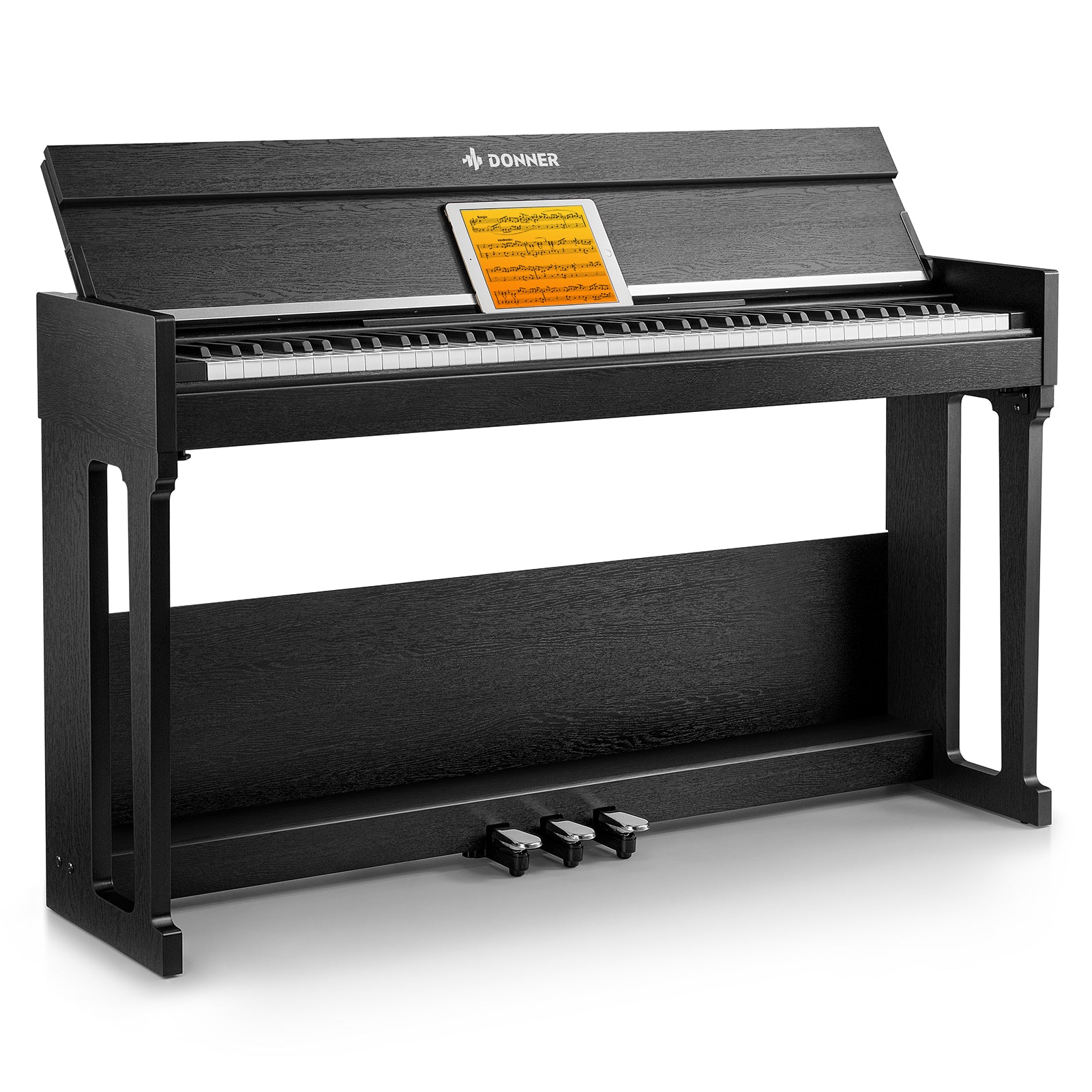
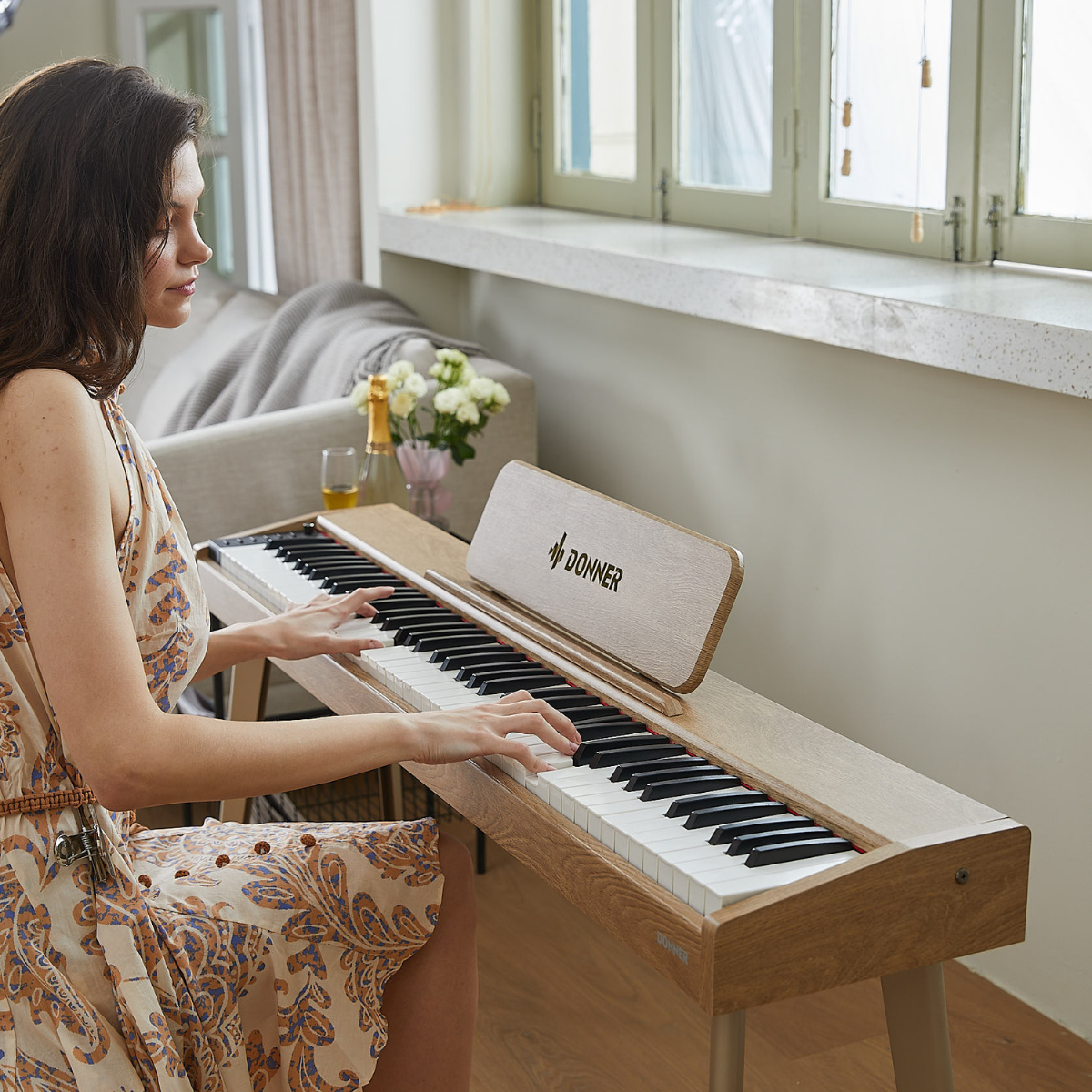
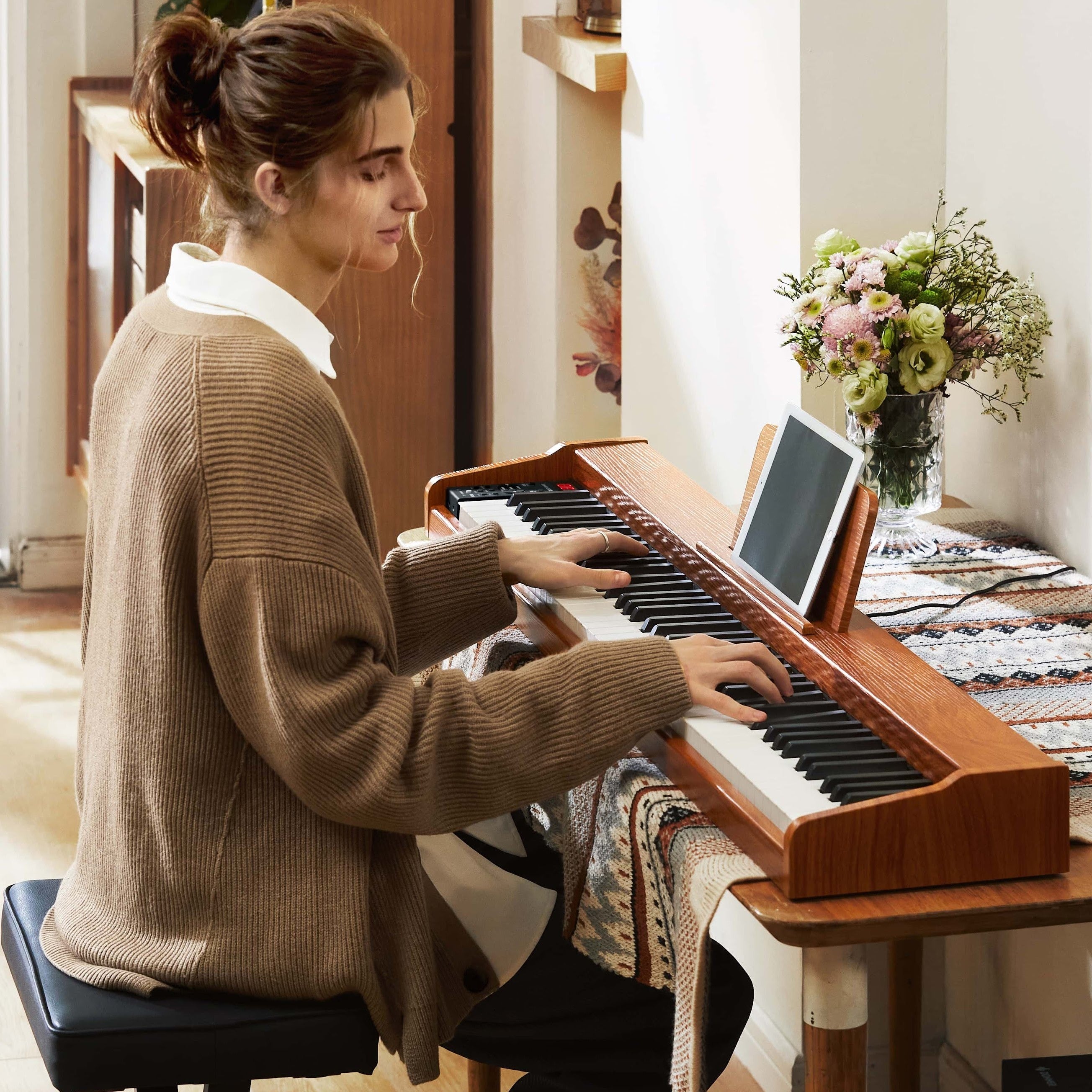
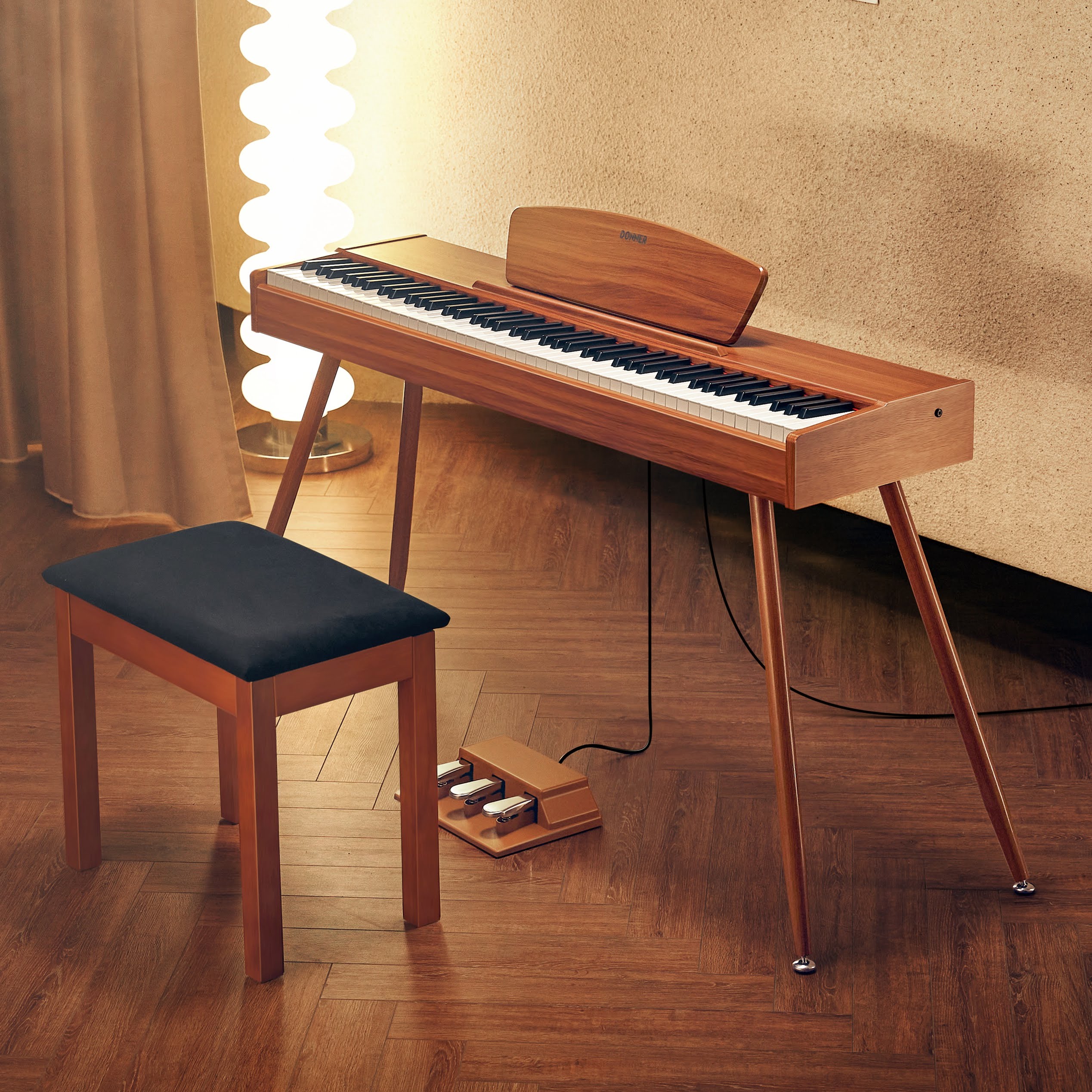
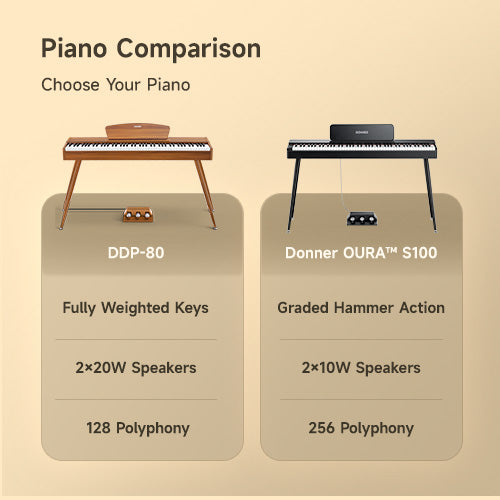
The Donner DDP-80 Plus digital piano solves a specific problem: you want an instrument that looks like furniture but costs like a portable stage piano. Its 88-key fully weighted hammer action keybed sits inside a clean, minimalist console cabinet with a sliding key cover — the kind of design that doesn't scream "electronic instrument" when you place it in a living room or study.
Why it stands out: The only furniture-style weighted digital piano in its price tier that includes a sliding key cover, a complete accessory bundle, and an upgraded multi-layered sound engine.
The Plus model improves on the original DDP-80 where it mattered most: the sound engine. Donner upgraded to a multi-layer sampling approach, and the difference is audible. Piano tones have more body in the midrange and less of the synthetic "bloom" that budget digital pianos often produce in the octave above middle C. You also get touch sensitivity that responds to playing velocity, so pressing a key harder actually produces a louder, brighter tone — the basic mechanic that makes weighted practice meaningful.
The furniture cabinet houses built-in stereo speakers. They're adequate for a medium-sized room. Plug in headphones and the speaker mutes automatically, which is what makes this an apartment-friendly instrument. The sliding key cover protects the keybed from dust when the instrument sits idle — a practical touch that extends key action longevity.
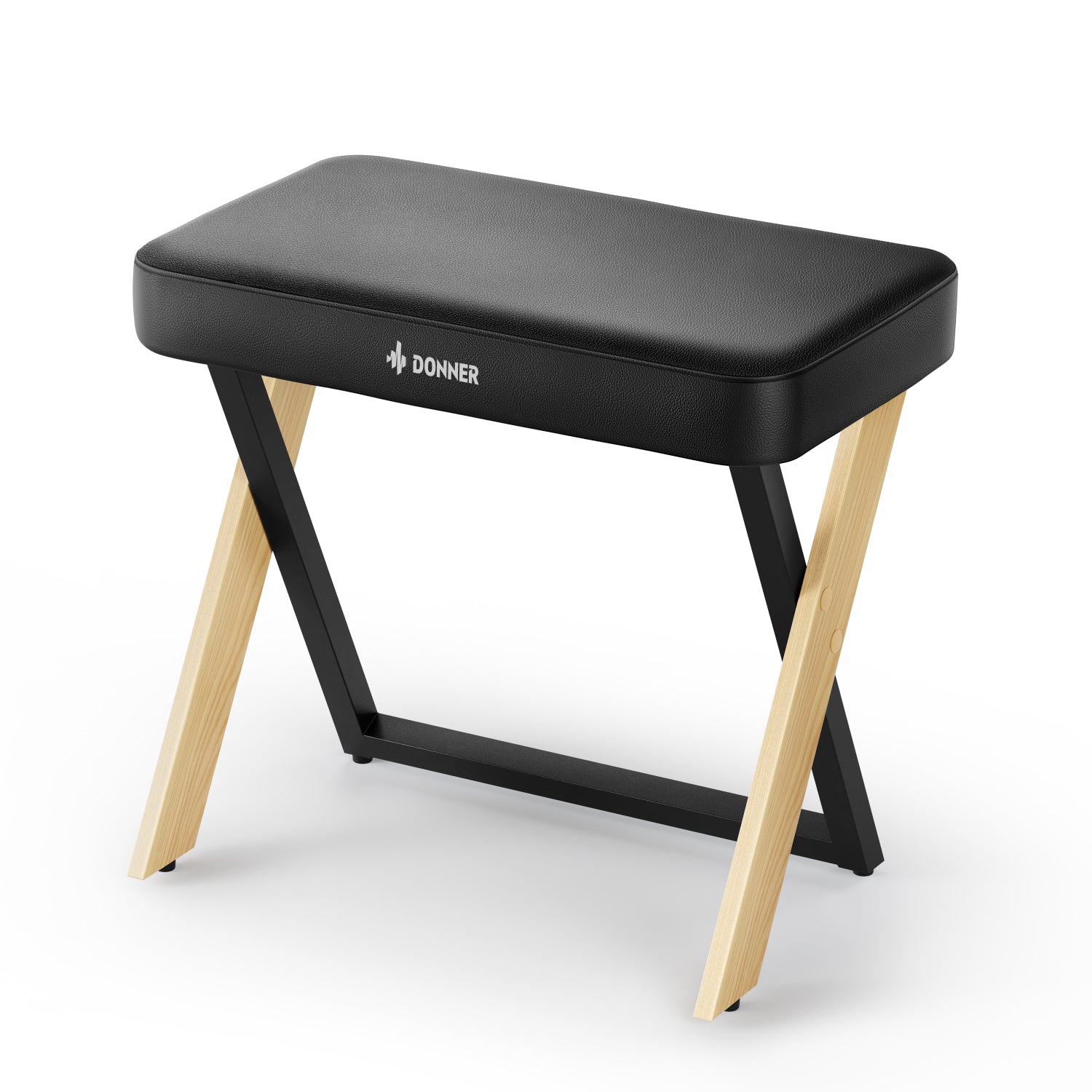
It ships with a matching stand, a triple-pedal unit (soft, sostenuto, sustain), and a padded bench. Everything you need arrives in one box.
Pros
- Only furniture-console weighted digital piano at this price point with a sliding key cover
- Clean minimalist aesthetic — blends into home decor without looking like studio gear
- Complete out-of-box package: stand, bench, triple pedals all standard
- Improved multi-layer sound sampling over the original DDP-80
Cons
- Sound engine still trails flagship Yamaha and Roland models in dynamic nuance. At one-third to half the price, it's entirely sufficient for beginners through intermediate practice
- Assembly of the furniture stand takes roughly 30–45 minutes, though the instructions are clear and all tools are included

Yamaha P-225 — Best Overall Portable Weighted Digital Piano
The Yamaha P-225 digital piano is the reference point in portable weighted instruments. If you walk into any music school practice room in the US, there's a strong chance a P-series Yamaha is sitting on the stand.
Its Graded Hammer Compact action delivers a heavier touch in the bass that progressively lightens toward the treble — exactly what you'd feel on a Yamaha acoustic upright. The GHC mechanism is quieter than the previous GHS action, so late-night practice with headphones produces less mechanical thumping through the floor.
The sound engine draws from Yamaha's CFX concert grand sampling. In practical terms, the piano tone has clarity in the attack, a rounded sustain, and natural decay — the kind of voice that doesn't fatigue your ears during a two-hour practice session. At 11.5 kg with 192-note polyphony, it's light enough to take to a gig and powerful enough to handle dense classical passages without note dropouts.
The trade-off is the box contents. Yamaha ships the P-225 with a music rest and a basic sustain pedal. The stand, a proper triple-pedal unit, and a bench are all separate purchases.
Pros
- GHC action with authentic graded weighting — heavier bass, lighter treble
- CFX concert grand sampling — clear, natural piano tone
- Only 11.5 kg, best-in-class portability in this category
Cons
- No accessories included beyond a basic footswitch — stand, proper pedals, and bench sold separately
- Built-in speaker output is modest at 7W × 2 — adequate for a bedroom, underwhelming in a living room

Roland FP-30X — Best Key Action for Serious Practice
The Roland FP-30X digital piano is the answer for players who refuse to compromise on key feel. Its PHA-4 Standard keybed is widely considered the best action in the sub-$1,000 category. This isn't a marketing claim — the PHA-4 uses a triple-sensor detection system with an escapement mechanism, meaning it registers key position at three points during the stroke rather than two. The result is more accurate repetition response and more nuanced soft-playing control.
The escapement mechanism adds a subtle "notch" feel mid-stroke, mimicking the let-off point on a grand piano action. For students building classical repertoire, this tactile feedback is invaluable — it teaches the finger to sense where the hammer disengages, a skill that directly transfers to acoustic instruments.
SuperNATURAL Piano, Roland's modeling-based engine, provides unlimited polyphony on piano tones. You'll never hear a note cut off during a sustained pedal passage. The onboard speakers sound somewhat boxy at higher volumes — this is the FP-30X's main weakness. For critical listening, external monitors or good headphones make a significant difference. Bluetooth audio and MIDI let you connect to Roland's Piano App for additional sounds, recording, and lesson content.
Pros
- PHA-4 Standard keybed — best-in-class action, triple sensor, escapement feel
- SuperNATURAL Piano engine with unlimited piano polyphony
- Bluetooth audio + MIDI with Roland Piano App support
Cons
- Built-in speakers produce a boxy, midrange-heavy sound — external monitoring improves it dramatically
- At 14.8 kg, noticeably heavier and less portable than the Yamaha P-225

Kawai ES120 — Best Piano Tone for Purists
Kawai builds acoustic grand pianos. That DNA carries into the Kawai ES120 digital piano, particularly in its Responsive Hammer Compact II keybed. The RHC II uses a dual-sensor design that prioritizes smooth legato transitions — the connected, singing quality you hear in Romantic-era piano music. Chopin nocturnes and Debussy preludes sound natural on this action in a way that more clinically precise keybeds sometimes miss.
The Harmonic Imaging sound engine samples every individual key on a Kawai EX concert grand at multiple velocities. The tone has the warmth and harmonic complexity that Kawai acoustics are known for — less clinical than Yamaha, less forward than Roland. If you've ever heard a Kawai grand in person and loved the sound, the ES120 gets you remarkably close.
The built-in speakers received a meaningful upgrade from the ES110. Dialogue with the instrument — playing soft, then loud, then soft again — reveals a dynamic range that some competitors in this price tier compress noticeably at the extremes. At 192-note polyphony, it will still handle complex pedal passages. The limitation is Bluetooth: it supports MIDI only, not audio streaming.
Pros
- RHC II keybed — exceptional for legato playing, warm touch response
- Harmonic Imaging with 88-key individual sampling — naturally rich tone
- Substantially improved built-in speakers over the previous ES110 model
Cons
- Polyphony capped at 192 — Roland's competing FP-30X offers unlimited piano polyphony
- Bluetooth is MIDI-only, no audio streaming capability

Donner DDP-200 MK2 — Best Portable Weighted Digital Piano for Growing Players
The Donner DDP-200 MK2 digital piano is the portable sibling in Donner's weighted lineup. Where the DDP-80 Plus is a permanent living-room fixture, the DDP-200 MK2 slides onto a standard keyboard stand and weighs just around 12.5 kg — light enough to move between rooms or take to a friend's house.
Why it stands out: A portable digital piano with genuine graded hammer action, Bluetooth audio streaming, and an upgraded MK2 sound engine — priced well below what comparable graded-hammer instruments from competitors cost.
The MK2 designation signals the meaningful upgrade here: the sound engine. The original DDP-200 had serviceable piano tones but felt thin in the low registers. The MK2 revision brings richer, more layered samples across the keyboard range. The instrument voice library expanded too — you get electric pianos, organs, strings, and pads that are genuinely usable for layering and practice variety, not just checkbox features.
The key action is what earns the DDP-200 MK2 its recommendation. It uses an 88-key graded hammer action — meaning the keys in the bass register are physically heavier to press, and the resistance lightens as you move up toward the treble. This gradient mirrors how an acoustic piano's hammers work: bigger hammers in the bass require more force. For a student developing finger independence, graded weighting is the feature that makes scale practice and dynamic control exercises actually translate to a real piano.
It also packs Bluetooth audio, which is rare at this price. You can stream backing tracks or lesson audio from your phone through the DDP-200 MK2's speakers and play along wirelessly. Bluetooth MIDI connects to learning apps like Simply Piano and Flowkey. USB-MIDI handles the wired connection to a computer for recording or notation software.
Pros
- Genuine graded hammer action where competitors offer non-graded or semi-weighted actions at the same price
- MK2 sound engine noticeably improved over the original — richer piano tones across the register
- Bluetooth audio streaming for wireless play-along (rare at this price)
- Lightweight and portable relative to furniture consoles
Cons
- Built-in speakers are adequate for practice but not room-filling — external monitors are recommended for performances, which is typical for this price range
- Plastic chassis construction doesn't have the premium heft of metal-bodied competitors, though this keeps the weight and cost down for the target user

Roland FP-10 — Best Entry-Level Weighted Digital Piano
The Roland FP-10 digital piano makes one strategic decision that defines its value: it uses the exact same PHA-4 Standard keybed found in the FP-30X, at roughly two-thirds the price. If key action quality is your non-negotiable and you're on a tight budget, the FP-10 gives you the premier action at an entry-level cost.
Roland cut costs in ways that matter less to a beginner. The speakers drop to 2.5W per side — usable for personal practice through headphones, but thin and underpowered in a room. The polyphony drops to 96 notes, which is still sufficient for beginner and intermediate repertoire. The line outputs disappear — you get a single headphone jack and USB-MIDI, nothing more.
The SuperNATURAL engine keeps the same core piano sound as the FP-30X. Bluetooth MIDI connects to Roland's Piano Partner 2 app for rhythm accompaniments and score display. If you plan to practice primarily with headphones and value key action above all else, the FP-10 is the sharpest value proposition in the entry-level weighted digital piano category.
Pros
- Same flagship-grade PHA-4 Standard keybed as the more expensive FP-30X, at entry-level pricing
- SuperNATURAL piano sound engine with Bluetooth MIDI
Cons
- Smallest speakers among all recommendations at 2.5W × 2 — best experienced through headphones
- No 1/4" line outputs limits connection options for external speakers or recording gear

Casio PX-S1100 — Best Slim Design Weighted Digital Piano
The Casio PX-S1100 digital piano redefines what "portable" means in a weighted instrument. At just 23.2 cm deep, it's the world's slimmest 88-key weighted hammer action digital piano. You can fit it on a desk, slide it under a bed, or run it on six AA batteries for outdoor practice.
The Smart Scaled Hammer Action is Casio's proprietary compact mechanism. It delivers graded weighting in a shockingly thin chassis — the bass keys offer firm resistance, and the treble keys feel appropriately lighter. The trade-off is key travel. The PX-S1100's keys have a slightly shorter vertical stroke than traditional hammer actions. If you're coming from an acoustic piano, the feel takes a few days to adjust to. Once you do, the precision is there — the action tracks velocity accurately, and the repetition speed handles fast passages well.
The sound engine draws from Casio's AiR (Acoustic and Intelligent Resonator) technology with 192-note polyphony. String resonance and damper resonance modeling add realism to sustained passages. The touch-button interface uses the top panel surface as capacitive controls, which keeps the design clean but demands a short learning curve. You'll occasionally trigger functions you didn't intend to until you develop the right touch.
Pros
- Only 23.2 cm deep — unprecedented portability in a weighted hammer action digital piano
- Six AA battery operation for practice anywhere, no power outlet needed
Cons
- Smart Scaled Hammer Action has shorter key travel than traditional actions — requires an adjustment period for acoustic piano players
- Capacitive touch-button interface takes practice to operate without accidental triggers

Korg B2 — Best Budget Weighted Digital Piano for Absolute Beginners
The Korg B2 digital piano is the lowest-cost legitimate weighted digital piano you can buy in 2026. Its Natural Weighted Hammer Action provides the essential weighted feel — bass notes are heavier, treble notes lighter — without the mechanical refinements of more expensive actions.
Korg made pragmatic choices here. The 120-note polyphony handles basic piano repertoire without note stealing. The sound engine uses stereo PCM samples of a German concert grand, which deliver a serviceable piano tone. The interface consists of a single power button, a volume knob, and a handful of sound selection buttons — there is no screen, no menu diving, no learning curve. You plug it in, turn it on, and play.
What you give up is refinement. The key feel doesn't have the escapement "notch" of a Roland or the smooth legato of a Kawai. The speakers are basic. The instrument voices beyond the core piano sound are limited. But for an absolute beginner who has never touched a piano and isn't ready to commit $700+, the Korg B2 asks the least financial risk while still providing the weighted mechanism that makes practice count.
Pros
- Most affordable entry point to a fully weighted hammer action digital piano
- Dead-simple interface — power button, volume knob, play
Cons
- Clear gap in key action feel and tone quality compared to mid-tier models — the differences become apparent as your ear and fingers develop
- Minimal feature set — not suitable for users who want a variety of instrument voices and rhythms

Weighted Key Types Explained — Hammer Action, Graded Hammer, and More
Fully Weighted / Hammer Action — The Standard for Piano Practice
When you press a key on an acoustic piano, your finger lifts a hammer that strikes a string. That mechanism — the lever, the pivot, the weight of the hammer — creates resistance. Fully weighted hammer action in a digital piano replicates this using a physical hammer mechanism under each key. There are no springs mimicking resistance. There is actual mass moving against your finger.
This is the defining feature that separates a digital piano from a keyboard piano. A keyboard piano uses spring-loaded synth-action keys that have no moving counterweight. They feel like pressing a light switch. A digital piano with hammer action feels like pressing a piano key — because mechanically, that's what's happening.
For anyone learning piano, the distinction is not academic. Finger strength, dynamic control, and articulation all develop through feedback from the keybed. A spring-loaded key gives you one resistance level. A hammer action gives you graduated resistance that responds to how you play. The adult learner from earlier in this guide saw his breakthrough precisely because of this — 18 months of spring-loaded practice produced flat dynamics. Two weeks on hammer action and his teacher noticed the change.
Graded Hammer Action — Why Weight Varies Across the Keyboard
On an acoustic grand piano, the bass strings are thick and heavy. The hammers that strike them are proportionally larger. The treble strings are thin and light, with smaller hammers. This means bass keys require more force to play than treble keys — a natural gradient built into the instrument's physics.
Graded hammer action replicates this gradient digitally. The key resistance is heaviest in the lowest octave, tapers through the midrange, and reaches its lightest point in the highest octave. For a student learning to control dynamics between hands, graded weighting teaches an essential skill: the left hand playing bass lines must exert more force than the right hand playing melody, but both must sound balanced in volume. A uniform-weight action cannot teach this because the resistance never varies.
Progressive hammer action and graded hammer standard are different manufacturers' terms for the same concept. The Yamaha P-225's GHC action, the Donner DDP-200 MK2's graded hammer, and the Roland PHA-4 all implement this gradient — the difference lies in how accurately they execute it at each price point.
Semi-Weighted vs. Fully Weighted — What Beginners Need to Know
Semi-weighted pianos add a spring and a small weight plate to a synth-action design. The result feels heavier than an unweighted key, but there is no hammer mechanism — the resistance comes from spring tension, not counterweight momentum. When you bottom out a semi-weighted key, it bounces back with a spring-like recoil. A fully weighted hammer action key returns with the natural momentum of its counterweight.
For piano learning specifically, fully weighted is the standard. Semi-weighted keys belong to the keyboard piano and MIDI controller categories. They serve different purposes — synth playing, music production, organ technique — where spring-loaded bounce and quick return are advantages, not compromises. If your goal is to play piano music with expressive dynamics and you ever plan to sit at an acoustic instrument, the extra cost of fully weighted keys is the difference between practicing and just pressing buttons.
How to Choose the Right Weighted Digital Piano?
Key Action Quality — The Single Most Important Factor
Key action is the dimension you cannot fix after purchase. Speakers can be upgraded with external monitors. Sounds can be expanded through VST plugins and apps. The keybed — how it feels under your fingers — is permanent.
When comparing actions, pay attention to three things: whether the weighting is graded (bass heavier, treble lighter), whether there's an escapement simulation (the subtle notch mid-stroke), and how the keys return after release. A sluggish return limits fast repetition. A crisp return enables it. Structured piano education frameworks like ABRSM and RCM have no official requirement for specific key actions, but every experienced teacher knows the difference — a student who practices on a quality weighted action arrives at exams with noticeably better control.
Sound Engine — Sampling vs. Modeling
Sampling records a real acoustic piano note by note, velocity layer by velocity layer. High-quality sampling (Yamaha's CFX sampling, Kawai's Harmonic Imaging) captures the natural attack, sustain, and decay of individual notes on a specific concert grand. The limitation is storage — each sampled layer costs memory, and budget instruments sample fewer layers, which means fewer dynamic gradations between soft and loud.
Modeling generates the piano sound mathematically in real time. Roland's SuperNATURAL is the best-known implementation. Modeling produces unlimited polyphony and smoother transitions between dynamic levels, but can sound slightly synthetic in the upper treble. For practice purposes, either approach works. For recording and performance, the difference becomes more noticeable.
Polyphony — Why It Actually Matters
Polyphony is the number of individual notes the digital piano can produce simultaneously. Sustain pedal usage is why this matters. Hold the pedal through a four-measure phrase of sixteenth notes, and you've stacked dozens of sustained tones on top of each other. When polyphony maxes out, the instrument cuts the oldest notes first — a phenomenon called note stealing.
For beginner practice, 64-note polyphony is adequate. For intermediate classical repertoire with heavy pedal usage, 128 becomes the floor. For advanced pieces and layered sounds (piano + strings), 192 or unlimited is the safe zone. All the instruments on this list exceed 96 notes, which covers the vast majority of real-world playing scenarios.
Portable vs. Furniture — Stage Piano or Home Console?
Portable digital pianos (sometimes called stage pianos or slab pianos) are designed to sit on a removable stand. They weigh 11–15 kg on average and prioritize transportability. You can gig with them, move them between rooms, or pack them away when not in use.
Furniture consoles are built into a permanent cabinet with an integrated stand, often including a sliding key cover and built-in triple pedals. They look like a piece of furniture because they are one. The Donner DDP-80 Plus is the example in this category. The trade-off is immobility — once assembled, you're not moving it casually.
The decision hinges on two questions: do you need to transport the instrument, and does it need to look like furniture? If either answer is yes, your category is decided. If both are no, choose based on key action and sound quality regardless of form factor.
Connectivity — Bluetooth, USB-MIDI, and Audio Outputs
USB-MIDI connects your digital piano to a computer for recording, notation software (MuseScore, Sibelius), or virtual instrument plugins (Keyscape, Pianoteq). Bluetooth MIDI does the same wirelessly and pairs with mobile learning apps. Bluetooth audio lets you stream music from your phone through the instrument's speakers — useful for playing along with tracks without cables.
Line outputs (1/4" jacks) connect to external speakers, audio interfaces, or a PA system. Headphone jacks let you practice silently. Not every instrument on this list has all of these — check each product's specs against your needs.
Digital Piano vs. Keyboard Piano — The Weighted Key Distinction
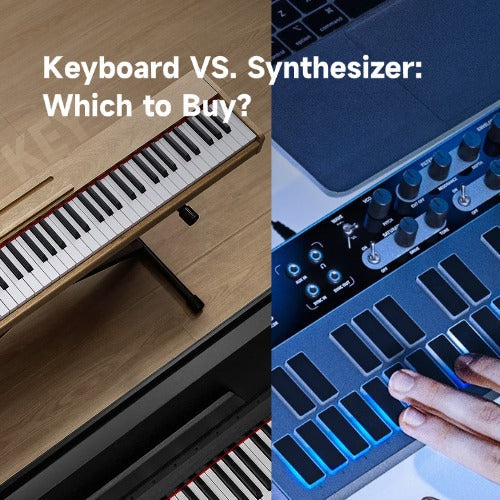
A digital piano has fully weighted hammer action keys that simulate acoustic piano touch through a physical counterweight mechanism. A keyboard piano uses synth-action or semi-weighted keys — spring-loaded designs with no moving counterweight. They are different instrument categories designed for different purposes.
If you want to learn piano and develop the finger technique that transfers to an acoustic instrument, you need a digital piano with weighted keys. If you want to produce music, play synth lines, or trigger samples, a keyboard piano or MIDI controller with semi-weighted keys may serve you better. The confusion between the two categories is why many beginners buy a keyboard piano expecting piano-like feel and are disappointed. Check the key action specification before buying — if it doesn't say "fully weighted," "hammer action," or "graded hammer," it will not feel like a piano.
Frequently Asked Questions
Do I really need weighted keys to learn piano?
Yes, if your goal is to play piano music expressively or ever transition to an acoustic instrument. The resistance of weighted keys builds the finger strength, independence, and dynamic control that define piano technique. Non-weighted keys teach you to press buttons at the right time. Weighted keys teach you to play with intention.
What is the difference between a weighted digital piano and a keyboard piano?
The key action. A weighted digital piano uses a physical hammer mechanism under each key. A keyboard piano uses springs. The hammer action replicates the resistance and rebound behavior of an acoustic piano. The spring action replicates an electronic organ. They feel completely different and serve different musical purposes.
Can a weighted digital piano fully replace an acoustic piano?
For home practice and most performance scenarios at the beginner through intermediate levels, yes. Weighted digital pianos offer volume control, silent headphone practice, zero tuning costs, and portability that acoustics cannot match. At the advanced and professional level, an acoustic piano's natural string resonance and infinite dynamic granularity remain unique. Many professional pianists own both.
How much should I spend on a digital piano with weighted keys?
A legitimate fully weighted digital piano starts around $400 (Korg B2) and runs to $1,700+ (Yamaha P-525). For beginners, $400–$700 gets you a solid instrument. For serious students aiming toward exams, $600–$900 is the sweet spot where key action quality improves noticeably. Above $1,000, you're paying for premium sound engines, wooden key materials, and advanced features.
Do weighted keys get looser or noisier over time?
They can, but quality matters more than time. Key actions on instruments from established manufacturers (Yamaha, Roland, Kawai) are designed for years of daily use and tend to hold their feel well. The PHA-4 action in Roland's instruments, for example, has a strong reputation for long-term consistency. Budget instruments with simpler action mechanisms may develop more key noise or uneven resistance after several years of heavy use. A dust cover or sliding key cover — like the one on the Donner DDP-80 Plus — helps extend action life by keeping debris out of the mechanism.
What accessories do I need for a weighted digital piano?
At minimum: a sustain pedal. The basic footswitch included with most instruments works initially, but a proper piano-style pedal provides better control. A sturdy stand is essential for portable models. A padded bench that adjusts for height prevents back strain during long practice sessions. Headphones let you practice silently. Some instruments — notably the Donner DDP-80 Plus — include all of these in the box. Factor accessory costs into your budget when comparing models that don't include them.
Final Verdict
Since 2012, Donner has focused on making quality weighted digital pianos accessible to players who value authentic touch without the premium markup.
If you're ready to upgrade from a non-weighted practice setup, or you're buying your first serious instrument, Donner's weighted digital piano lineup is the best value for money you'll find.