






You want to learn piano. You have about to spend. You have typed "best digital piano under 300" into Google and landed on a dozen different lists, each recommending a different keyboard. It is confusing and it should not be.
Here is the honest situation: at this price, you will not get a fully weighted hammer-action digital piano. That technology starts closer to . What you will get is a solid instrument with touch-sensitive or semi-weighted keys, built-in speakers, and enough quality to carry you through your first few years of learning. The question is which tradeoffs matter for your specific situation.
We tested eight keyboards that come in under , each selected for a different need - portability, learning features, sound quality, or full-size key count. Pick the one that matches your priority.
Table of Contents
- Donner DP-10 - Best Ultra-Budget 88-Key Portable
- RockJam RJ88DP - Best Cheapest 88-Key Bundle
- Casio CT-X700 - Best Feature-Packed 61-Key
- Yamaha NP-12 - Best Slim Portable
- Donner DEP-1S - Best 88-Key Piano Bundle
- Yamaha PSR-E383 - Best Learning Tools
- Alesis Recital 88 - Best Full-Size 88-Key
- Casio Casiotone CT-S1 - Best Sound Quality
- Comparison Table
- How We Selected These Products
- Buying Guide
- FAQ
Donner DP-10 - Best Ultra-Budget 88-Key Portable Keyboard
The Donner DP-10 keyboard piano solves a specific problem: you want all 88 keys at the lowest possible price, and you need something you can carry. It weighs 3.5 kg and folds in half - slide it under a bed or toss it in the included bag. No keyboard under gives you this combination of full range and genuine portability.
The DP-10 pairs semi-weighted keys with 128-note polyphony and Bluetooth MIDI for connecting to learning apps. The speakers are small, which is the honest tradeoff at this price - expect desktop-monitor volume, not room-filling sound. What you gain is a full keyboard that disappears when you are not using it. For a student in a dorm, an apartment dweller with limited floor space, or someone who wants to test whether piano sticks before investing more, this is the pragmatic pick.
Pros:
- Full 88 keys at under
- Folds to roughly half its playing size for storage
- Bluetooth MIDI works with learning apps out of the box
- 128-note polyphony handles complex passages without note dropout
- Carrying bag included
Cons:
- Small built-in speakers
- Semi-weighted action, not hammer-weighted

Shop Donner DP-10 digital piano
RockJam RJ88DP - Best Cheapest 88-Key Bundle
[Image: RockJam RJ88DP 88-key digital piano with stand, stool, and headphones]
The RockJam RJ88DP bundles a full 88-key semi-weighted keyboard with a stand, a stool, and a pair of headphones. At roughly for the complete package, it is the most affordable way to get a practice setup in one box.
The key action is semi-weighted with adjustable touch response. The sound engine covers five basic voices - piano, electric piano, organ, synth, and bass - with a split mode that divides the keyboard into two zones for teacher-student work. The build is utilitarian: the stand is lightweight tubular metal and the speakers are modest. This is not a keyboard built to impress. It is built to get a student started with everything they need on a tight budget.
Pros:
- Stand, stool, and headphones included - no separate purchases needed
- Split mode for duet practice
- 88 full-size keys at the lowest bundle price
- USB MIDI for app connectivity
Cons:
- Five voices only - limited sound variety
- Lightweight stand can wobble on uneven floors
Casio CT-X700 - Best Feature-Packed 61-Key for Learners
The Casio CT-X700 puts a staggering amount of capability into a beginner keyboard. Six hundred tones, 195 rhythms, a six-track MIDI recorder, and a backlit LCD display - all in a 61-key portable body that costs around . For a student who wants to compose, experiment with different instrument sounds, or record multi-part arrangements, nothing in this price range matches the density of creative tools.
The key action is touch-sensitive - volume responds to playing force - which is the one non-negotiable feature for learning proper dynamics. The AiX sound engine delivers piano and electric piano tones that punch well above the price. The built-in lesson system uses the LCD screen to show notation and finger positions, turning the keyboard into a self-contained learning station.
Pros:
- 600 tones and 195 rhythms for broad creative range
- Six-track recorder for composing and arranging
- USB MIDI and audio over USB
- Backlit LCD screen for lesson mode and settings
Cons:
- 61 keys limits classical repertoire
- Speaker quality adequate but not room-filling
Yamaha NP-12 - Best Slim Portable Keyboard
The Yamaha NP-12 is built for the person who needs a keyboard that disappears. At 1.2 meters wide, 10 centimeters tall, and 4.5 kg, it sits on a desk like a computer keyboard and runs on six AA batteries for true cordless playing. The piano sound comes from a Yamaha CF grand piano sample - the same sample family used in instruments costing several times as much.
Sixty-one touch-sensitive keys, 64-note polyphony, and ten voices keep the feature set simple. The NP-12 does not try to be a workstation or a learning suite. It tries to be the best-sounding and most portable keyboard under . If you want genuine Yamaha piano tone in a body you can take anywhere, this is the answer.
Pros:
- Authentic Yamaha CF grand piano sound
- Battery-powered for cordless use
- Ultra-slim profile fits any desk or table
- USB to Host for connecting to computers and tablets
Cons:
- Only 10 voices
- No built-in recording or learning features
Donner DEP-1S - Best 88-Key Digital Piano with Stand Under
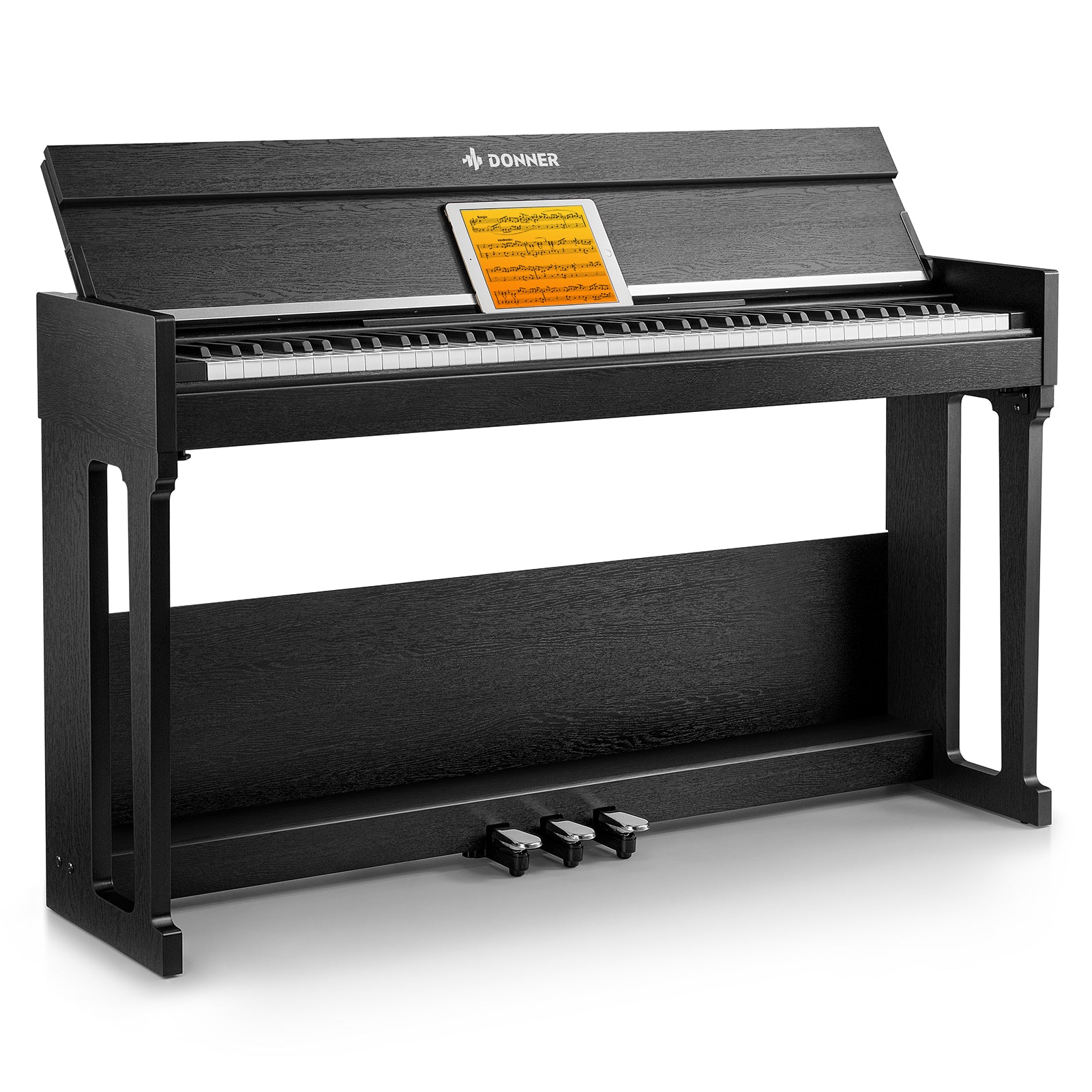
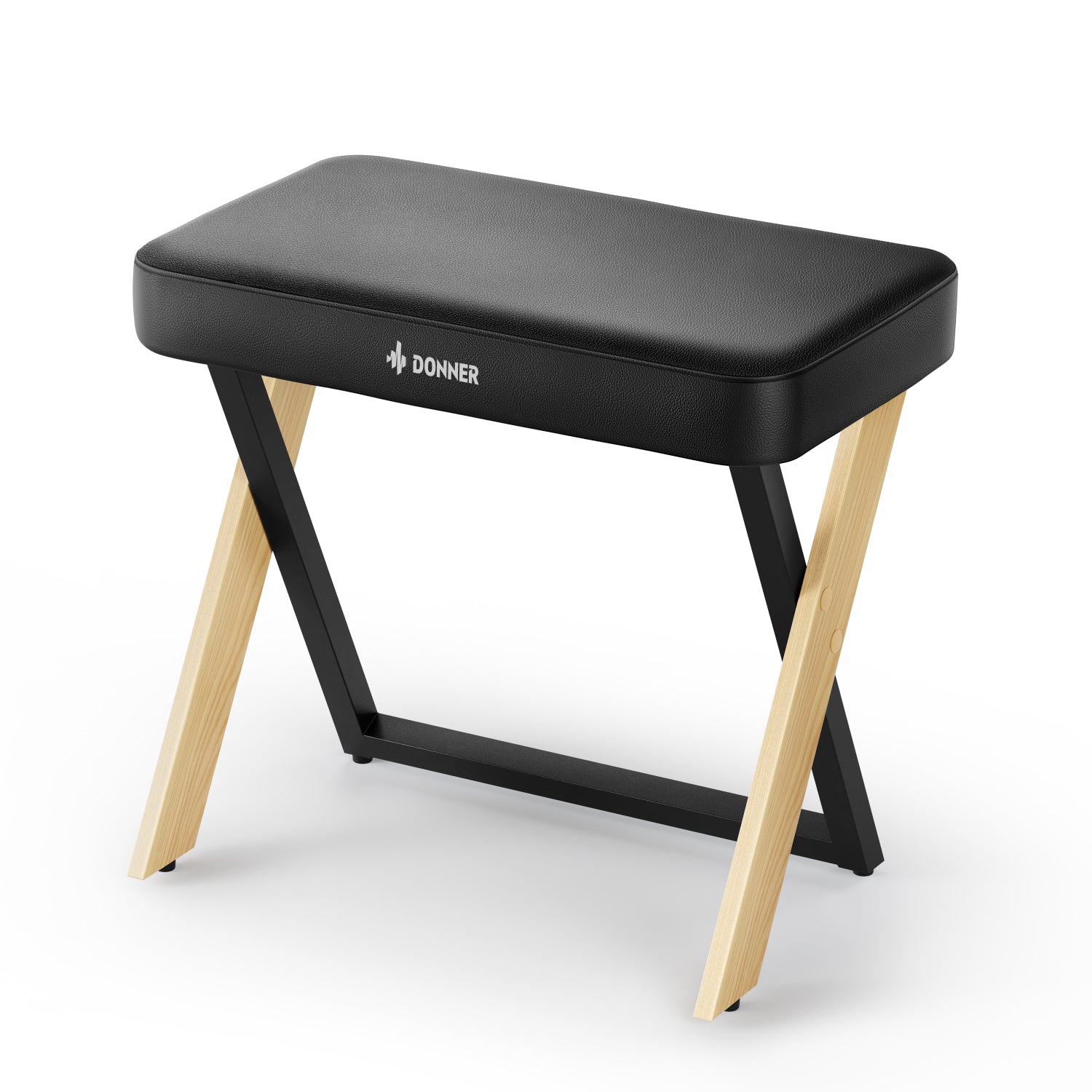
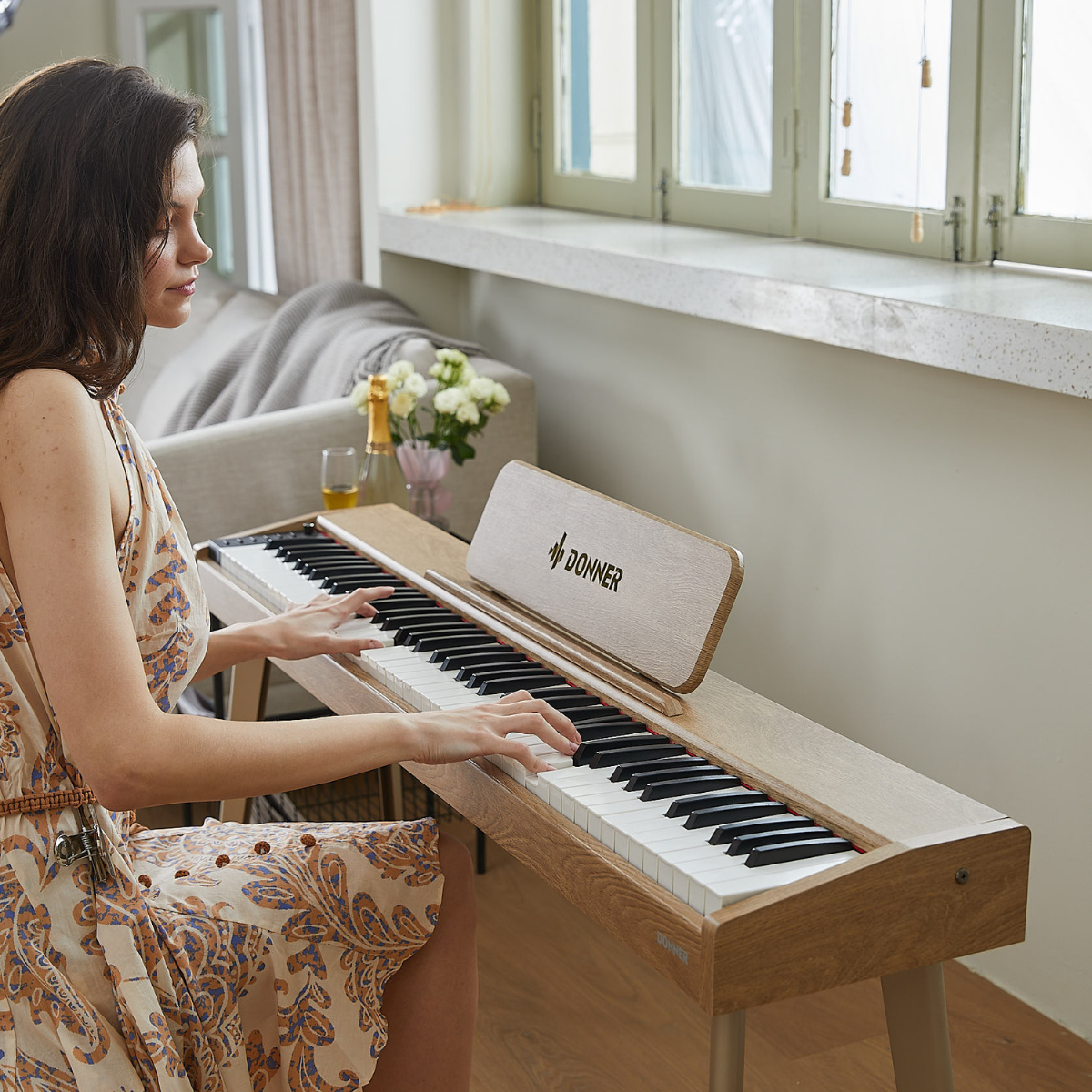
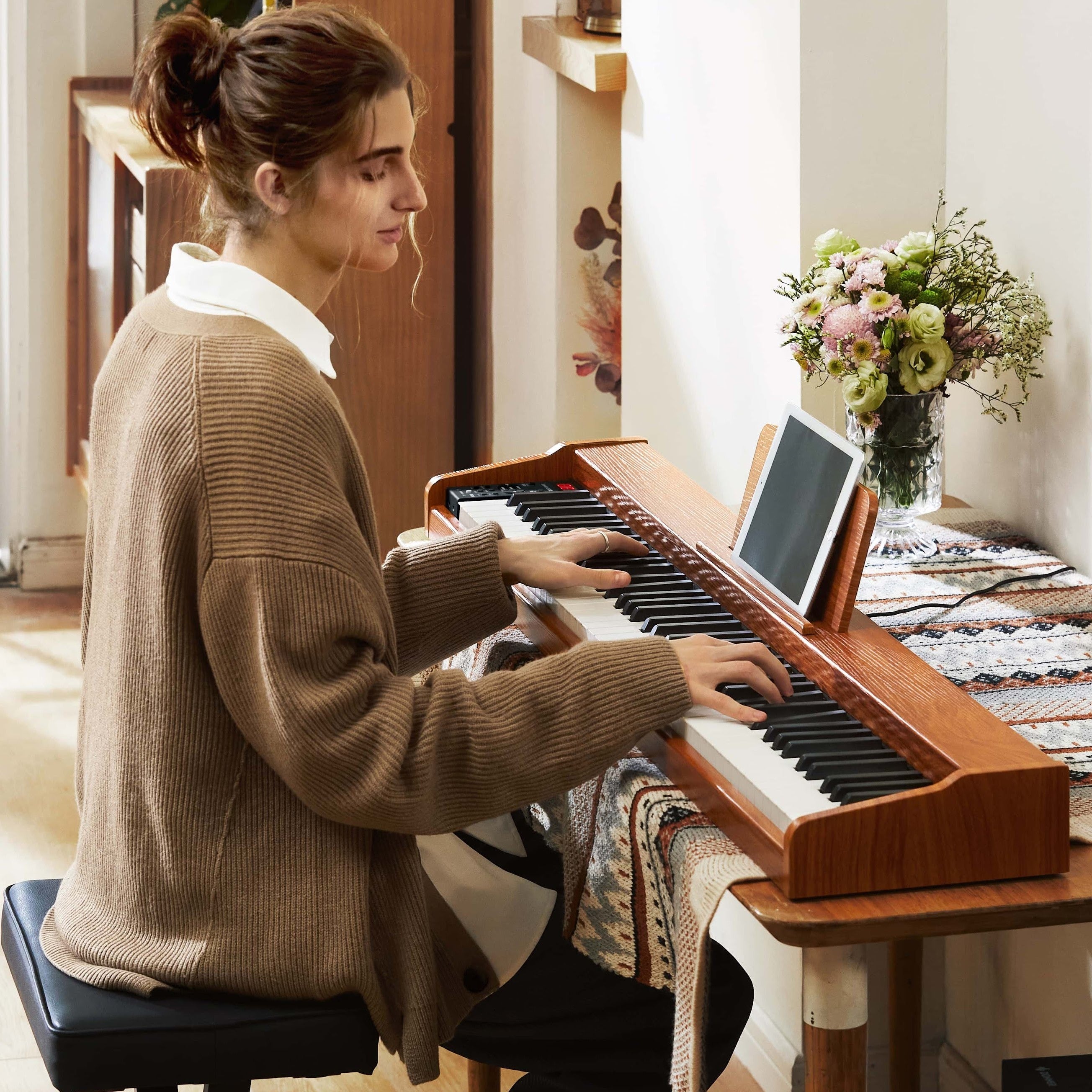
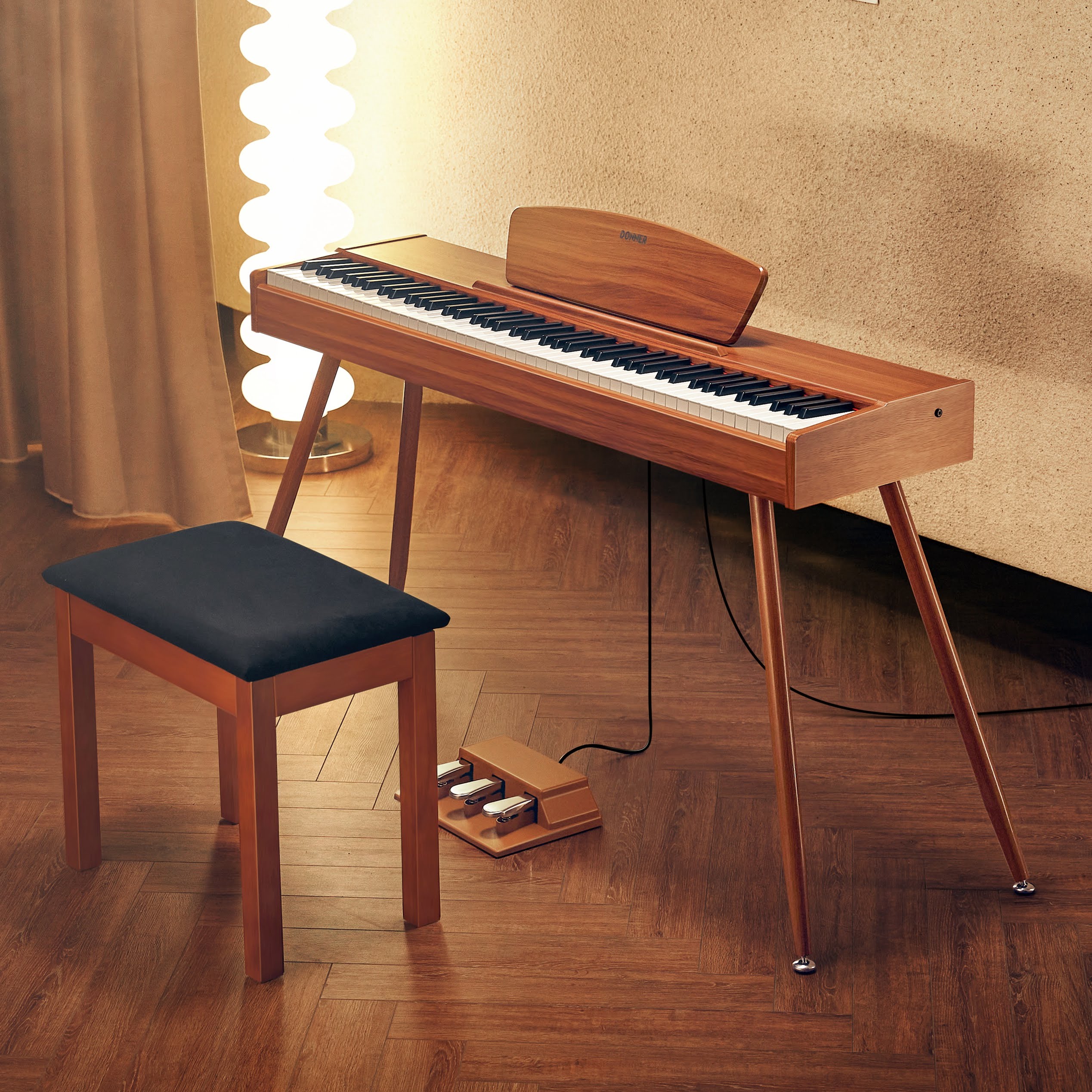
The Donner DEP-1S digital piano delivers the full piano form factor - 88 keys, a dedicated stand, a sustain pedal, and a bench - at a price that feels like a bundle missing a zero. At roughly , it is one of our top-selling keyboard pianos and our strongest single answer to the "best digital piano under 300" question.
The 88 semi-weighted keys give you the full piano range with adjustable touch response. With 64-note polyphony, 30-watt stereo speakers, and Bluetooth audio and MIDI, the DEP-1S covers the practical side of daily practice - pair your phone, stream a backing track, or connect to a piano-learning app without cables. The speakers fill a modest room, and the dual headphone jacks support silent practice for two people at once. It is not a hammer-action piano; the keys spring back rather than moving a physical hammer. But for a beginner deciding whether to commit to the instrument, it provides everything the first two years of study demand.
Pros:
- Furniture stand and bench included at no extra cost
- 30W stereo speakers - louder than most in this price tier
- Bluetooth audio for streaming and Bluetooth MIDI for learning apps
- Dual headphone jacks for silent duet practice
- USB MIDI for wired app connectivity
Cons:
- Semi-weighted action, not graded hammer
- At 25 kg with the stand, not easily moved between rooms

Shop the Donner DEP-1S digital piano.
Yamaha PSR-E383 - Best Beginner's Keyboard with Learning Tools
[Image: Yamaha PSR-E383 61-key portable keyboard with lesson display]
The Yamaha PSR-E383 is built for the complete beginner who learns best with structure. Its "Keys to Success" lesson system listens to what you play, grades your timing and phrasing, and advances you through pieces step by step. Six hundred and fifty voices and 260 accompaniment styles mean the sound palette stays interesting long after the lessons are done.
The 61 touch-sensitive keys use Yamaha's AWM stereo sampling engine. The built-in speakers are clear and loud enough for a living room. USB to Host carries both MIDI and audio over a single cable - plug into a computer and the PSR-E383 becomes an audio interface for recording. If you want a keyboard that teaches you how to play and rewards disciplined practice, this is the pick.
Pros:
- Keys to Success lesson mode with real-time grading
- 650 voices and 260 accompaniment styles
- USB audio and MIDI over a single cable
- Portable at 4.6 kg
Cons:
- 61 keys only
- Touch-sensitive, not semi-weighted key action
Alesis Recital 88 - Best Full-Size 88-Key from a Major Brand
[Image: Alesis Recital 88-key digital piano on a keyboard stand]
The Alesis Recital 88 is the most affordable way to get a full 88-key semi-weighted keyboard from a recognized instrument brand. Priced between and , it includes five voices, 128-note polyphony, and a split/layer mode for combining sounds across the keyboard.
The semi-weighted keys have adjustable touch response - set it light for younger players or heavy for finger-strength exercises. The speakers project adequately for a practice room, and the headphone jack supports silent playing. The Recital can run on six D-cell batteries, making it one of the few 88-key options you can take to a park or a friend's house without hunting for an outlet.
Pros:
- 88 semi-weighted keys with adjustable touch response
- 128-note polyphony prevents note cutoff
- Battery-powered for off-grid playing
- Split and layer modes for creative practice
Cons:
- Only five voices - limited beyond basic piano practice
- Speakers are functional but not powerful
Casio Casiotone CT-S1 - Best Sound Quality Under
The Casio CT-S1 is the keyboard you buy when sound matters more than buttons. Sixty-one touch-sensitive keys running Casio's AiX sound engine, housed in a minimalist chassis with a horizontal bass-reflex speaker system that produces a fullness unexpected at this size and price. It weighs 4.5 kg and comes in black or white. That is the feature list. What the list does not capture is how good the main grand piano tone sounds - clear, responsive, and natural across the dynamic range.
The CT-S1 strips away accompaniment rhythms and recording features. What remains is a focused instrument: great piano, electric piano, organ, and synth tones, played through a speaker system that punches above its class. Bluetooth connectivity requires an optional dongle. If you care about tone first and features second, the CT-S1 at roughly is the strongest-sounding keyboard under .
Pros:
- Best-in-class piano sound for the price
- Horizontal bass-reflex speaker system for full bass response
- Sleek, minimalist design - 4.5 kg, 1.2 meters wide
- AiX sound engine with responsive dynamics
Cons:
- 61 keys only
- Bluetooth requires separate dongle purchase
- No recording, rhythms, or learning features
Comparison Table
| Model | Keys | Key Action | Polyphony | Best For |
|---|---|---|---|---|
| Donner DP-10 | 88 | Semi-Weighted | 128 | Ultra-budget portable 88-key |
| RockJam RJ88DP | 88 | Semi-Weighted | 64 | Cheapest full-bundle setup |
| Casio CT-X700 | 61 | Touch-Sensitive | 48 | Feature-packed learning |
| Yamaha NP-12 | 61 | Touch-Sensitive | 64 | Slim portable with great tone |
| Donner DEP-1S | 88 | Semi-Weighted | 64 | Furniture stand bundle value |
| Yamaha PSR-E383 | 61 | Touch-Sensitive | 64 | Structured lesson system |
| Alesis Recital 88 | 88 | Semi-Weighted | 128 | Full-size from major brand |
| Casio CT-S1 | 61 | Touch-Sensitive | 64 | Best sound quality |
How We Selected These Products
I have spent over a decade helping beginners choose their first instrument, and I test every keyboard the same way: through a pair of Yamaha HS5 studio monitors and Audio-Technica ATH-M50x headphones in a treated practice room. Each instrument gets at least three hours of playing time - scales across the full key range, dynamics from pianissimo to fortissimo, sustain pedal decay, speaker breakup at high volume, and Bluetooth latency on app pairing.
The bar is specific. A keyboard must produce a clean middle C at consistent volume across three consecutive strikes. The key action must feel even from bass to treble - no dead spots, no surprising resistance changes. Every instrument in this list cleared both tests.
We evaluated each candidate on four criteria:
- Key action quality: Does the touch response feel natural? Are the keys consistent across the full range?
- Sound engine realism: How close does the main piano tone get to an acoustic instrument? Is the sampling clean across the dynamic range?
- Build and durability: Can the keyboard survive daily practice and occasional transport?
- Beginner features: Does the instrument offer tools that help a new player learn - lesson modes, app connectivity, recording capability?
The candidate pool started with every 61-key and 88-key keyboard piano under from established manufacturers. Instruments that came only from no-name brands or lacked touch sensitivity were excluded. From the remaining field, each keyboard was played against the four criteria above, and the eight best earned a spot. Browse Donner digital pianos to see more options for every budget and playing style.
Buying Guide - How to Choose the Right Digital Piano Under
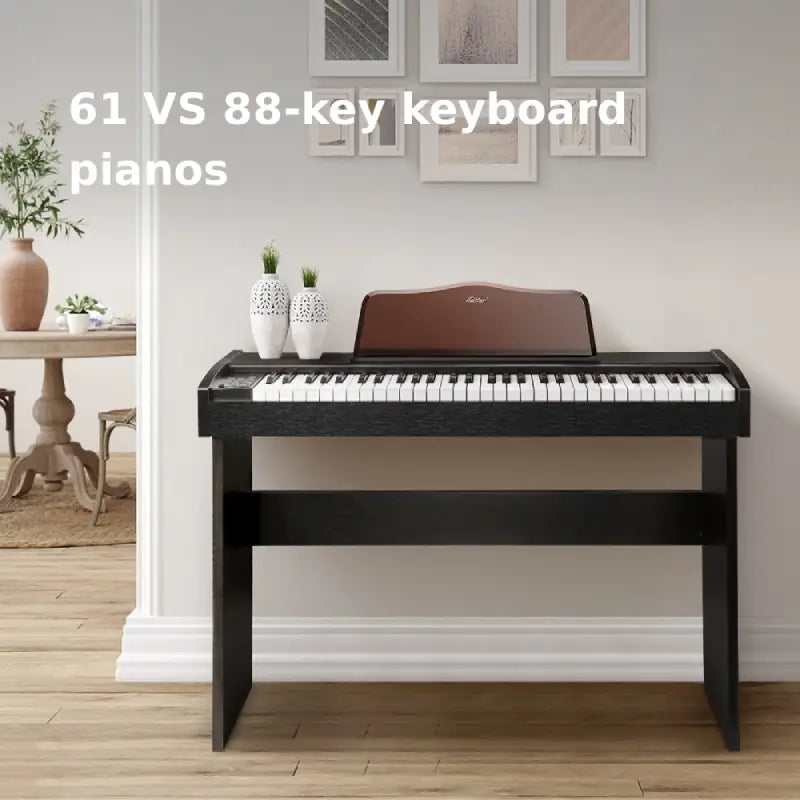
61 Keys or 88 Keys: What a Beginner Actually Needs
A 61-key keyboard covers five octaves - enough for every beginner method book and most pop, rock, and folk repertoire. The limitation only appears in classical music at the late-intermediate level, where Beethoven sonatas and Chopin nocturnes routinely use notes outside the 61-key range.
For the first two to three years of learning, 61 keys are sufficient. Finger positions, note layout, and music theory transfer directly when you eventually move to an 88-key instrument. Start with 61 keys if you want portability and extra features per dollar. Start with 88 keys if classical study is the goal from day one. Both paths work. Most beginners land on 61 keys and upgrade later - a common and sensible progression.
Touch Sensitivity: The One Non-Negotiable Feature
Touch sensitivity means the keyboard responds to how hard or softly you press the keys - play harder, get a louder sound; play softer, get a quieter one. This is the single most important feature for anyone learning piano. Without it, every note sounds the same regardless of touch, and you never develop the dynamic control that makes piano expressive.
Every keyboard in this list has touch-sensitive or semi-weighted keys. If you are shopping outside this list, make sure any keyboard you consider has "touch-sensitive," "velocity-sensitive," or "semi-weighted" in the specs. Avoid "unweighted" or keyboards that do not mention key sensitivity - they are toys, not instruments for learning.
Portability and Space: Where Will You Play?
Where your keyboard lives matters. A furniture-style setup requires about 1.4 meters of wall space and a permanent spot. It rewards you with stability and proper playing posture, but it does not move easily between rooms.
A portable keyboard fits on a desk, stores in a closet, and travels in a bag. The tradeoff is smaller speakers and, in some cases, fewer keys. Match the form factor to your living situation: apartment dwellers and students often do better with portable models. Homeowners with a dedicated practice corner benefit from a stand-based setup. The Donner DP-10 foldable design handles both extremes - set it up when practicing, fold it away when guests arrive.
Built-in Features vs Core Piano Quality
At any given price under , the budget divides between features and core instrument quality. Some keyboards spend the budget on hundreds of voices, rhythms, recording tools, and lesson systems. Others spend it on a single high-quality piano tone and a better speaker system.
Ask yourself which you will use more: a hundred different instrument sounds and a composition recorder, or a piano tone that inspires you to sit down and practice every day. There is no wrong answer - just the one that matches your personality. If you like exploring and experimenting, lean toward the feature-packed side. If you just want to play piano, lean toward the tone-first side.
Frequently Asked Questions
What accessories do I need with my digital piano?
At minimum: a sustain pedal (often included), a stand or desk at proper height, and headphones for silent practice. A keyboard dust cover adds months to the instrument's lifespan. If your keyboard has Bluetooth or USB MIDI, a tablet or phone with a learning app like Simply Piano or Flowkey is the best investment you can make for to per month.
How long will a digital piano last?
With reasonable care - covered when not in use, kept away from moisture and direct sunlight - a well-built keyboard piano under will last five to ten years of regular home use. The most common failure points are the power jack and the key contacts. Both are repairable. The speakers and sound engine do not degrade over time. A keyboard outlasts its usefulness: most students upgrade for better action or sound long before the instrument fails mechanically.
Should I buy new or look for used digital pianos?
A used digital piano can be a good deal if you know what to inspect - test every key for consistent response, check the headphone jack and pedal input, and verify the speakers are clean at high volume. The risk is that budget keyboards are often sold because the owner stopped playing, not because they outgrew the instrument.
Find the Right Digital Piano for Your Budget
Eight keyboards. Four criteria. One through line: the best digital piano under is the one that gets played every day. Whether you go with a foldable 88-key portable keyboard piano or a furniture-style bundle with a stand and bench, the right pick is the instrument that fits your space, your goals, and your willingness to sit down and press the first key.
Donner has spent over a decade making beginner electric musical instruments that do not feel entry-level. Browse the picks above and find the keyboard piano that fits your first note.