






Is 61 keys enough? Yes, if you're starting out on a budget, playing pop songs, or using a keyboard as a MIDI controller. Do you need 88 keys keyboard piano? Yes, if your goal is classical piano, formal lessons, or building technique that transfers to an acoustic instrument.
This article walks you through the real differences between 61-key and 88-key keyboard pianos: the action, the price, the space they take, and what each one asks you to give up. You'll also learn why 88 keys became the standard in the first place and whether a 76-key middle ground exists.
Table of Contents
- At a Glance: 61-Key vs 88-Key Keyboards
- What 61 and 88 Keys Actually Mean for Your Playing
- Head-to-Head Comparison
- When to Choose a 61-Key Keyboard
- When to Choose an 88-Key Digital Piano
- Why Does a Full-Sized Piano Have 88 Keys?
- What About 76 Keys: The Middle Ground?
- Common Mistakes When Choosing Your Key Count
- Frequently Asked Questions
- Your Perfect Keyboard Starts With Your Goals
- Related Posts
At a Glance: 61-Key vs 88-Key Keyboards
If you want the quick answer, here it is in one table:
| Feature | 61-Key Keyboard | 88-Key Digital Piano |
|---|---|---|
| Keys / Octaves | 61 keys (5 octaves) | 88 keys (7¼ octaves, full piano) |
| Width | ~39 inches (fits a standard desk) | ~52 inches (needs a stand or dedicated surface) |
| Key Action | Usually synth or semi-weighted | Typically fully weighted hammer action |
| Price (Entry) | $130–$200 | $230–$400 |
| Weight | 8–15 lbs | 25–45 lbs |
| Portability | Light, often battery-powered | Heavy, meant to stay in place |
| Repertoire Coverage | ~90% of beginner-to-intermediate pieces | 100%. Zero limitations |
| Best For | Casual playing, pop, synth, DAW work, tight budgets | Serious piano study, classical, exams, technique |
| Upgrade Timeline | Likely within 1–2 years if pursuing piano seriously | No upgrade needed |
The short version: the right choice depends on what you play, where you play, and how much you want to spend. Neither is the wrong answer.
What 61 and 88 Keys Actually Mean for Your Playing
A 61-key keyboard covers five octaves, from C2 to C7. That's the range of a standard orchestral keyboard instrument before the piano era. A full 88-key digital piano covers seven and a quarter octaves, from A0 to C8, the exact span of an acoustic grand.
The practical difference shows up in what you can play. Beginner method books (Alfred's, Faber, and Bastien) stay within a five-octave range for the first 18 to 24 months of material. Pop songs, chord charts, and most contemporary piano parts also fit comfortably on 61 keys. You'll run into the wall when you reach intermediate classical pieces. Chopin nocturnes, Beethoven sonatas, and Debussy preludes all use notes beyond the 61-key range. Some advanced pop arrangements, film scores, and jazz solos also push past five octaves.
But here's what the key-count conversation often misses: the action (how the keys feel) affects your playing far more than the range. A 61-key keyboard with quality touch response will teach you more about dynamics than a cheap 88-key keyboard with stiff, springy keys. The next section digs into this.

Head-to-Head Comparison
Price & Value
61-key keyboards start where real instruments begin, at around $130. The Yamaha PSR-E373 and Casio CT-S1 both sit in this range, giving you touch-sensitive keys, a few hundred sounds, and built-in speakers. You're getting a musical instrument, not a toy.
Donner digital pianos at the 88-key entry level start around $230–$360. The Donner DEP-20 digital piano is a fully weighted 88-key instrument that ships as a complete bundle: stand, triple pedal, sustain pedal, and power supply included. At this price, competitors like Yamaha and Roland sell portable slabs with no stand or pedals.
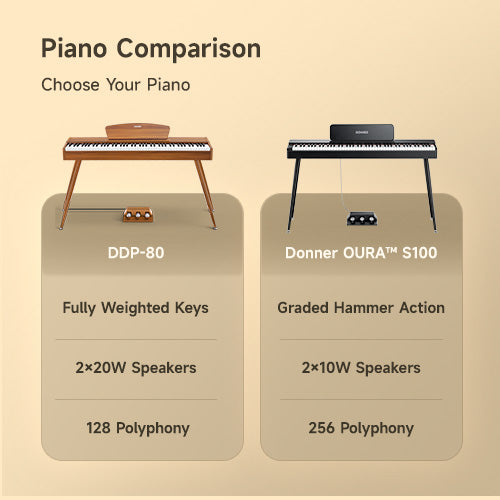
Mid-range 88-key models run $500–$700. The Donner DDP-80 PRO adds graded hammer action, a furniture-style wooden cabinet, and upgraded speaker projection.
What the extra money buys in an 88-key piano: weighted hammer action, multi-layered piano samples that respond to how hard you press, 128 or more notes of polyphony (so sustained chords don't cut off), and speakers that fill a room rather than a desk.
Key Action & Feel
This is the part that matters more than key count.
Synth-action (most 61-key keyboards): Light, spring-loaded keys with no weight gradation. Press any key anywhere and it feels the same. Fine for synth leads, organ parts, and DAW input. Not fine for building piano technique, because your fingers learn habits that don't transfer.
Semi-weighted (some 61-key, some portable 88-key): Spring tension plus a small weight for resistance. A step toward acoustic feel. Adequate for the first six months of piano learning, but you'll eventually want more.
Fully weighted hammer action (standard on 88-key digital pianos): A mechanical hammer mechanism inside each key. The bass keys feel heavier, the treble keys feel lighter, just like an acoustic grand. This resistance builds finger strength, independence, and dynamic control. When piano teachers say "weighted keys," this is what they mean.
The metaphor holds: learning piano on unweighted keys is like training for a marathon in flip-flops. The motions are the same, but the resistance that builds your foundation isn't there.
One exception: if you're a synthesizer player or DAW producer, lighter action may be exactly what you want. Hammer action can slow down synth leads and drum pad programming. In that context, synth-action 61 keys is the right tool for the job.

Space & Portability
A 61-key keyboard is about 39 inches wide. It fits on a standard desk, a small table, or a keyboard tray. Most models weigh under 15 pounds, so you can move them from room to room, stash them in a closet, or take them to a friend's house. Many 61-key models run on batteries, so you can play on the couch or outside without hunting for an outlet.
An 88-key digital piano is about 52 inches wide. That's the width of a loveseat. It won't fit on a standard desk (a typical IKEA desk is 47 inches). You need a dedicated stand or furniture surface, and once it's set up, you'll likely leave it there. Weighted 88-key pianos weigh 25 to 45 pounds. That heft is a feature (stability during playing) and a constraint (you're not carrying it to the park).
If your practice space is a dorm room, a shared apartment, or a corner of your bedroom, measure before you buy. The instrument that fits your room gets played. The one that doesn't collects dust.

Sound Quality & Features
88-key digital pianos focus on doing one thing well: sounding like a piano. The main piano tone uses multi-layered samples: different recordings for soft, medium, and hard keystrokes, blended in real time based on how you play. Polyphony (the number of notes that can sound at once) typically starts at 128 on entry-level models and reaches 256 on mid-range instruments. The built-in speakers are tuned for piano frequencies, with ports or upward-firing drivers that project sound the way an acoustic piano does.
61-key keyboards take the opposite approach: hundreds of sounds, rhythms, and backing tracks in one light package. You get synth pads, string sections, drum kits, and world instruments alongside a basic piano tone. The piano sound itself is thinner, with fewer sample layers and less dynamic nuance. But if you want to layer a Rhodes over a drum beat and record a demo, the 61-key keyboard does that out of the box in a way most digital pianos don't.
Connectivity is comparable on both: USB MIDI for connecting to computers and learning apps, a headphone jack for silent practice, and a sustain pedal input. 88-key models sometimes add dedicated line outputs for external speakers or audio interfaces.
When to Choose a 61-Key Keyboard
You're on a tight budget. The gap between a $150 61-key instrument and a $350 88-key bundle is real. If that gap is the difference between playing and not playing, start with 61 keys.
Space is genuinely limited. A dorm desk, a small apartment, a shared room: if you can't fit a 52-inch instrument, the 39-inch keyboard that actually fits your space wins every time.
You play pop, rock, or electronic music. Most songs in these genres stay within five octaves. If your goal is to play along with recordings, write songs, or perform at open mics, 61 keys gives you everything you need.
You need portability. Battery power, light weight, and a compact case fit into a gig bag. You can take it to a lesson, a jam session, or across the country.
You work in a DAW. As a MIDI controller for recording software, 61 keys gives you enough range for most virtual instruments without dominating your desk. The lighter action is often faster for programming drums, bass lines, and synth parts.
Limitations you should know about: within 12 to 24 months of serious practice, you'll start running into pieces that need keys you don't have. The unweighted or semi-weighted action won't build the finger strength that transfers to an acoustic piano. And when you eventually sit at a full-sized instrument, the keyboard's center point will feel slightly offset from what you're used to, a temporary disorientation that takes a few sessions to adjust.
When to Choose an 88-Key Digital Piano?
You want to learn piano, not just keyboard or synth. If your goal is Chopin, Beethoven, graded exams, or playing at church on Sunday, you need the full range and weighted action.
You want to build technique that lasts. Weighted hammer action develops proper finger strength, independence, and dynamic control. Every hour you practice on the right tool is an hour you don't have to redo later.
You have the budget and the space. Entry-level 88-key digital pianos start around $230. Mid-range models at $500–$700 deliver a playing experience close to an acoustic upright. If you have the money and roughly four and a half feet of wall space, 88 keys is a one-time purchase that grows with you.
You never want the instrument to be the reason you can't play something. With 88 keys, the limiting factor is your skill, not the hardware. No piece is off limits because of range.
Donner 88-key recommendations, from entry to mid-range:
The Donner DEP-20 is the practical entry point. Fully weighted 88 keys, graded hammer action, and everything in the box: stand, triple pedal unit, sustain pedal, power supply. With 238 tones, 200 accompaniment rhythms, and 128-note polyphony, it covers daily practice, casual performance, and recording. The main piano tone is clean and functional, ideal for learning, not a recording studio centerpiece.
The Donner DEP-1S trades the full furniture bundle for portability. Semi-weighted 88 keys with Bluetooth MIDI and a rechargeable battery. You can practice without being tethered to a wall outlet. It fits players who want the full key range in a lighter, more mobile form.
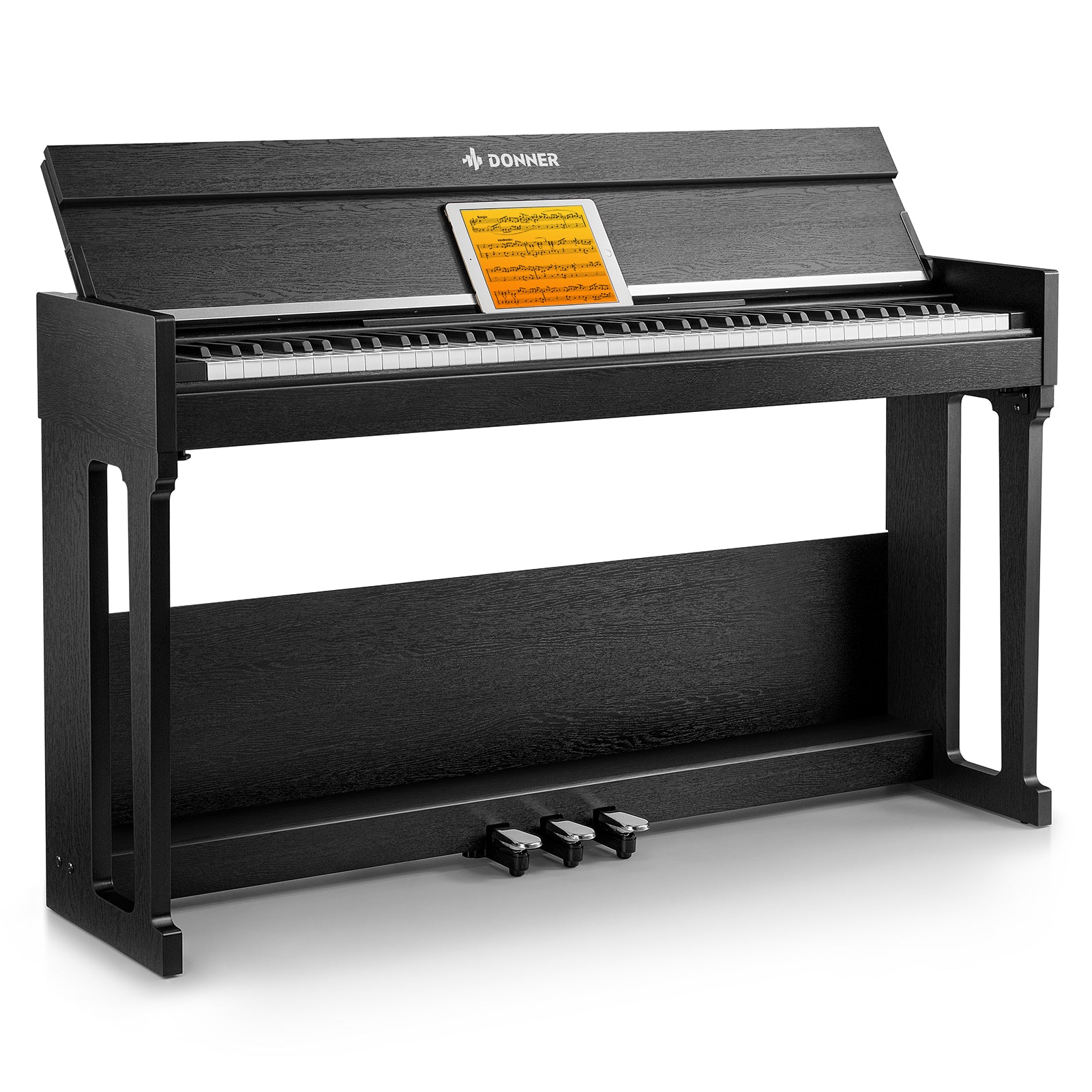
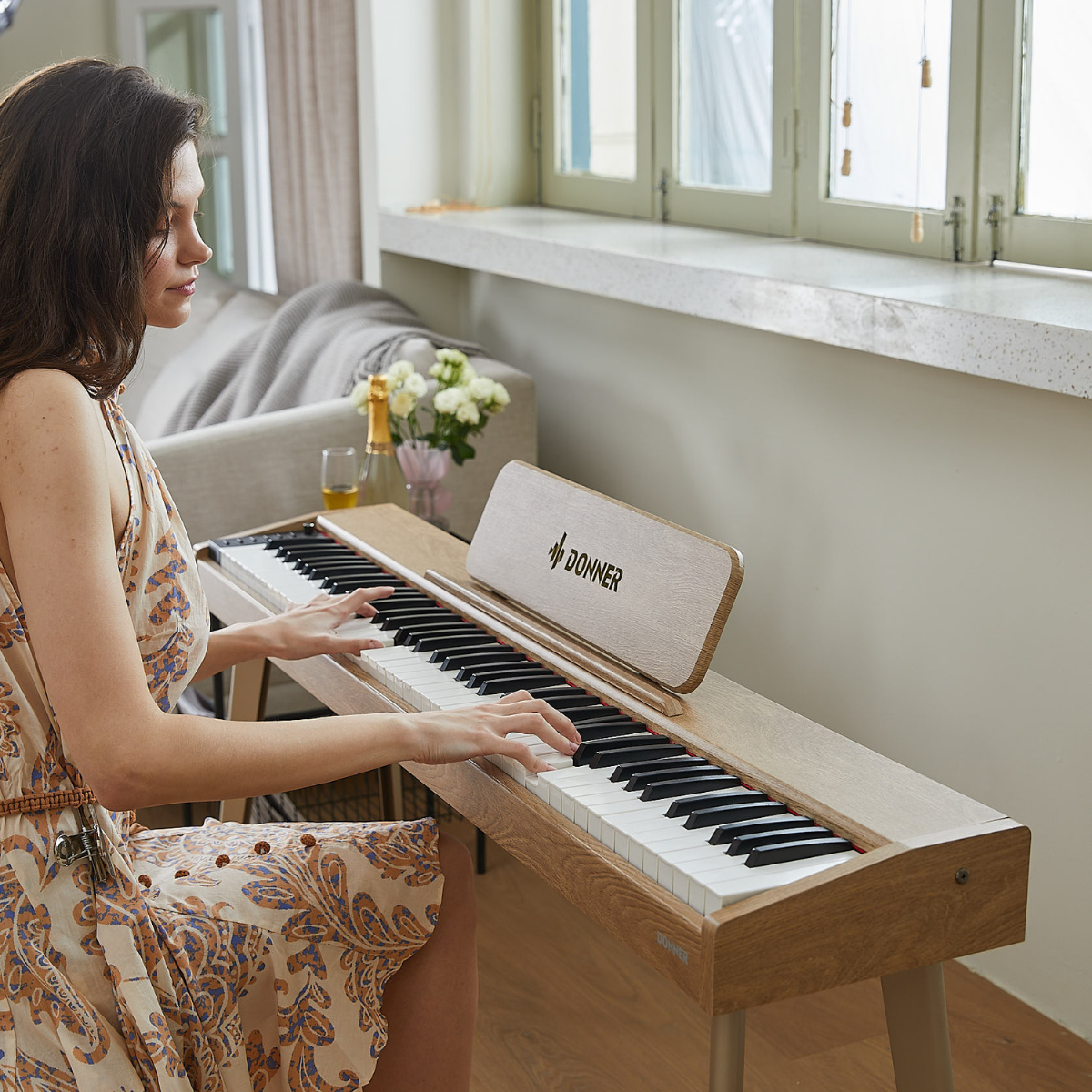
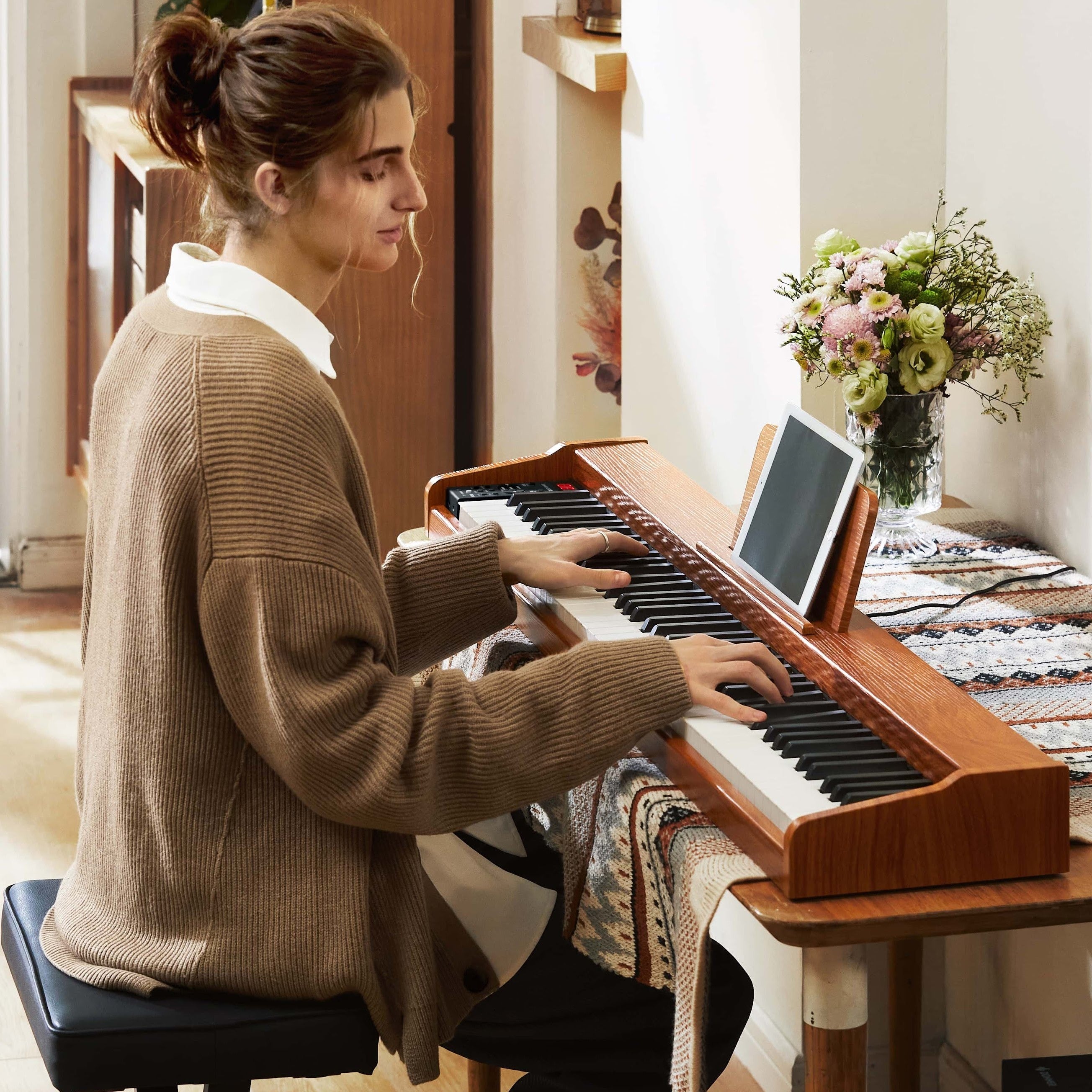
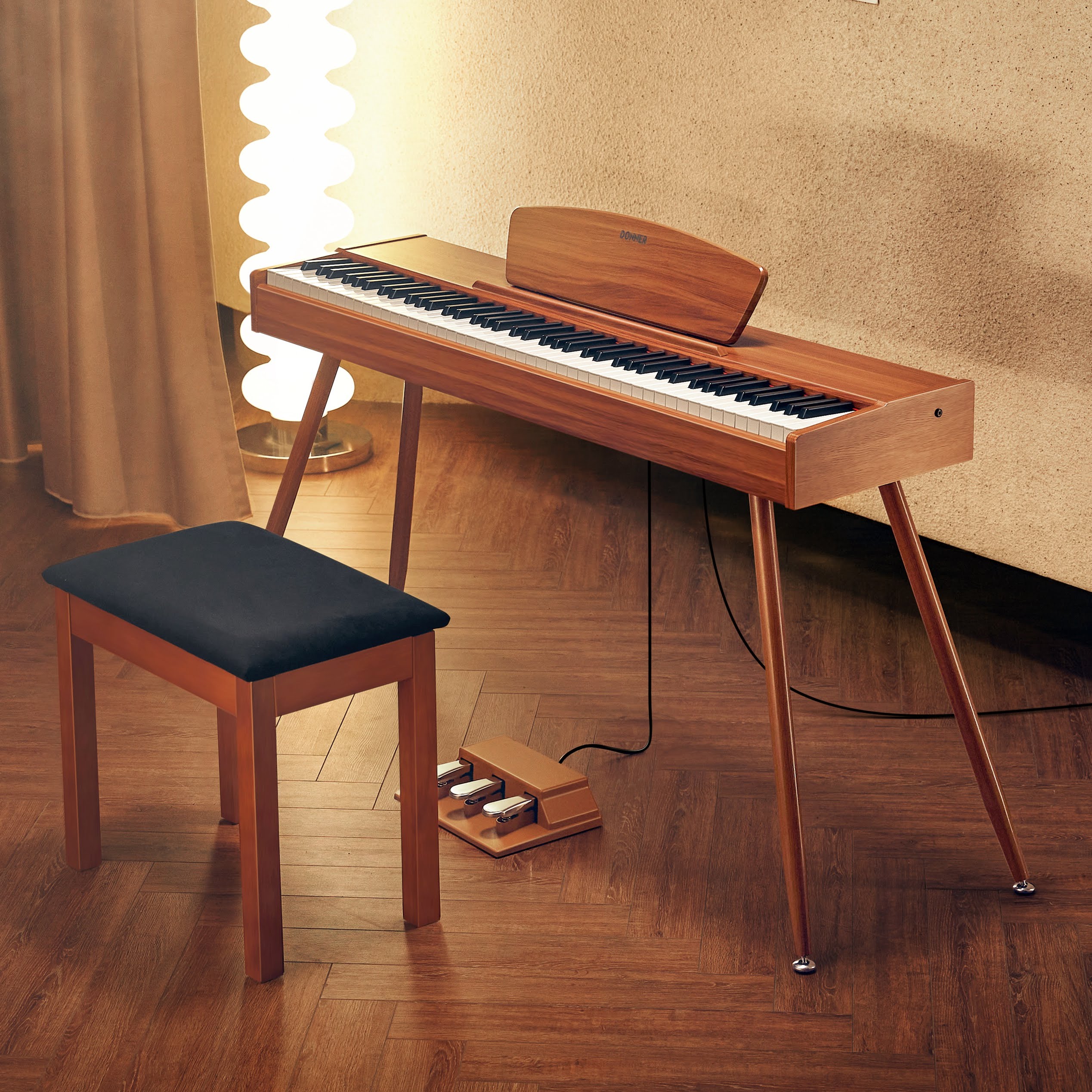
The Donner DDP-80 PRO steps up to a furniture-style cabinet with a wooden finish. Graded hammer action provides a heavier touch in the bass and lighter touch in the treble, matching the feel of an acoustic grand. Upgraded speaker projection fills a living room, and the piano lid design doubles as a dust cover.
The Donner DDP-200 adds Bluetooth MIDI and audio to the graded hammer action platform. Stream backing tracks through the piano's speakers while you play, or connect wirelessly to learning apps without cables. The furniture stand and triple pedal come standard.
At the same price points, the Yamaha P-145 and Roland FP-10 are the most common alternatives. Yamaha's action is lighter and faster; Roland's is firmer with a more pronounced escapement feel. Try both if you can. Hand preference on key action is personal.
Why Does a Full-Sized Piano Have 88 Keys?
The 88-key standard wasn't designed. It evolved.
Before the piano existed, the harpsichord was the dominant keyboard instrument. It had about 60 keys (five octaves). When Bartolomeo Cristofori built the first piano around 1700 in Florence, his instrument had only 49 keys, or four octaves. It was described as a "gravicembalo col piano e forte": a harpsichord that could play soft and loud, which is where the name "pianoforte" comes from.
As the piano spread across Europe, composers pushed for more range. Mozart's later works started filling the available keys. Beethoven, never satisfied with limits, demanded notes at both extremes that piano makers hadn't built yet. Manufacturers responded: six octaves by 1810, seven octaves by 1820. Each expansion was driven by composers asking "can you add one more?"
In the 1880s, Steinway & Sons in New York produced a piano with 88 keys: 52 white, 36 black, spanning from A0 to C8. Other manufacturers followed, and it became the permanent standard.
Why stop at 88? The limits are biological, not mechanical. The lowest note, A0, vibrates at 27.5 Hz, approaching the boundary where individual pitch becomes difficult for the human ear to distinguish. Below that, notes blend into rumbling texture rather than recognizable tones. The highest note, C8, sits at roughly 4,186 Hz. Beyond that point, frequencies become thin, piercing, and musically impractical. Pianos can be built with more keys. Bösendorfer makes a 97-key Imperial Grand, and Stuart & Sons produced a 108-key piano in 2018, but those extra notes exist mainly for sympathetic string resonance. They enrich the tone of the notes you actually play.
A piece of trivia: World Piano Day is celebrated on the 88th day of the year: March 28, or March 29 in leap years.
What About 76 Keys: The Middle Ground?
Between the 39-inch 61-key keyboard and the 52-inch 88-key piano sits a third option: 76 keys, roughly 47 inches wide, covering six and a third octaves.
The 76-key format solves a real problem. It covers virtually all repertoire. Only a handful of advanced classical works require the full 88 keys. It fits on a wider desk or a compact stand where 52 inches won't work. And it weighs less than a full 88-key weighted piano.
The problem is availability. Very few manufacturers produce 76-key instruments with weighted action. The Yamaha NP-35 is semi-weighted at 76 keys, good for casual playing but not for building technique. Most 76-key models sit in the workstation keyboard category, aimed at stage performers who need to split the keyboard into zones for different sounds, not at piano learners.
If you find a 76-key weighted digital piano that fits your budget and space, it's a legitimate option. For most buyers, the choice stays between 61 and 88, not because 76 is bad but because good 76-key weighted instruments are hard to find.
Frequently Asked Questions
Is 61 keys enough for learning piano?
Yes, for the first 12 to 24 months, and indefinitely if you stay with pop, rock, and casual playing. The major beginner method books (Alfred, Faber, Bastien) all stay within five octaves for their first 18 to 24 months of material. The note names, chord shapes, and music theory are identical on 61 and 88 keys. What you learn transfers directly when you eventually upgrade.
Do I need weighted keys from day one?
If you're learning piano with the goal of playing acoustic instruments, yes. Weighted keys build finger strength and dynamic control from the start. If you learn on unweighted keys, you'll eventually need to retrain your touch when you switch to an acoustic or weighted digital piano, a process that takes weeks to months.
If your focus is synthesizer, organ, or DAW production, weighted keys may actually slow you down. The lighter action of a synth-style keyboard is faster for those applications.
Can I play classical music on a 61-key keyboard?
Beginner classical, yes. Most pieces labeled "easy piano" or graded at levels 1–3 fit entirely within five octaves. Intermediate classical, sometimes. Baroque and Classical-period pieces by Bach, early Mozart, and Clementi often stay in range. Advanced classical, no. Chopin, Liszt, Debussy, Rachmaninoff, and late Beethoven all require the full 88-key range. Expect to hit the limit within one to two years of dedicated classical study.
How long until I outgrow a 61-key keyboard?
Casual and pop players may never outgrow it. If you're learning chords, playing along with songs, or composing in a DAW, 61 keys can serve you for years. Classical students typically want 88 keys within one to two years. The upgrade usually coincides with reaching intermediate repertoire, around the time you start your first Chopin nocturne or Beethoven sonata.
Why do some pianos have more than 88 keys?
The Bösendorfer Imperial Grand (97 keys) and Stuart & Sons pianos (102 or 108 keys) add extra bass strings below A0. These keys are rarely played directly in performance. Their purpose is sympathetic resonance: when you play a note, the extra strings vibrate in response, adding harmonic richness to the overall sound. Composers have written only a handful of pieces that use these extra keys as played notes.
Your Perfect Keyboard Starts With Your Goals
The 61-key vs 88-key decision doesn't have one right answer. It has your right answer.
If your goal is classical piano, the instrument needs to support that from day one: 88 weighted keys, hammer action, a stand, and pedals.
If you're exploring, testing whether piano is for you, or just want to play songs you love without committing to a furniture-sized instrument, a quality 61-key keyboard gets you playing today. The skills transfer later.
The instrument that gets played is the right one. Buy what fits your space, your budget, and your goals right now. You can always upgrade when your playing demands more.
Browse Donner's digital pianos to compare 88-key models, from portable starters to furniture-style home pianos.