






On Amazon, some forty-nine keys keyboard pianos are for $49, while a full 88-key digital piano is for $599. You don't want to blow your budget on something you'll regret by week two.
If you're serious about learning, get an 88-key digital piano. It's the standard. It's what acoustic pianos use. And it's what nearly every lesson book, video course, and piano teacher expects you to have.
That said, 61 keys has its place — and we'll cover exactly when it makes sense. By the end of this guide, you'll know which option fits your goals, your budget, and the space you actually live in.

Quick Decision Checklist
Before you choose your keys on keyboard piano, pin down four things:
- Your hard budget cap
- Available desk or floor width (measure it now)
- Weighted keys — do you need them?
- Are you moving this thing between rooms?
Tip 1 - 49, 61, 76, and 88 Keys Portable Keyboard Usage Explained
Digital pianos and portable keyboards come in four sizes. Here's what each one actually means for your playing — and which ones are worth your money.
| Keys | Width | Best For | Real Example |
|---|---|---|---|
| 49 | ~32" | Toddlers, toy-level. Not for adults. | — |
| 61 | ~39" | Tight budget, tight space, DAW production. | Yamaha PSR-E373 / Casio CT-S1 |
| 76 | ~47" | Space-constrained serious players. Rare. | — |
| 88 | ~52" | Anyone serious about learning. Classical, exams, long-term study. | Donner DEP-20 / Alesis Recital |
49 Keys - Don't Bother
Four octaves. Cheap, tiny, fits anywhere. And completely useless for an adult beginner.
The moment you try to play with both hands, your left and right hand collide in the middle of the keyboard. You'll outgrow this within two or three weeks. Unless the player is under age six, skip it.

61 Keys - When It Makes Sense (And When It Doesn't)?
A 61-key portable keyboard comes with five octaves and covers roughly 90% of beginner-to-intermediate repertoire, and it fits on a standard desk at about 39 inches wide.
When 61 keys is the right call: You're producing music in a DAW and need MIDI input, not a piano-learning tool. You're learning synth or organ, where five octaves is standard. Your budget and space are genuinely tight, and the alternative is not playing at all.
When it's not: You're learning to play piano. Most 61-key portable keyboards use semi-weighted or synth-style keys. They don't feel like a real digital piano, and they won't build the finger strength that piano technique demands. You'll also run into range limits on classical pieces within the first year or two of lessons.
76 Keys — The Gap Nobody Fills
Six and a quarter octaves. Nearly the full range of an 88-key digital piano, in a noticeably smaller footprint.
The problem: almost nobody makes them. Manufacturers treat 76 keys as a gap between 61 and 88, and most buyers end up on one side or the other. If you happen across a 76-key digital piano you genuinely like, it's perfectly fine — just don't limit your search to this count expecting variety.
88 Keys - The Right Answer for Most Beginners
Seven and a quarter octaves. This is the full piano keyboard — what every acoustic piano has, what every piano teacher uses, and what every method book assumes you're sitting at.
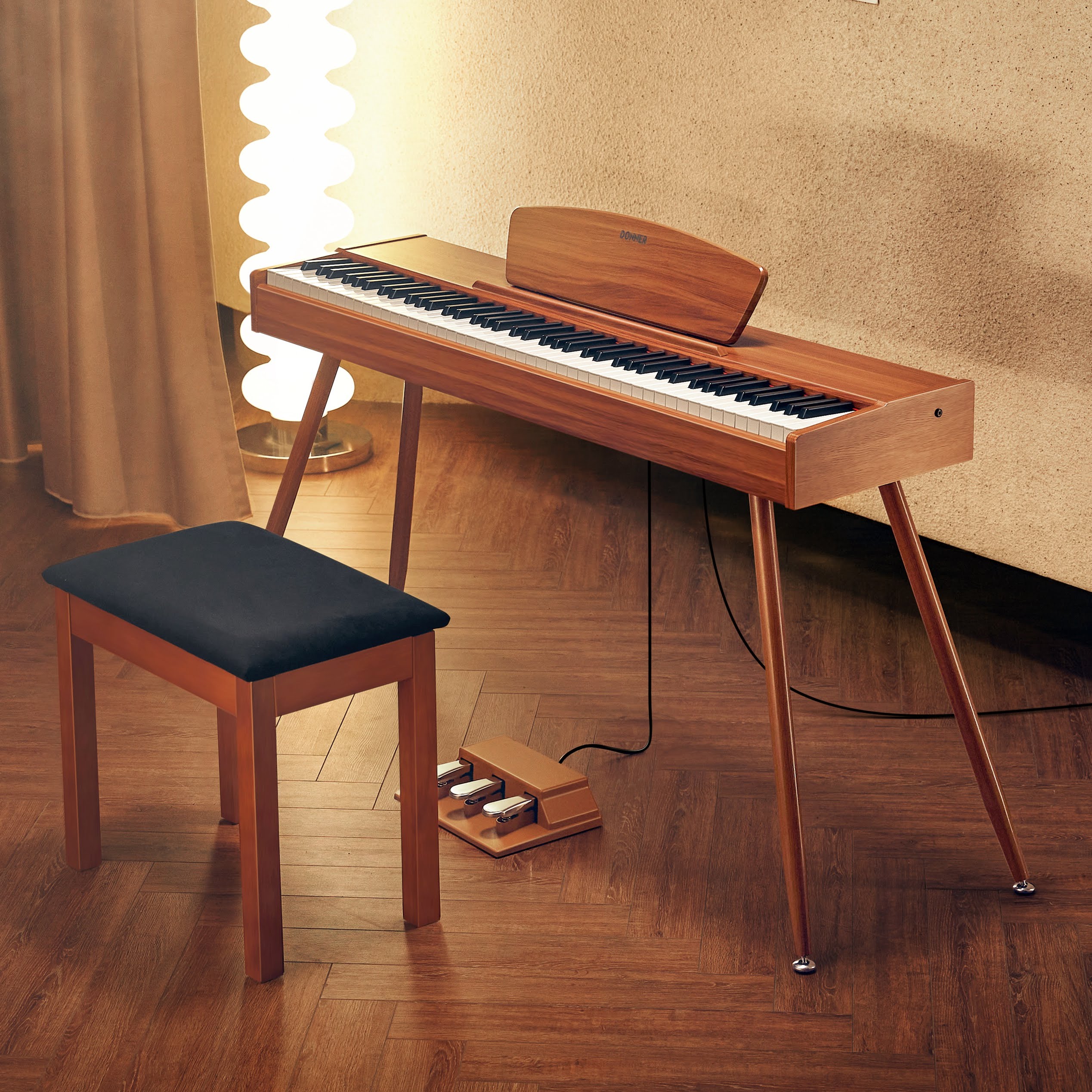
The case for 88 keys: Zero repertoire limitations. You can play anything ever written for the instrument, from a beginner's first piece to advanced Chopin. Fully weighted hammer action is standard on 88-key digital pianos — the keys push back with resistance that matches an acoustic piano, building proper finger technique and dynamic control from day one. Most models in this category include a sustain pedal and can be paired with a furniture-style stand and triple-pedal unit later.
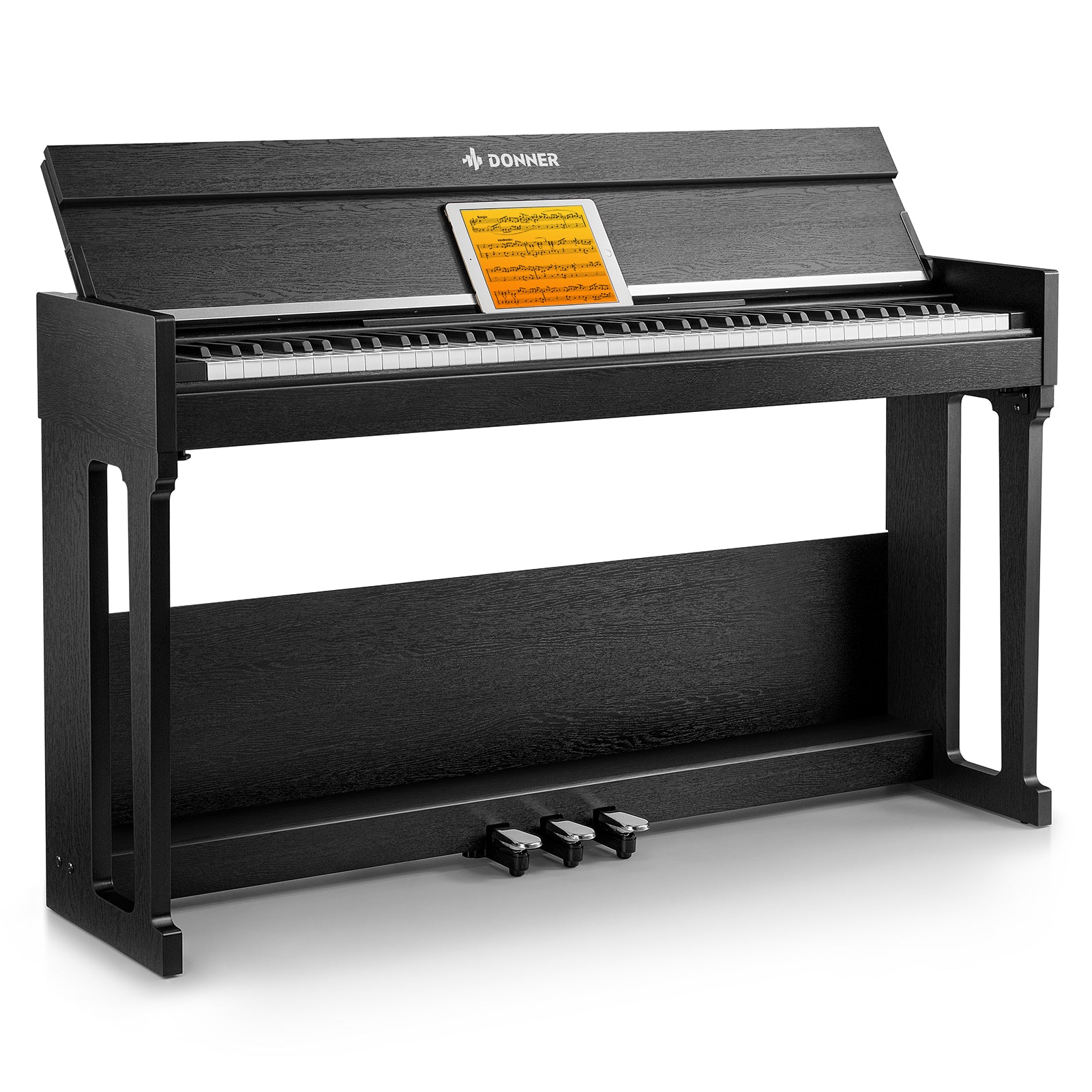
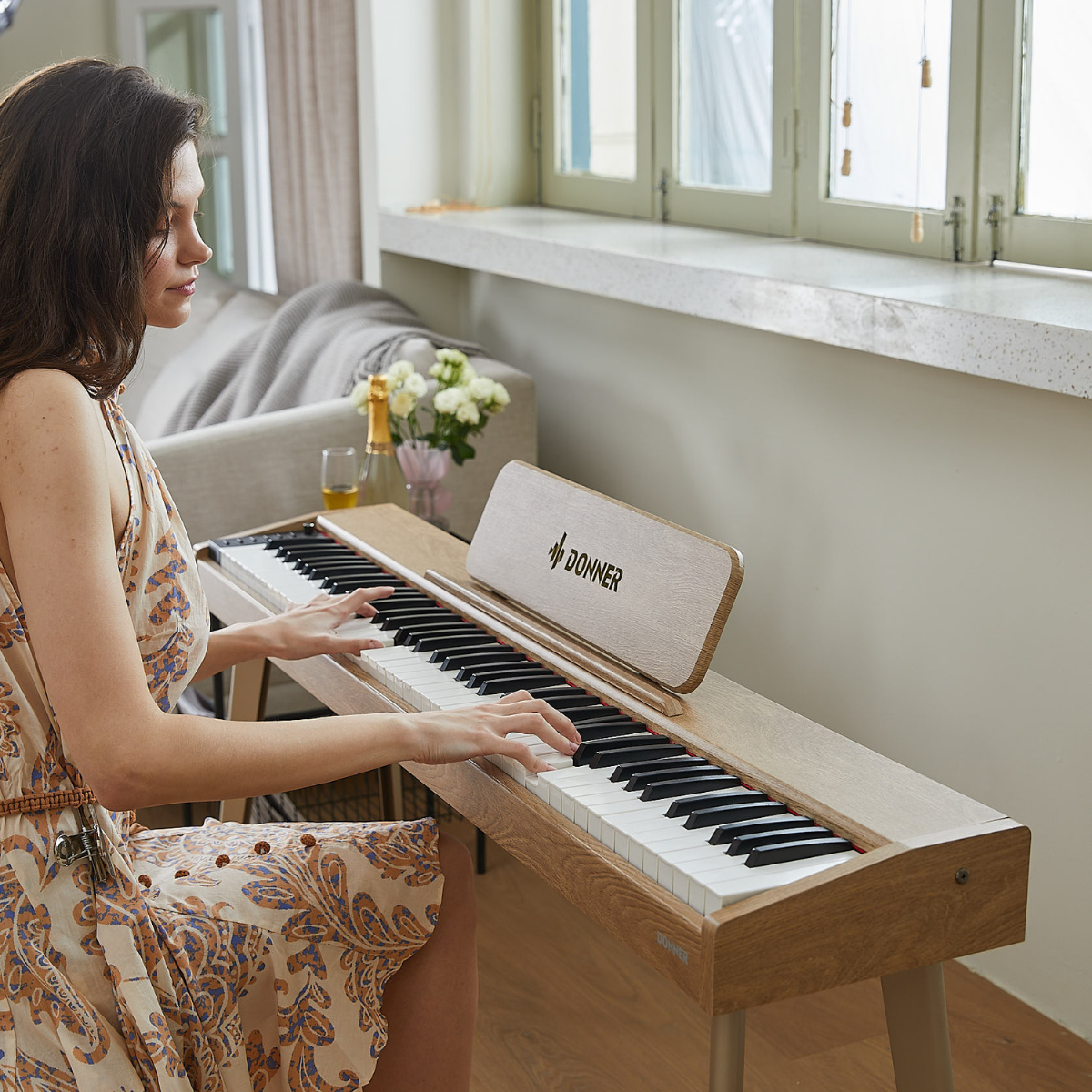
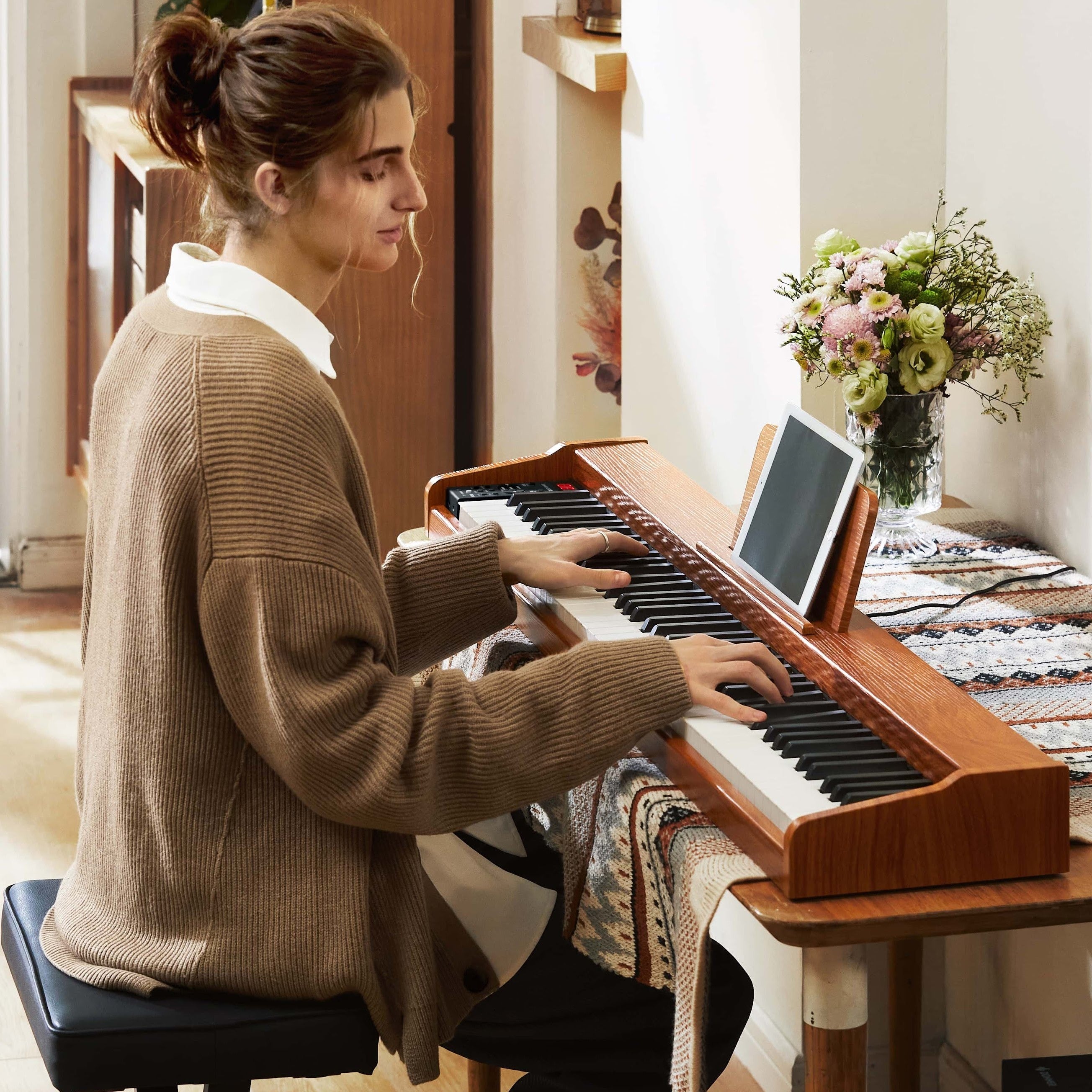
The Donner DEP-20 keyboard piano is popular entry choice. It uses fully weighted hammer action.
The tradeoffs: An 88-key digital piano is 52 inches wide. That does not fit on a standard desk — measure your space before ordering, not after the box shows up. Full-size digital pianos with weighted action are substantial instruments; they're not something you casually move between rooms every day. They also cost more than a 61-key portable keyboard, for reasons we'll get into below.
But here's what nobody tells you: Starting on 88 weighted keys means you never have to relearn anything. Every hour you practice on the right tool is an hour you don't have to redo later on a different instrument. If you can afford it and you have the space, 88 keys is the choice you won't second-guess.

Tip 2 - Match Your Budget to the Right Tier
When you go from a 61-key portable keyboard to an 88-key digital piano, you're not just paying for 27 extra keys. The entire instrument upgrades: the key action gets closer to an acoustic piano, the sound engine uses richer samples, the speakers improve, and the physical build shifts from lightweight plastic to a stable, furniture-grade cabinet.
Key count is a useful shorthand for what quality tier you're in. Here's how that plays out with real products:
| Tier | Budget | What You Get | Example |
|---|---|---|---|
| Entry | $130–$200 | 61 keys, touch-sensitive, synth or semi-weighted action, basic onboard sounds. Enough for DAW work or casual playing. | Yamaha PSR-E373 / Casio CT-S1 |
| Mid | $230–$400 | 88 keys, semi-weighted or fully weighted action, improved sound engine (64–128 polyphony), better speakers. | Donner DEP-20 / Alesis Recital |
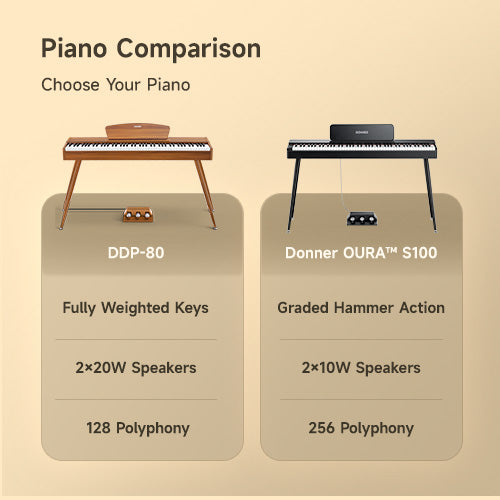
| Serious | $500–$700 | 88 keys, fully weighted graded hammer action, multi-layered samples, furniture stand and triple pedal included or available. | Donner DDP-80 / Yamaha P-145 |
What Actually Improves as You Go Up
Each tier jump upgrades more than just the key count:
- Key action: Synth-action springs → semi-weighted → fully weighted graded hammer action. Each step brings the feel closer to an acoustic piano. This matters for building finger strength and technique — it's the single biggest reason to stretch your budget if you can.
- Sound engine: Basic samples → multi-layered samples that respond to how hard you play. Hit the key softly and you get a soft tone; dig in and the sound opens up. This dynamic response is what makes a digital piano feel like an instrument rather than a gadget.
- Polyphony: 32 voices → 64 → 128+. Higher polyphony means no notes cut off when you hold the sustain pedal through a chord progression. Below 64 voices, you'll hear notes drop — distracting and impossible to ignore.
- Physical build: Lightweight portable shell → furniture-style cabinet with integrated stand and pedal unit. The instrument goes from something you set up and put away to something that has a permanent home in your room.
Reality Check
"Buy once, cry once" is bad advice for a beginner. You don't know what you need yet — you haven't played enough to form an opinion. An entry-level 61-key portable keyboard won't hold you back during your first year of casual playing. A mid-tier 88-key digital piano like the Donner DEP-20 will serve a serious student for years.
Buy what fits your budget and your room. The things that make people quit — boring practice routines, unrealistic expectations, no structure — have nothing to do with the instrument.
Tip 3 — Beyond Key Count: What Else to Look For
Key count gets all the attention, but these four factors are just as important. In some cases, more.
Weighted vs unweighted keys. If you're learning to play piano, weighted keys are non-negotiable. They build finger strength and dynamic control from the start. A digital piano with weighted action — even a 61-key model, if you can find one — will serve a piano student far better than an 88-key keyboard with springy, unweighted keys. The technique lives in how the keys respond, not in how many there are.
Touch sensitivity. Also non-negotiable. If pressing harder doesn't make the sound louder, the instrument cannot express dynamics. You cannot play softly or build to a climax. Any keyboard or digital piano that lacks touch sensitivity is a toy — skip it regardless of key count, brand, or price.
Polyphony. Sixty-four voices is the minimum for a beginner. Polyphony determines how many notes the instrument can sound at once. With 32 voices — common on cheap portable keyboards — you'll hear notes drop out the moment you hold the sustain pedal through a few chords. It's frustrating, it sounds bad, and there is no setting to fix it.
Portability. Portable keyboards with synth or semi-weighted action are relatively light and easy to move. Full-size digital pianos with weighted hammer action are heavy instruments — they're meant to stay put. If you move between rooms, take your instrument to lessons, or live somewhere you can't leave it permanently set up, this matters. Don't buy a heavy digital piano if moving it every day will make you practice less.

Common Mistakes Beginners Make
Mistake 1: "88 keys or nothing". Yes, 88 keys is the right answer for most piano learners. But a cheap 88-key keyboard with unweighted, springy action is worse than a quality 61-key digital piano with touch sensitivity and weighted keys. Key count doesn't guarantee quality. If your budget only reaches an 88-key keyboard with terrible action, drop to a better-built 61-key model instead.
Mistake 2: Buying 49 keys to "start small." You'll hit the range limit within two weeks. The price jump from 49 to 61 keys is often $30 or less. Spend it.
Mistake 3: Not measuring your space. An 88-key digital piano is 52 inches wide. A typical IKEA desk is 47 inches. Discover this after unboxing and you're either returning a 40-pound shipment or playing sideways for months. Measure first.
Mistake 4: Assuming more keys means better sound. Sound quality comes from the sample engine and the speakers, not the key count. A $200 61-key portable keyboard often sounds significantly better than a $200 88-key model — because the manufacturer put the budget into audio hardware instead of extra plastic keys.
Frequently Asked Questions
Can you actually learn to play on a 61-key keyboard?
Yes, for the first year or two. The major piano method books — Alfred's Basic Piano Library, Faber's Piano Adventures, and Bastien Piano Basics (the three most widely used lesson book series in the US) — all stay within five octaves for their first 18 to 24 months of material. A 61-key portable keyboard covers that range completely. You only run into limitations once you reach intermediate-to-advanced repertoire.
But keep in mind: most 61-key keyboards in the entry-level price range have unweighted or semi-weighted keys. If your goal is to play piano, not synth or organ, you'll eventually want an 88-key digital piano with fully weighted action. Starting on 61 unweighted keys means you'll need to transition later — which is doable, just not ideal.
How long until I outgrow a 61-key portable keyboard?
Casual players who stick to pop songs and chord-based playing may never outgrow it. Classical-focused students working through method books and preparing for graded exams will want an 88-key digital piano within one to two years.
Do I need weighted keys from day one?
If you're learning piano — yes. Weighted keys build finger strength and teach dynamic control from the beginning. Unweighted, springy keys create habits you'll spend months unlearning when you eventually switch to a weighted digital piano or an acoustic piano. If your goal is synth, organ, or DAW production, unweighted is fine.
What's the absolute minimum I should spend?
$130 to $150 gets you a Yamaha PSR-E373 or Casio CT-S1 — a 61-key portable keyboard with touch sensitivity. That's the floor for a real instrument. Below $100, you're buying a toy: no touch sensitivity, tinny speakers, keys that feel like typing on a laptop. It won't make you want to practice, and practice is the whole point.
For an 88-key digital piano with weighted action, the floor is around $230 to $360, and the Donner DEP-20 keyboard piano sits in this range.
Stop Scrolling, Start Playing
The person we started with, he said browsing Amazon at 11pm, afraid of wasting money on the wrong thing, ended up with a Donner DEP-20. It's an 88-key digital piano with fully weighted hammer action. It fits along the wall of a small apartment, sounds like a real instrument, and won't need to be replaced when the lesson books get serious.
If your budget and space allow it, make the same call. Eighty-eight weighted keys means you learn on the standard from the start. No transitions. No relearning.
The goal isn't to sell you the most expensive instrument. It's to remove the one decision standing between you and actually sitting down to play.
Visit Donner's digital piano series to find the right fit, every listing includes key count, action type, and dimensions, so you know it'll work in your space before you order.