








Choosing guitar effects pedals gets crowded fast. There are hundreds of options, your first pedal rarely solves every tone problem, and each new box takes board space and power. The more useful question is which job your sound needs next: a louder lead, a shimmering texture, a loop for song ideas, or one box that covers most of the work. Browsing the guitar pedals range is a good way to see how those categories are organized.
The ten picks below cover gain, modulation, ambience, looping, tuning, and all-in-one processing. Each one is matched to a specific job and a specific kind of player, so you can fill the gap on your board that matters most before adding anything else.

The Best Guitar Effects Pedals at a Glance
- Donner Arena 2000 Multi-Effect Pedal: best all-in-one multi-effects
- Boss DS-1 Distortion: best classic distortion
- Ibanez TS9 Tube Screamer: best overdrive
- Electro-Harmonix Big Muff Pi: best fuzz
- Donner X MIYAVI Double Swords Pedal: best signature dual pedal
- MXR Phase 90: best phaser
- Boss TU-3 Chromatic Tuner: best stage tuner
- Donner Versa Yellow Fall II Delay and Reverb Pedal: best delay and reverb combo
- TC Electronic Ditto Looper: best simple looper
- Donner Vowel Wah Volume Pedal: best wah and volume combo
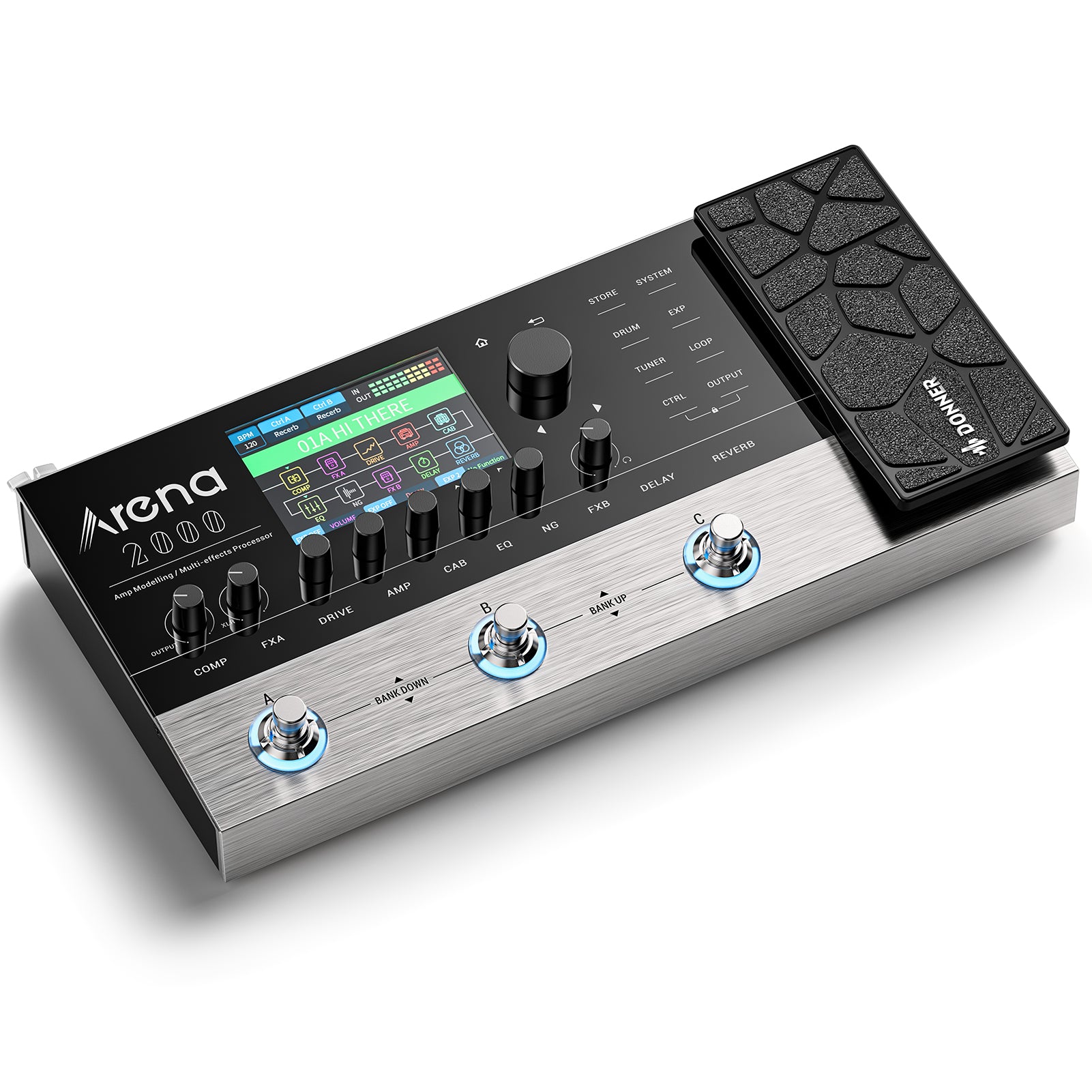
Donner Arena 2000 Multi-Effect Pedal Best all-in-one multi-effects
Pros
- Covers gain, modulation, delay, and amp models
- 50 user IR banks for extra cabinets
- Drum patterns and looper for song ideas
Cons
- Large feature set takes time to explore
If you are still building your rig, the Donner Arena 2000 Multi-Effect Pedal can stand in for a shelf of single-purpose boxes. It offers 278 effect types, which include 100 effect simulations, 80 amp models, and 50 cabinet IRs. An IR (impulse response) is a digital snapshot of a real speaker cabinet, so your sound can pass through a cabinet model instead of a physical speaker.
Audio processing runs at 24-bit, 44.1 kHz with FAVCM tone shaping, and the 50 user IR banks let you load third-party cabinet files as your rig grows. The 40 drum patterns and 60-second looper make it useful for writing song ideas on your own, since you can lay down a groove and a phrase without a second player.
Boss DS-1 Distortion Best classic distortion
Pros
- Classic hard-edged tone
- Mild boost at low settings
- Simple three-knob layout
Cons
- Hard-edged tone suits rock and metal more than mellow styles
The Boss DS-1 Distortion has been on rock, punk, and metal boards since 1978, and that long run is the appeal for a player who wants classic, hard-edged distortion. Its three knobs cover level, tone, and distortion, and its two-stage transistor and op-amp circuit produces tight gain with rich harmonics. Harmonics are the extra overtones that give a distorted note its character, so the sound stays focused rather than muddy.
The tone control works in both directions. Turned one way it boosts the highs and trims the lows, and turned the other way it does the reverse, so you can move the sound between brighter and darker. At low distortion settings the DS-1 works as a mild boost, and rolling back your guitar's volume knob cleans the sound up.
Ibanez TS9 Tube Screamer Best overdrive
Pros
- Classic mid-focused overdrive
- Reissue of the original circuit
- Battery or adapter power
Cons
- Single effect, so a board still needs other pedals
With a tube amp, the Ibanez TS9 Tube Screamer pushes the amp into a fuller drive and tightens a tone that is already breaking up. Its drive, tone, and level controls follow the classic Tube Screamer layout, so the pedal is quick to learn and quick to set for either a lead or a rhythm sound.
This model is a reissue of the original green overdrive circuit in the same housing. It runs on a 9-volt battery or a DC 9-volt center-negative adapter and draws about 8 mA, a small current draw that keeps the power demands of a board light.
Electro-Harmonix Big Muff Pi Best fuzz
Pros
- Long, singing sustain
- True bypass keeps tone clean when off
- Classic rock and grunge voice
Cons
- Crushing distortion leaves little room for clean tones
If you want fuzz with long, singing sustain, the Electro-Harmonix Big Muff Pi is built for it. This analog fuzz, distortion, and sustainer pedal turns a single note into a long, thick tone that suits solos and wall-of-sound rhythm parts.
Its volume, tone, and sustain controls set the output level, the tone range, and how much gain and sustain you get. The long, singing sustain and crushing distortion suit classic rock, grunge, and stoner rock. The pedal has true bypass, so your signal passes through unchanged when it is switched off. It ships with a 9-volt battery and can also run on a 9.6-volt adapter sold separately.
Donner X MIYAVI Double Swords Pedal Best signature dual pedal

Pros
- Two signature voices in one unit
- Gain and spatial effects together
- Buffered or bypass modes for longer chains
The Donner X MIYAVI Double Swords Pedal puts two signature voices into one unit. Rage Breaker covers overdrive, fuzz, and booster sounds, with an adjustable gate, sustain, and tone controls plus an independent +3 dB solo boost for lead parts. Dimension Weaver takes the spatial side with chorus, delay, and reverb. It uses three footswitches and rate, depth, time, and repeat controls, along with tone and mix shaping.
You can use the two halves together or on their own, so one unit can cover a gain part and an ambient part in the same song. Buffered or bypass modes help it sit cleanly in a longer pedal chain, which matters once the board holds several boxes.
MXR Phase 90 Best phaser
Pros
- One knob, quick to set
- Shimmer through fast phasing
- Battery or adapter power
Cons
- Only one control to shape the sound
The MXR Phase 90 is a phaser built around one rate knob. A phaser sweeps a set of filters through your tone, which makes the sound swirl. Turn the rate knob a little and you get subtle spatial shimmer, turn it further and the swirl becomes fast phasing. The compact orange enclosure houses the M101 model.
It runs on a 9-volt battery or a Dunlop ECB003 adapter, and it works with DC Brick and Iso-Brick power supplies. With only one control to set, it suits a player who wants a phaser that is quick to dial in during a rehearsal or a live set.
Boss TU-3 Chromatic Tuner Best stage tuner
Pros
- High-brightness meter for outdoor stages
- Silent tuning with output mute
- Guitar, bass, and 7-string support
Cons
- Other pedals need an extra adapter and cable
A gigging player needs a tuner that is fast to read in bright or dark stage light and quiet to use between songs. The Boss TU-3 Chromatic Tuner has a 21-segment LED meter with brightness control and a high-brightness mode for outdoor stages. It reads to plus or minus one cent, and the Accu-Pitch sign confirms when the note is in tune.
Output muting engages during tuning, so the audience hears silence while you tune. Chromatic mode is joined by guitar and bass modes, with support for 7-string guitars and 5- and 6-string basses. The DC output jack can also help power other pedals when you add an adapter and daisy cable.
Donner Versa Yellow Fall II Delay and Reverb Pedal Best delay and reverb combo

Pros
- Delay and reverb in one unit
- Tap tempo for live rhythm
- Two saved presets
Cons
- Only two preset slots
A combined delay and reverb pedal makes sense when you want both effects and have room for only one box. The Donner Versa Yellow Fall II Delay and Reverb Pedal offers a 3x3 model matrix, which gives you nine model choices to start from, along with adjustable delay time, reverb depth, reverb size, and pre-delay. Pre-delay sets the gap before the reverb starts, which keeps the reverb from washing over your notes.
Separate footswitches for delay and reverb let you switch each effect on its own. Tap tempo sets the echo rhythm by tapping in time with the song, and the two saved presets let you recall a setting quickly during a live set. The all-metal shell and low-noise buffer bypass round out the design.
TC Electronic Ditto Looper Best simple looper
Pros
- One footswitch for every loop action
- Five minutes of looping time
- Compact footprint for tight boards
Cons
- Five minutes caps the total loop time
Looping ideas and layering parts is the whole job of the TC Electronic Ditto Looper, and it does that job with a single footswitch. Record, undo and redo, stop, and erase all sit on that one switch, and the pedal provides five minutes of looping time.
The 24-bit uncompressed audio keeps the loop clean, and the analog dry signal path keeps the unlooped part of your tone clean too. Your dry signal is the guitar sound without effects. True bypass switching and a compact footprint make the pedal practical for tight pedalboards.
Donner Vowel Wah Volume Pedal Best wah and volume combo

Pros
- Wah and volume in one unit
- Active volume keeps signal clean
- Durable housing and metal hinge
Cons
- Less value if you only need one function
A player who uses both a wah and a volume pedal usually needs two board slots for the pair. The Donner Vowel Wah Volume Pedal combines a classic wah with an active volume control in one compact footprint, so both functions take up one spot. Active means the volume section runs on its own built-in circuit.
The active volume circuit is designed to avoid signal loss and reduce popping and background noise, which keeps your guitar signal clean when you roll the volume up or down. The durable housing, metal hinge, and status indicator lights add to the build.
How to Choose Guitar Effects Pedals
Four checks decide whether a pedal earns its place on your board. Start with the effect you need, then look at circuit style, signal flow, and power and space, because each one changes how well a pedal fits a real setup.
Start With the Effect You Actually Need
Group the options first: gain (overdrive, distortion, and fuzz), modulation (phasers and similar sweeping effects), ambience (delay and reverb), utility (tuners, loopers, and wah or volume controls), and multi-effects units that cover several groups. Choose the group before the model. A player who needs a louder lead tone should start with gain pedals, while a player who wants more depth should look at ambience.
Analog and Digital Circuits
Analog pedals process the guitar signal with traditional electronic parts, and they remain a common choice for overdrive and fuzz. Digital effects use processing to build delays, reverbs, and amp models that are hard to make with analog parts alone. Some pedals combine both approaches, so check the product description to see which part is analog and which is digital, rather than assuming one approach is better for every effect.
Bypass, Buffers, and Signal Flow
True bypass sends your guitar signal straight through the pedal's wiring when the pedal is off, so an unused pedal does not change your tone. A buffer is a circuit that keeps the signal strong over long cables and long chains of pedals. Buffered bypass keeps that strength even when the pedal is switched off, which matters on a board with many boxes. Signal flow is the order your pedals sit between guitar and amp, and that order changes how each effect sounds.
Power, Size, and Board Space
Standard enclosures are larger and easier to operate with your foot, while mini pedals save space but can make small knobs harder to adjust mid-song. Check power needs before you buy: a 9-volt battery is simple, but some pedals need their own adapter, and a shared power supply can run several pedals from one place. Measure the board and count the boxes that cover your core sound first, so each new pedal earns its spot. Multi-effects units and combo pedals can replace two separate boxes when space is the real limit.
FAQ About Guitar Effects Pedals
The answers below cover the questions that usually come up when a board is taking shape.
What is the best guitar effects pedal for a beginner?
Start with the sound you hear yourself wanting most. A single overdrive or distortion pedal gives you a clear, immediate change, while a multi-effects unit covers a wider range in one box. Budget and goals decide which path makes more sense, so compare the two before you buy.
What order should guitar pedals go in?
A common starting order is tuner first, then gain pedals such as overdrive and distortion, then modulation like phasers, then ambience such as delay and reverb, with loopers often placed at the end. Treat it as a starting point rather than a rule, since some players move a gain pedal after a modulation effect to change how the two interact.
Do budget effect pedals sound good?
Circuit design and build quality shape how a pedal sounds, so a well-designed budget pedal can sound good. Buffers and bypass modes keep the signal strong through a long chain of pedals.
How many pedals does a guitarist need?
Start with the one effect you use in most songs, then add one category at a time as a real need appears. More pedals only help when each one fills a gap you can hear, so resist buying a box for a sound you have not yet needed.
Build Your Pedalboard With Donner
Pick your next pedal by the job it needs to do, then build the board one gap at a time. The Donner pedals you just read about are part of the brand's electric music instruments line, so you can compare them with the other picks before you decide.