










Picking your first electric guitar is harder than it should be. Most starter models look alike, the advice conflicts, and the differences that matter—how a neck feels, which pickups suit your music, whether you can practice quietly—are hard to judge from a spec sheet. The right choice also depends on where you play: a traditional solid-body needs an amp or headphones, while a compact travel guitar lets you practice silently and pack easily.
The shortlist below gives you ten candidate first electrics—three Donner options and seven familiar favorites—organized by the situation each one serves. Compare the cards, then weigh neck feel, pickups, tuning stability, practice setup, and included gear before you decide.
The Best Electric Guitars for Beginners at a Glance
Start with the scenario that sounds most like your own, then open the matching card below.
- Donner VIVA Stringless Smart Guitar — Best stringless smart guitar
- Squier Sonic Stratocaster HT H — Best simple Strat-style electric
- Yamaha Pacifica 112V — Best all-round beginner electric
- Donner HUSH I PRO Acoustic-Electric Travel Guitar — Best silent practice and effects
- Epiphone ES-335 (Inspired by Gibson) — Best semi-hollow electric
- Ibanez GRGM21M miKro — Best short-scale for smaller hands
- Jackson JS Series Dinky JS11 — Best rock/metal entry electric
- Fender Player II Telecaster — Best stage-ready Telecaster
- Donner HUSH C Nylon Acoustic-Electric Guitar — Best nylon-string silent practice
- Gretsch G2420 Streamliner Hollow Body — Best big-body sound
Donner VIVA Stringless Smart Guitar Best stringless smart guitar

Pros
- Stringless smart-guitar design with no traditional strings
- Listed as an electric guitar in Donner's lineup
- New arrival in the electric guitar range
Cons
- Not a traditional stringed electric guitar
The Donner VIVA Stringless Smart Guitar is the pick for a curious first-time buyer who wants to explore a different starting point before committing to a traditional electric. Its stringless smart-guitar design does away with traditional strings entirely, so it sits beside—not inside—the standard electric-guitar path.
It is listed as an electric guitar in Donner's official product record and marked as a new arrival in the lineup, which makes it an interesting option if you want the newest concept rather than a conventional first guitar.
Squier Sonic Stratocaster HT H Best simple Strat-style electric
Pros
- Simple single-pickup layout with no switching
- Hardtail bridge and sealed tuners hold tuning
- Slim C neck with familiar Strat feel
Cons
- One pickup limits tonal variety
The Squier Sonic Stratocaster HT H suits a beginner who wants the iconic Strat-style look with the simplest possible control layout. A single ceramic humbucker means there is no pickup switching to learn, so you can focus on playing rather than settings.
Poplar body with a gloss polyurethane finish. Slim C-shaped bolt-on maple neck with a 25.5-inch scale, 9.5-inch fingerboard radius, 21 frets, and a 1.65-inch nut width. A 6-saddle top-load hardtail bridge and sealed die-cast tuners keep tuning steady without tremolo maintenance. Available in Black, Flash Pink, and Sonic Blue.
Yamaha Pacifica 112V Best all-round beginner electric
Pros
- H/S/S pickups with five-way switching and coil-split
- Alder body with a familiar bolt-on feel
- Entry point of a long-standing beginner series
Cons
- Vibrato bridge adds setup considerations
The Yamaha Pacifica 112V is the versatile all-rounder for a beginner who wants one guitar to explore clean, overdriven, and in-between sounds across many styles. It is the entry point of Yamaha's Pacifica 100 series, a line built around beginners.
Alder body with a gloss polyurethane finish and a bolt-on maple neck with a rosewood fingerboard. Alnico V pickups in an H/S/S configuration with a 5-position selector and a push-pull coil-split for extra tonal options. A vintage-style vibrato bridge with block saddles on a 25.5-inch scale completes a classic layout.
Donner HUSH I PRO Acoustic-Electric Travel Guitar Best silent practice and effects

Pros
- Silent headphone practice with 18 built-in effects
- Bluetooth input plus USB-C OTG direct recording
- About 8 hours of battery and a full travel kit
Cons
- Feature-rich system is more involved than a basic setup
- Not a traditional solid-body electric
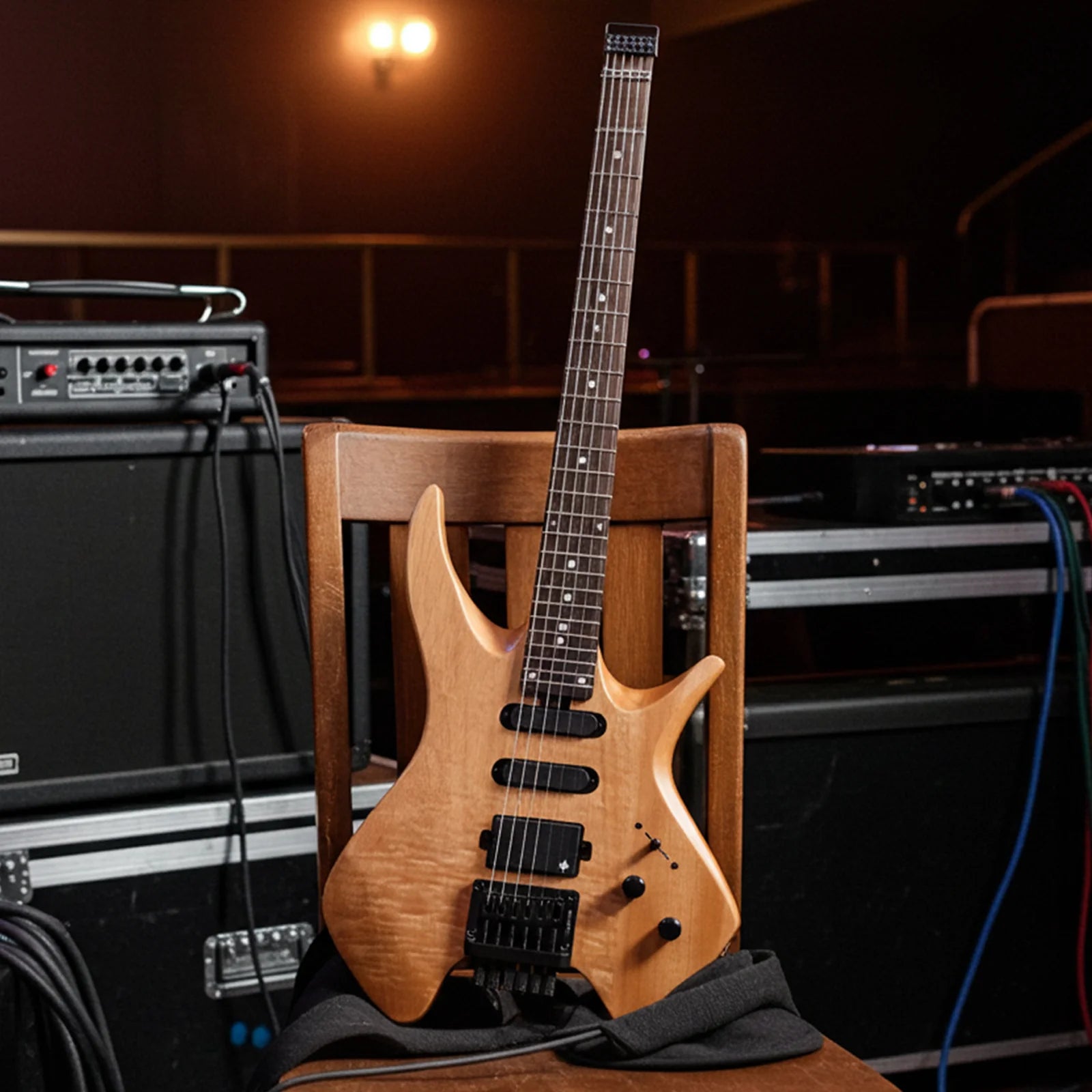
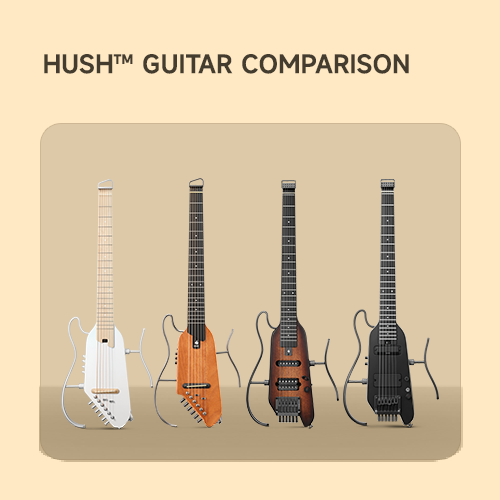
The Donner HUSH I PRO Acoustic-Electric Travel Guitar fits a beginner whose practice space is shared or quiet-sensitive. It is a compact headless acoustic-electric travel guitar—not a traditional solid-body electric—with silent headphone practice, built-in effects, backing-track playback, and a direct recording path.
The removable body frame and neck-through 5-piece mahogany/maple construction keep it packable. DONNER H-1 preamp adds 18 built-in effects, 8 body-shape simulations, 20 impulse-response slots, and a 5-band EQ with Air Boost and Tone Boost. Bluetooth AUX input lets you play along with backing tracks, the 1/8-inch headphone output handles silent practice, and USB-C with OTG output records directly to a phone or interface. Piezo pickup on a 24.75-inch scale with 20 stainless-steel frets and a bone nut. Internal rechargeable battery runs about 8 hours, and the kit includes a deluxe travel gig bag, earphones, strap, tools, cables, and picks.
Epiphone ES-335 (Inspired by Gibson) Best semi-hollow electric
Pros
- Warm semi-hollow tone with solid sustain
- Alnico Classic PRO humbuckers with full controls
- Centerblock controls feedback at volume
Cons
- Larger body is heavier to handle
The Epiphone ES-335 (Inspired by Gibson) is the natural match if you are drawn to a classic semi-hollow look and warm, resonant tones for blues, jazz, or rock. The solid maple centerblock keeps sustain up and feedback down where a full hollow body would be harder to manage.
Layered maple top, back, and sides over a solid maple centerblock. Mahogany set neck with a rounded C profile, a 12-inch-radius laurel fingerboard, 22 medium-jumbo frets, and a 24.75-inch scale. Alnico Classic PRO humbuckers with 2 volume and 2 tone controls plus a 3-way toggle, and a LockTone Tune-O-Matic bridge.
Ibanez GRGM21M miKro Best short-scale for smaller hands
Pros
- 22.2-inch short scale eases fretting reach
- Fixed bridge with independent string-height adjustment
- Two humbuckers for a tight, clear tone
Cons
- Short scale changes familiar string tension feel
The Ibanez GRGM21M miKro is the clearest fit for a younger player or anyone with smaller hands. Its 22.2-inch (564 mm) scale is roughly 1.5 inches shorter than standard, which makes stretches noticeably easier while keeping a conventional electric format.
Poplar body with a maple neck and maple fingerboard, black dot inlays, and 24 medium frets. Two Infinity R passive ceramic humbuckers give a clear, tight voice, and the F106 fixed bridge with independent string-height adjustment keeps maintenance simple. Available in Jewel Blue, Metallic Purple, Candy Apple, and Blue Burst.
Jackson JS Series Dinky JS11 Best rock/metal entry electric
Pros
- High-output HH ceramic humbuckers
- Graphite-reinforced speed neck with jumbo frets
- Aggressive Dinky styling
Cons
- Tremolo bridge needs occasional setup attention
The Jackson JS Series Dinky JS11 is aimed at a beginner whose music leans toward rock and metal. The Dinky body, bolt-on maple speed neck with graphite reinforcement, and a pair of high-output ceramic humbuckers point squarely at driven tones.
Flat 12-inch-radius amaranth fingerboard with 22 jumbo frets and white pearloid dot inlays supports fast playing high up the neck. A 2-point fulcrum tremolo, Jackson sealed die-cast tuners, and all-black hardware on a 25.5-inch scale finish the package. Available in Gloss Black, Metallic Blue, Metallic Red, and Snow White.
Fender Player II Telecaster Best stage-ready Telecaster
Pros
- Classic Alnico V Tele single-coils
- Rolled-edge fingerboard for comfortable fretting
- String-through-body bridge sustains well
Cons
- Higher-spec price tier than typical starters
The Fender Player II Telecaster is the step-up pick for a beginner who wants a classic Telecaster voice with modern comfort and room to grow into playing live. The Player Series Alnico V single-coils keep the traditional Tele character.
Choice of alder, chambered ash, or chambered mahogany body. Modern C neck profile with a satin urethane back and a 9.5-inch-radius maple or slab rosewood fingerboard with rolled edges. 22 medium-jumbo frets, a 6-saddle string-through-body bridge with block steel saddles, and ClassicGear tuners.
Donner HUSH C Nylon Acoustic-Electric Guitar Best nylon-string silent practice

Pros
- Nylon strings are gentle on beginner fingers
- Silent practice with AUX input and headphone output
- Complete travel kit with built-in tuner
Cons
- Nylon-string format differs from a standard electric
The Donner HUSH C Nylon Acoustic-Electric Guitar is the finger-friendly route when quiet practice matters. Nylon strings are gentler on beginner fingertips, and it is a nylon-string headless acoustic-electric travel guitar rather than a traditional solid-body electric.
Removable body frame with neck-through okoume construction reinforced with carbon fiber. HUSH Custom Piezo pickup with the DONNER HPS-II preamp offering volume and 2-band EQ. Built-in tuner with a low-battery alert, AUX input, and headphone output for silent practice. 25.5-inch (648 mm) scale with 20 frets, an HPL fingerboard, bone nut, and abalone inlays. The kit includes a gig bag, headphones, strap, pick, cleaning cloth, and a hidden magnetic hex wrench; available in Sunburst and Black.
Gretsch G2420 Streamliner Hollow Body Best big-body sound
Pros
- Warm, resonant hollow-body voice
- Broad'Tron humbuckers with coil-split
- Big-body vintage Gretsch styling
Cons
- Hollow body is bulkier and feedback-prone at high volume
The Gretsch G2420 Streamliner Hollow Body fits a beginner drawn to a big-body Gretsch look and a warm, resonant voice for blues, jazz, or rockabilly-style playing. The fully hollow arched body is where that classic voice comes from.
Fully hollow arched laminated maple body with parallel tone bars and a single cutaway. Broad'Tron BT-3S humbucking pickups with Alnico 5 and Alnico 2 magnets and push/pull coil-split. Nato set neck with a soft C shape, a 12-inch-radius laurel fingerboard, 22 medium-jumbo frets, and a 24.75-inch scale. Adjusto-Matic bridge with a Bigsby B60 tailpiece and die-cast sealed tuners, plus master volume, master tone, and individual pickup volumes.
How We Choose Beginner Electric Guitars
A first electric earns its place by making practice easy to repeat. The four factors below are the checks worth making on any candidate—hold it, tune it, plug it in, and play a few chords before you judge anything else.
Playability and Neck Feel
Neck shape, scale length, and body weight decide how long you will want to practice. A slim C neck settles into the hand, a shorter scale shortens the reach between frets, and a lighter body keeps long sessions from becoming a chore. The miKro's 22.2-inch scale exists precisely for smaller hands, while standard 25.5-inch models reward players who want familiar string tension.
Pickups and Tonal Versatility
Pickup type and switching shape what you can sound like. Single-coils read bright and clear, humbuckers push thicker, higher-output tones that handle distortion well, and H/S/S layouts give you both starting points. If you want clean-to-overdrive flexibility in one guitar, the Pacifica's H/S/S with coil-split shows what five-way switching can do; if you know you want rock or metal, an HH pair like the JS11's points straight at it.
Bridge Type and Tuning Stability for Beginners
A simple hardtail or a well-designed vibrato keeps a first guitar ready to play; a complex locking tremolo adds setup work a beginner does not need. The Squier HT H's top-load hardtail stays in tune with minimal fuss, while vintage-style vibrato bridges on the Pacifica and Jackson reward gentle use. Headless travel designs such as the HUSH models remove the headstock for portability rather than replacing a standard solid-body.
Value and Long-Term Fit
What a first electric should really include is the gear that supports your routine: a gig bag, strap, picks, cable, earphones, or tuner. Quiet-practice options matter just as much when you share walls with neighbors—the HUSH I PRO and HUSH C both add silent headphone practice to a compact format. Choose the format that fits your space first, then value the included kit.
FAQ About Electric Guitars for Beginners
What is the best electric guitar for beginners?
The best first electric depends on your hands, your music, and where you practice. If you want a conventional stringed electric, the Squier Sonic Stratocaster HT H keeps things simple, the Yamaha Pacifica 112V covers more styles, and the Epiphone ES-335 or Gretsch G2420 serve warm hollow voices. If silent practice matters more, the HUSH I PRO or HUSH C fit compact spaces, and the VIVA offers a stringless smart-guitar concept entirely of its own.
What is a good beginner electric guitar?
A good beginner electric guitar is comfortable to hold, stays in tune, has an easy-playing neck, and is simple to operate. A slim neck, a hardtail or straightforward vibrato bridge, and pickups that match your music are sensible priorities; save complex tremolo systems for a later guitar.
Do beginners need an amplifier for an electric guitar?
A traditional electric guitar needs an amplifier, an interface, or a headphone setup to be heard, so plan for one in your starting budget. Compact options such as the HUSH I PRO include a headphone output, which covers apartment practice without a loud amp.
What is the easiest electric guitar to play on?
Slim necks, shorter scales, and lighter bodies are easiest for most beginners. A short-scale model like the Ibanez GRGM21M miKro reduces the stretch your fretting hand has to make, and nylon strings on the HUSH C are gentler on fingertips when quiet practice matters.
What is the best first electric guitar?
The best first electric is the one with simple controls, stable tuning, and a comfortable fit for your size and music taste—the same criteria used across every pick in this list. Match the format to your practice space, then let tone and comfort decide.
Find Your First Electric Guitar at Donner
Donner builds instruments to make music approachable, so your first guitar should fit the way you actually practice. Pick the scenario that matches your space, your music, and your hands—then start playing.
When you know the format you want, explore the electric guitar range and find the instrument that makes you want to practice again tomorrow.
Related Posts
Keep exploring: the travel guitar hub covers packable silent-practice formats, the acoustic electric guitar range adds fuller unplugged projection, and the guitar pedals and guitar accessories hubs cover effects and the gear that completes a setup.